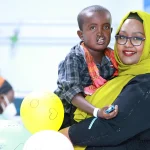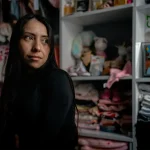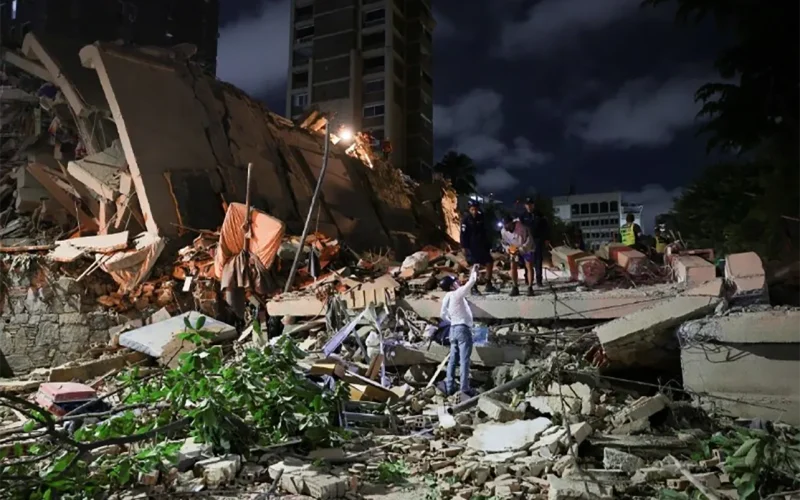
TWO days after Gusmaira Rizo delivered her fifth child by caesarean section, the ground beneath La Guaira state opened its fault lines. She had been discharged from hospital only hours earlier, her newborn daughter Irena still held back under medical observation. When the tremors hit just after 6 p.m. on 24 June, Rizo – still recovering from surgery – ran into the street with one of her older children as the walls around her cracked. Her baby was still inside the hospital, and the phone lines were dead.
“We spent the whole night in anguish because we didn’t know what had happened to her,” Rizo recalled. “There was no phone signal, no way to know if she was safe.”
She is not alone in that anguish, and Venezuela is not alone in the geography of disasters now routinely displacing the world’s poorest and most vulnerable. Across La Guaira and the surrounding earthquake-affected areas north of Caracas, the quakes of late June tore through densely packed neighbourhoods, collapsing apartment blocks in seconds and turning ordinary evenings into scenes of screaming and scrambling for exits. Yuleima Chivico’s family escaped their own home through a window after the front door jammed; by the time they looked back, entire buildings on their street had simply disappeared.
“One moment you have your home, your life, everything,” she said. “Thirty seconds later, you have nothing.”
A DISASTER MEASURED IN DOCUMENTS, NOT JUST DEBRIS
The immediate toll is grim enough on its own terms: Venezuelan government figures put the number of people left without shelter at nearly 18,000, with thousands more displaced across the country. But the more instructive number, for anyone tracking how disasters compound existing fragility in the Global South, is this one – a joint United Nations-Government assessment now estimates that 1.3 million people face new or worsened socioeconomic needs as a direct consequence of the earthquakes.
That is the real story here, and it is one Africa’s own disaster-scarred nations – from cyclone-battered Mozambique to flood-ravaged Libya and drought-stricken Horn of Africa communities – will recognise instantly. A natural disaster rarely ends when the shaking stops. It metastasises into a bureaucratic and legal crisis: lost identity documents, interrupted medical care, children separated from protection systems, and the quiet psychological toll of having watched a life collapse in half a minute.
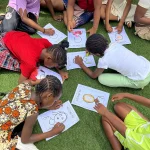
The Government of Venezuela has set up more than 80 “transitional camps” across the affected zones, among them a repurposed stadium in César Nieves, La Guaira, where both the Rizo and Chivico families found refuge. It is a government-led response — a detail worth underlining in a country whose humanitarian architecture is frequently reduced, in Western reporting, to a single political storyline. Here, the state has taken the lead, with the UN Refugee Agency (UNHCR) operating in support as the designated Protection Cluster lead, working alongside UNICEF, UNFPA and other partners.
RECOVERY AS INFRASTRUCTURE, NOT CHARITY
What UNHCR is doing inside those camps is instructive well beyond Venezuela’s borders. Rather than treating displacement as a matter of tents and blankets alone, the agency has stood up integrated one-stop service points offering legal assistance, help recovering lost identity documents, psychosocial care and child protection referrals – the unglamorous administrative scaffolding without which a family cannot access healthcare, schooling, banking or even freedom of movement.
For Gusmaira Rizo, who returned to Venezuela after four years as a displaced person in Colombia, that scaffolding matters in a very specific way: one of her children, born abroad, faces documentation complications that only legal support can untangle. It is a reminder that displacement crises rarely respect tidy categories – returnee, earthquake survivor and undocumented parent can be the same person, in the same tent, on the same day.
UNHCR’s acting representative in Venezuela, Kirstin Halvorsen, framed the agency’s role in terms that read almost as a manifesto for post-disaster protection work: recovery, she said, begins long before a home is physically rebuilt – it begins when people can access support, reconnect with services and start imagining a future again. UNHCR’s task, in her telling, is to help families take those first steps while reinforcing the Venezuelan government’s own protection systems, rather than substituting for them.
That is a distinction African policymakers should note closely. Too often, disaster response on the continent has been designed around parallel humanitarian systems that bypass, rather than strengthen, the state institutions communities will still need long after international agencies have moved on. UNHCR’s model in La Guaira – protection services embedded within, not around, government-run camps – offers a template for African disaster and displacement responses from Maputo to Derna.
THE LOGISTICS BEHIND THE HUMAN STORY
The relief effort has also drawn on a distinctly Global South logistics chain: more than 50 metric tonnes of humanitarian supplies – mosquito nets, blankets, kitchen sets, solar lamps – have moved into affected communities with support from LATAM Cargo and UPS, complementing the wider international response. UNHCR has operated in Venezuela for 35 years, working with refugees, returnees, internally displaced people and host communities alike, giving it institutional memory that is now being redirected toward earthquake recovery.
None of this erases the precarity families still face. Many of the displaced do not know when – or whether – they will return home. Panic attacks and fear marked Chivico’s first days in the camp; slowly, she says, that has given way to something else: neighbours sharing what little they have, parents watching each other’s children, strangers becoming, in her words, family.
“We’ve learned to lean on one another,” she said.
For Rizo, recovery has a simpler, more visceral marker. Two weeks ago she could not sleep for fear she would never see her newborn daughter again. Today, Irena sleeps in her arms while her older children play nearby.
“The most important thing is that we are together and our family is complete,” she said.