VENEZUELA is careening toward a full-blown humanitarian and human rights catastrophe as the government intensifies its authoritarian grip while navigating escalating confrontation with the United States, UN High Commissioner for Human Rights Volker Türk warned in a stark assessment to the Human Rights Council.
The dire picture Türk painted reveals a nation where fear has become policy, where families are torn apart for political dissent, and where the most vulnerable—children, the elderly, Indigenous peoples—bear the brunt of state repression. Yet even as he catalogued these mounting abuses, the UN’s top human rights official issued an urgent caution about the dangers of external military pressure that could trap ordinary Venezuelans in a deadly crossfire.
The Venezuelan government has constructed what Türk described as a surveillance state that would be chilling in any context. Authorities are actively encouraging citizens to inform on relatives, neighbors, and colleagues through a state-sponsored mobile application—a digital-age echo of history’s darkest chapters.
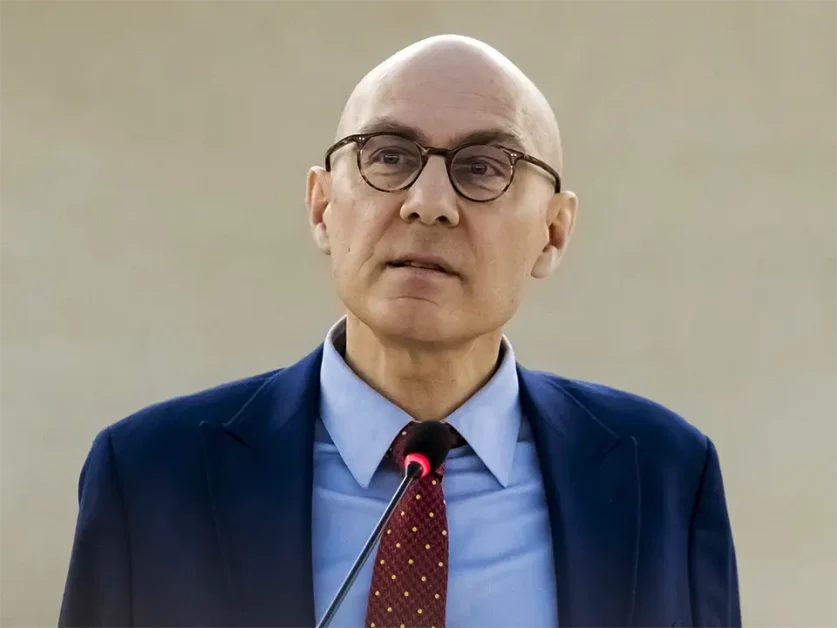
“Such policies breed fear, mistrust, and self-censorship,” Türk stated, describing a society where the bonds of community are being deliberately severed by the state itself.
The militarization of public life has accelerated dramatically. Reports detail coerced enlistment into the Bolivarian Militia, with adolescents and elderly people pressed into service. In a country already plagued by high crime rates, this forced militarization creates a powder keg of potential violence.
Legislative maneuvers have granted the government sweeping emergency powers under the guise of external threats. The content of laws passed in September and November remains unpublished, deliberately shielded from scrutiny and impossible to assess for compliance with international law. Civic space, already constricted, is now being suffocated entirely.
The statistics Türk presented amount to a catalog of state violence. Hundreds remain imprisoned for political reasons. Several journalists languish in arbitrary detention. The recent arrest of the secretary-general of Venezuela’s main trade union sent what Türk called “a chilling signal” to workers nationwide.
Inside Venezuela’s prisons, conditions have become lethal. The UN Human Rights Office documented at least five deaths of people detained in connection with last year’s presidential elections. Among them was opposition politician Alfredo Díaz, whose health reportedly deteriorated sharply in custody. All of these deaths demand prompt, independent investigation.
At three detention centers—Helicoide, Rodeo I, and Fuerte Guaicaipuro—detainees are held incommunicado, denied contact with relatives or lawyers in flagrant violation of basic rights. The rise in transfers to unknown locations has created what amounts to enforced disappearances. Throughout the system, persistent lack of food and medicine exacts a devastating toll on prisoners’ physical and mental health.
The government’s reach extends beyond those it perceives as dissidents to terrorize their families. Since July, authorities have detained at least 17 people—predominantly women, children, and elderly individuals—solely because of their relatives’ activities. Another 12 family members have simply disappeared, their fates unknown.
“It pains me to report that the Venezuelan authorities have stepped up reprisals against family members of those perceived to be voicing dissent—both at home and abroad,” Türk said.
The High Commissioner issued an urgent call for the unconditional release of all those arbitrarily detained for civic engagement, including prominent figures like Rocío San Miguel, Javier Tarazona, and four adolescents still held after the 2024 elections.
Even citizenship has become a weapon. Türk expressed alarm at attempts to strip certain opposition figures of Venezuelan nationality—an action he reminded authorities is unlawful under international law.
Indigenous Peoples Under Siege
Venezuela’s Indigenous communities face a distinct and deadly crisis. Several Indigenous leaders have been killed in recent years, including Virgilio Trujillo, Joaquín Hernández, and most recently Cesáreo Panapera. Their rights and territories remain under assault, while investigations into these killings remain largely unresolved.
The targeting of Indigenous peoples represents not just individual tragedies but an assault on entire communities and their ancestral claims to land and resources.
The External Dimension
Against this backdrop of internal repression, Türk issued a forceful warning about the dangers of escalating US military pressure. His language carried unusual urgency for a UN official.
“I cannot ignore the mounting tensions and challenges facing Venezuelans in a precarious regional situation. I am deeply concerned about the human rights impact of intensifying US military pressure,” he stated. “History has shown, time and again, that when confrontation escalates, it is often ordinary people who are caught in the crossfire. Not criminals. Not those in power. Ordinary people.”
The High Commissioner’s concerns come as tensions between Washington and Caracas have reached dangerous new heights. The Trump administration’s aggressive posture toward Venezuela—including declarations targeting the country’s oil sector and recent US military operations in international waters—has created a volatile regional dynamic.
Türk specifically called on the United States to employ “well-established law-enforcement methods” to counter drug trafficking rather than military pressure that risks engulfing Venezuelan civilians in conflict they did not choose and cannot escape.
His intervention represents a rare moment of a senior UN official publicly cautioning a major power about the human rights consequences of its military actions – a recognition that the Venezuelan people face threats from multiple directions.
The combination of internal repression and external tensions continues to drive Venezuelans from their homeland. Journalists and human rights defenders face an impossible choice between continued persecution and exile. Their departure, Türk warned, means “truth and accountability leave with them.”
The High Commissioner encouraged all states hosting Venezuelan migrants, refugees, and asylum-seekers to ensure international protection, given what he termed “the perilous human rights situation in the country.”
Despite the bleak assessment, Türk refused to accept that the situation has reached a point of no return. He emphasized that his office remains open to constructive engagement and expressed hope that authorities would enable UN human rights staff to resume all activities in Venezuela.
“The suffering of the Venezuelan people must end,” he concluded.
Yet that suffering shows every sign of intensifying. A government wielding emergency powers in secret, encouraging citizens to inform on one another, and imprisoning family members of dissidents has created a climate of pervasive fear. Add to this the dangers of external military confrontation, and Venezuela’s people find themselves trapped between authoritarian repression at home and the risk of becoming collateral damage in a geopolitical standoff.
The release of 51 detainees since Türk’s last update, including opposition members and people in poor health, and consular access for some foreign nationals represent modest positive developments. But they are drops in an ocean of repression.
For Venezuelans, the question is no longer whether their situation can worsen, but how much more they can endure before the country’s social fabric tears beyond repair. The international community faces its own question: whether it will find ways to support the Venezuelan people that don’t compound their suffering or simply watch as a nation descends further into darkness while caught between authoritarian rule and external military pressure.