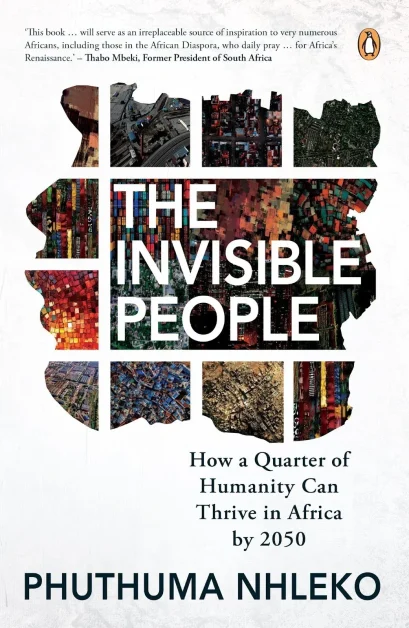
IN a sweeping new book that challenges both how the world sees Africa and how Africans see themselves, celebrated business leader Phuthuma Nhleko argues that the continent must urgently prepare for a demographic shift that will see one in four people on earth living in Africa by 2050.
The Invisible People: How a Quarter of Humanity Can Thrive in Africa by 2050, published this month by Penguin Random House, presents a three-pillar vision for an African Renaissance grounded in reclaiming identity, unleashing economic development, and bolstering geopolitical influence.
According to current projections, Africa’s population is expected to nearly double from its current size to 2.5 billion people within the next 25 years. Nigeria alone could surpass 400 million people, making it larger than half of Europe’s population.
What did this portend for Africa and, say, for the future life of a five-year-old African child today? And more generally, what did this mean for the world? Nhleko writes in the book’s introduction, describing his initial reaction to demographic projections he first encountered a decade ago.
The book has received strong endorsements from former African heads of state and international figures who say it challenges prevailing narratives about the continent.
Former South African President Thabo Mbeki described the work as an irreplaceable source of inspiration for Africans seeking the continent’s rebirth.
This book, cleverly entitled The Invisible People, will serve as an irreplaceable source of inspiration to very numerous Africans, including those in the African Diaspora, who daily pray, like the author of this book, for Africa’s Renaissance, Mbeki said. This is because it illustrates and communicates the message that the rebirth of a modern and humanist society of more than a billion people, rendered invisible by a hostile past, is actually possible and within reach if and when, as Africans, we allow ourselves to act together as Pan-Africanists.
Hailemariam Desalegn, former Prime Minister of Ethiopia, called the book a long-awaited celebration of Africa’s overlooked contribution to world history, a challenge to African countries to join together to achieve their economic potential, and a call for the continent to take its rightful place in world affairs.
Nhleko argues that Africa’s economic and geopolitical future depends first on reconstructing a confident common identity rooted in the continent’s long history and contributions to modern civilisation.
Africa suffers from a double identity challenge, both in the way the world sees it and in the way it sees itself, he writes. Its collective identity has been erased, obscured, distorted or fragmented beyond recognition.
The book challenges what Nhleko describes as centuries of narrative positioning Europe at the top of a hierarchy of civilisations and Africa at the bottom, despite what he presents as incontrovertible evidence of Africa’s profound contributions to religion, culture, and economic development.
Professor Ngaire Woods, Dean of the Blavatnik School of Government at Oxford University, praised the work’s approach. This wonderfully rich and readable book reframes Africa’s history and future. It begins with history, culture, religion and identity, with the author weaving in his own experiences, from his childhood in apartheid South Africa and Swaziland, to his international business career, to create a memorable sense of what is changing and what needs to change, before outlining a positive economic pathway for the continent.
Economic Leapfrogging
The book’s second pillar focuses on unleashing economic development through what Nhleko calls technological and economic leapfrogging, bypassing outdated models to embrace opportunities presented by the fourth industrial revolution.
Drawing on his experience as former CEO and chairman of MTN, one of Africa’s largest mobile network operators, Nhleko points to mobile telephony’s rapid development as proof of the continent’s capacity to leapfrog traditional development stages.
In twenty years, a significant part of the continent digitally leapt over the era of copper lines in telephony, he writes, noting that Nigeria went from 650,000 fixed landlines and zero mobile phones in 2002 to over 190 million mobile phones by 2020.
He argues that similar leapfrogging can occur across sectors from agriculture to health care, but warns against repeating historical patterns of extractive exploitation, this time of data rather than minerals.
Inherent to the technological and digital revolution in Africa is the risk of repeating historic patterns of exploitative extraction for a precious resource of a new kind, such as personal data, Nhleko cautions. Africa losing effective control of its data would be tantamount to another extractive colonisation, a digital one.
Geopolitical Positioning
The third pillar addresses Africa’s role in world affairs, calling for what Nhleko terms progressive neutrality between the United States and China while strengthening ties with the African diaspora.
When asked with whom Africa will align in US-China tensions, Nhleko writes that his answer is simple. With Africa.
Dr Jendayi Frazer, former US Assistant Secretary of State for African Affairs and former US Ambassador to South Africa, praised this strategic vision, particularly the emphasis on integrating the continent with its global diaspora.
At a decisive moment in global history and demographic transition, The Invisible People contends that Africa’s transformation hinges on intentionally reconstructing a unified African identity, integrating the continent and its diaspora as a strategic force, Frazer said. Mr Nhleko highlights the vital contributions of Pan-African thought and links this consciousness to modern digital, financial, and cultural networks, foundations for an African Renaissance in power, prosperity, and global influence.
Urgent Imperative
Several endorsers emphasised the urgency of the book’s message, given current global transitions.
Professor Nouriel Roubini of New York University said the book compels us to reflect on the tectonic shift in the world’s demography, with Africa predicted to reach a population of 2.5 billion people in just over two decades, amounting to a quarter of humanity.
What does this portend for Africa and those beyond its borders in an interconnected world, increasing migration, a race for AI supremacy, growing insecurity and inequality, and turbulent geopolitics? Roubini asked. The book suggests a way forward that Africa and the world cannot dismiss.
Sir Mo Ibrahim, philanthropist and founder of the Mo Ibrahim Foundation, called the work a good read that provides an aerial view of Africa’s past, present and possible future, while it struggles to find its place in this turbulent world.
The author, a successful African businessman, projects his own personal journey against the new evolving Africa, Ibrahim said.
Nhleko is a celebrated business leader who served as CEO and chairman of MTN, one of Africa’s largest mobile network operators. He is currently chairman and co-founder of Phembani Group, a South African resource and energy-focused investment holding company. He serves as chairman of the Johannesburg Stock Exchange and is a director of IHS Towers and Engen Petroleum. His previous directorships include BP plc, Anglo American plc, Nedbank Group, and Old Mutual SA. He was voted Sunday Times Business Leader of the Year in 2009.
Nhleko holds a BSc in civil engineering from Ohio State University and an MBA from Clark Atlanta University, and is a Transformational Leadership Fellow of the Blavatnik School of Government at Oxford University.
- The Invisible People is published by Penguin Random House South Africa and retails for R360. You can purchase the book here:
- Takealot
- Exclusive Books
- Amazon