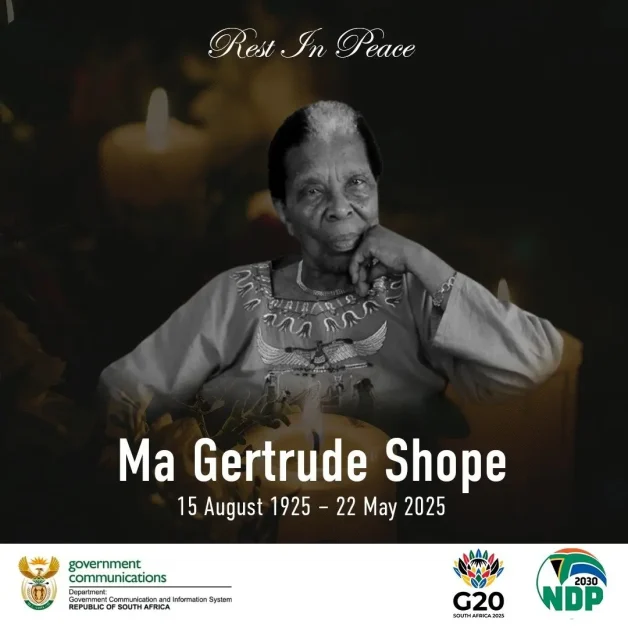
IN the twilight hours of May 22, 2025, as South Africa prepared to bid farewell to the day, the nation received news that would forever mark this Friday in history. Ma Gertrude Ntiti Shope – revolutionary, mother, teacher, and lioness of liberation – had completed her remarkable 99-year journey. Her passing was not just the end of a life; it was the closing of a chapter that had begun when apartheid was young and concluded in a democracy she had helped birth with her own hands.
The story begins in an era when black South African women were expected to be invisible, voiceless, and powerless. But Shope was born with fire in her spirit and steel in her backbone. In the classrooms where she first worked as a teacher, she witnessed daily the cruel machinery of apartheid – how it sought to crush young dreams before they could take flight, how it limited brilliant minds to fit the narrow confines of racial oppression.
But Ma Shope saw something else in those classrooms: potential. Not just in her students, but in herself. She understood that education was both a weapon and a shield in the fight for liberation. Each lesson she taught became an act of defiance, each student she inspired became a small victory against the system designed to break them all.
PRESIDENT RAMAPHOSA MOURNS PASSING OF MA GERTRUDE NTITI SHOPE
— The Presidency ???? (@PresidencyZA) May 23, 2025
President @CyrilRamaphosa has expressed his profound sadness at the passing of educator, freedom fighter, trade unionist and former Member of Parliament Ma Gertrude Shope, who has passed away at the age of 99.
??… pic.twitter.com/QeWMe8SLyV
It was here, among the worn desks and dog-eared textbooks, that a teacher began her transformation into a revolutionary.
The African National Congress called, and Gertrude Shope answered. But she didn’t simply join the movement – she helped reshape it. Her vision extended beyond South Africa’s borders, reaching toward organisations like the Federation of South African Women and the World Federation of Trade Unions. She understood what many of her contemporaries were only beginning to grasp: that the struggle for liberation was not just a South African fight, but a human one that required global solidarity.
Her activism drew the attention of the apartheid regime’s security apparatus. They watched her, followed her, and documented her every move. And then came the ultimate recognition of her threat to their system – her name appeared on the most dangerous list in South African history.
When the apartheid government compiled its list of co-conspirators in the Rivonia Trial, Gertrude Shope’s name was inscribed alongside the pantheon of liberation heroes: Oliver Tambo, Joe Slovo, Ben Turok, Duma Nokwe, Joe Modise, Jack Hodgson. To be named a Rivonia conspirator was to receive an unwanted but unmistakable badge of honour – proof that the regime considered her among the most dangerous threats to their oppressive order.
But Ma Shope wore this designation like armour. She was, as President Ramaphosa would later say, an mbokodo – a grinding stone that could not be broken. The more pressure apartheid applied, the stronger she became.
The decision to leave South Africa was not made lightly. It meant abandoning everything familiar – the red soil of home, the languages that sang in the streets, the communities that had nurtured her activism. With her husband Mark and their children, Gertrude Shope embarked on what would become a 25-year odyssey across continents.
Hamba khahle Mbokodo Isithwalandwe. Thank you Mme Gertrude Shope for championing the struggle for women in SA and globally. RIP Getrude Shope pic.twitter.com/BNQ24DYL4j
— phumla williams (@mirriamp) May 22, 2025
First came Botswana, where the family found temporary refuge but never rest. The struggle traveled with them like a shadow, demanding constant attention and sacrifice. Then Tanzania, where Ma Shope continued organising women and building networks of resistance. Zambia followed, and finally Czechoslovakia, each destination bringing new challenges but also new opportunities to mobilise international support.
In each country, the Shope family home became more than a dwelling – it became an embassy of hope. Freedom fighters found sanctuary at their table. International allies gathered in their living rooms to plan campaigns and coordinate support. Children played in their gardens while adults plotted the downfall of apartheid.
Ma Shope transformed exile from punishment into platform, using her forced separation from home to build the very international pressure that would eventually help liberate South Africa.
By 1990, as apartheid began its death throes, Shope had evolved into something more than an activist – she had become a matriarch of the movement. Her election as President of the ANC Women’s League was not just a recognition of her years of service, but an acknowledgement of her unique ability to bridge different worlds: the domestic and international struggles, the past and future of the liberation movement, the roles of women in both resistance and reconstruction.
In this position, she championed not just the broad goals of liberation, but the specific needs of women who had borne so much of the struggle’s burden. She understood that freedom would mean nothing if it didn’t extend to every South African, regardless of gender, class, or circumstance.
When Nelson Mandela walked free in February 1990, Ma Shope knew that her own return home was finally within reach. After 25 years of exile, the family that had carried South Africa’s struggle to the world was coming home to help build the democracy they had fought so long to achieve.
Mam Gertrude Shope, Isithwalandwe and former ANC Women’s League President , as always did her patriotic duty and voted today in Gaborone. Malibongwe!! #LetsDoMoreTogether ?@MYANC? ?@MbalulaFikile? pic.twitter.com/wgKce43Pen
— Fébé Potgieter ???? (@FebePotgieter) May 18, 2024
In 1994, at an age when many would choose quiet retirement, 68-year-old Gertrude Shope entered South Africa’s first democratic Parliament with what President Ramaphosa described as “vibrancy and vision that made her an exemplary first-generation parliamentarian.” She brought to those hallowed halls not just her own experience, but the collective wisdom of decades spent in the liberation trenches.
Her presence in Parliament was profoundly symbolic – here was living proof that the struggle had not been in vain, that the sacrifices had not been meaningless, that the long road from oppression to liberation was not just possible but real.
As news of Ma Shope’s passing spread across the nation and beyond, voices rose to honour her memory, each testimony adding another layer to the story of her remarkable life.
President Cyril Ramaphosa spoke for the nation: “We have lost an eminent national heroine and mother to our nation. During a lifetime of close on a century, Ma Shope made a monumental contribution to our struggle for a free and inclusive South Africa, while inspiring generations of women and men to emulate her commitment.”
The ANC, the organisation that had been her political home for so many decades, issued their own tribute: “Ma Gertrude Shope was a pillar of our movement, a beacon of hope, and a relentless fighter for justice. Her leadership in the Women’s League and her work internationally set a standard for all of us. She embodied the spirit of ubuntu and the resilience of our people.”
Mme Gertrude Ntiti Shope
— Thulasizwe Makhanya (@Thulasizwe70721) May 23, 2025
“Every generation has got a responsibility to know what its mission is. Mine was to liberate the country; what is yours?”
Hamba kahle Mkhonto
Selfless, Principled and Upright Leader pic.twitter.com/WU9RTc6HaR
South Africa has found itself grappling with the end of an era. Ma Gertrude Ntiti Shope’s story had begun in the 1920s when apartheid was establishing its cruel foundations. It concluded in a democratic South Africa that bore the indelible imprint of her struggle and sacrifice.
Her life was a masterpiece painted across nearly a century’s canvas – a work of art created not with brushes and paint, but with courage and conviction, sacrifice and solidarity, hope and determination. She had witnessed her country’s darkest hours and lived to see the dawn of democracy. She had endured separation from everything she loved and returned to help build the nation of her dreams.
The little girl who had once sat in apartheid’s inferior schools had grown into a woman who helped write the constitution of a free nation. The young teacher who had been forced into exile had returned as an elder stateswoman to take her place in the first democratic Parliament. The mother who had raised her children in foreign lands had lived to see them serve their liberated homeland with distinction.
In President Ramaphosa’s words: “She was indeed an mbokodo that apartheid failed to erode or fracture, and she entered our first democratic Parliament in 1994 with a vibrancy and vision that made her an exemplary first-generation parliamentarian. Gertrude Shope lives on in our national memory and her life’s work is reflected in the transformation we have attained and continue to effect in our society.”
As South Africa prepares to lay this remarkable woman to rest, her story does not end – it transforms. From biography, it becomes inspiration. From history, it becomes hope. From memory, it becomes mandate for future generations who must carry forward the work she began.