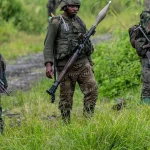
“OUR office has confirmed cases of summary execution of children by M23 after they entered the city of Bukavu last week,” UN spokesperson Marta Shamdasani’s voice trembled as she delivered the devastating news. “We are also aware that children were in possession of weapons.”
The morning sun cast long shadows across Lake Kivu as Bukavu grappled with these horrific revelations. The city that had long served as a haven for those fleeing violence in eastern Congo had become the site of unthinkable atrocities against its youngest residents.
Shamdasani’s stark warning echoed through the international community: “We call on Rwanda and M23 to ensure that human rights and international humanitarian law are respected. We are also documenting cases of ill-treatment, conflict-related sexual and gender-based violence, child and forced recruitment, intimidation and death threats.”
The rebels’ brutality extended beyond the execution of children. The UN Human Rights Office reported widespread intimidation of civil society, with journalists and human rights defenders forced to flee or trapped in the occupied cities. Those who remained faced dire threats for their previous denunciations of violations committed by Rwanda and M23 in eastern DRC.
“The UN Human Rights Chief Volker Türk calls on Rwanda and M23 to protect all individuals in territories under their control,” Shamdasani emphasized. “He expresses his horror at the events unfolding in South and North Kivu, and the impact this is having on civilians. The violence must stop immediately.”
The situation deteriorated further when M23 fighters breached Kabare and Bukavu central prisons on February 14. “Following the prison break, we have received protection requests from victims and witnesses,” Shamdasani reported. “They fear retaliation from escapees, given their active participation in the trials against some of these prisoners convicted of grave human rights violations and abuses – some of which amount to international crimes.”
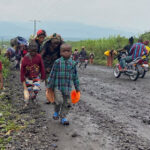
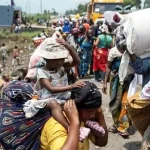
The fall of Bukavu marks a dangerous new chapter in a crisis that threatens to engulf the entire Great Lakes region. Just days earlier, Goma – the capital of North Kivu province – had fallen to the Rwandan-backed rebels, sending tremors through neighbouring countries. The capture of these two strategic cities has created what UN Human Rights Chief Türk describes as a humanitarian catastrophe, with over 237,000 people displaced since the beginning of 2025 alone.
Behind the military advances lies a web of regional rivalries and resource competition. Rwanda’s President Paul Kagame continues to deny his country’s involvement, despite mounting evidence of support for M23. Meanwhile, Uganda maintains its delicate balancing act, cooperating with Congolese forces against Islamic State-linked militants while facing accusations of providing supply routes to M23 through its territory.
“The Rwanda-backed M23 advance to South Kivu has plunged the region into a complex security and humanitarian crisis, provoking population displacement,” Shamdasani noted, underlining the broader implications of the rebel advance.
Burundi’s President Evariste Ndayishimiye has warned that the conflict risks spiralling into a broader regional war. With thousands of Burundian troops already stationed in eastern DRC, the advance of M23 forces toward South Kivu has raised the spectre of direct confrontation between regional powers.
As night falls over Bukavu, the city’s residents huddle in their homes, many planning their escape. The distant sound of gunfire echoes across Lake Kivu, while diplomatic efforts at emergency summits of the Southern African Development Community and East African Community seem increasingly disconnected from the brutal reality on the ground.
For those who remember the devastating regional wars of the late 1990s, when nine countries were drawn into a conflict that claimed millions of lives, today’s crisis carries ominous echoes. As one senior UN official noted, “The pieces are falling into place for another catastrophic regional conflict. The question is no longer if, but when – unless the international community can find a way to halt this deadly advance.”
Meanwhile, in the hills above Bukavu, the sun sets on another day of uncertainty, fear, and desperate hopes for peace in a region that has known too little of it.