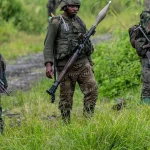
SINCE late 2021, the M23 rebel group has swept across vast areas of eastern Democratic Republic of the Congo, displacing millions of people and installing its own systems of governance as it drives one of the country’s biggest crises in decades.
Heavily backed by troops from neighbouring Rwanda – long supported by some of the world’s most powerful countries – the M23 has made especially large gains this year, seizing DRC’s biggest eastern cities and threatening to topple the Congolese government altogether.
The group has framed its takeover as a liberation for communities long neglected and repressed by state authorities and armed groups alike. But what does rebel rule actually look like on the ground? Is life better or worse than what came before?
To answer these questions, The New Humanitarian has spent the past few months working with a team of mostly Congolese journalists (reporting anonymously for their safety), both from major cities and from overlooked rural and provincial areas.
Together, we have documented widespread human rights abuses – from summary executions to forced labour – examined how the rebels tax and control people, and uncovered small but striking acts of resistance that continue despite the occupation.
What follows is a summary of some of the most important things we uncovered. For more background on who the M23 are, why they are fighting, and Rwanda’s role in the conflict, click the box below.
Severe human rights violations in DRC’s biggest eastern cities
The M23 seized Goma, the biggest city in eastern DRC, at the start of the year, and since then its population of roughly two million people has faced a whole range of difficulties and abuses.
In the early days of the occupation, residents told us bodies kept turning up on the streets – though when we visited crime scenes, it was unclear if the perpetrators were rebels or felons who had broken out of prison. Either way, parents told us they feared sending their children to school in case they came across a corpse.
Young men in the city said they feared the mass round-ups that the M23 has been conducting to try to root out elements of the Congolese army and pro-government militias – known as Wazalendo – and to recruit people into its ranks.
Our reporters witnessed several of these operations, documenting men of different ages being loaded into trucks and taken to unknown locations or to public spaces where they were subjected to harsh and abusive checks.
Civil society members – from poets to activists – told us they have been forced to flee, while others said the M23’s attempts to clamp down on insecurity had backfired, with heavy-handed “anti-crime” operations creating new abuses rather than preventing them.
“Many people are arrested, some disappear, and families don’t know where their loved ones are,” said the president of a civil society group in North Kivu, the province where the M23 is most active.
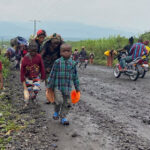
Meanwhile, hundreds of thousands of displaced people who had been sheltering in Goma after fleeing M23 offensives in their home areas were expelled from the city and forced back into dire conditions, according to affected people we interviewed.
Others living near Goma were also illegally deported to Rwanda by the M23, which accused them of supporting armed groups opposed by the rebels and Kigali. As our reporting showed, some deportations were controversially facilitated by the UN.
“It was brutal, like you wouldn’t believe,” said one man who managed to escape a deportation to Rwanda in May. He said he was rounded up by the M23 alongside dozens of other men from a displacement centre in a town near Goma.
Abuses in provincial areas fly under the radar
As scrutiny centred on major cities like Goma, we also investigated abuses in provincial areas under rebel rule, working with local reporters in Lubero, Rutshuru, and Walikale – three of six territories in North Kivu.
In Walikale, residents said they had been made to build camps, haul firewood, fetch water, and dig rifle pits for the M23. They said the forced labour was not something they had experienced before, and that it had driven many to leave the area.
Residents told us that people accused of crimes or affiliation with pro-government militias are often arrested without trial and tortured in detention – including being held in pits filled with water. Others have disappeared and never returned, they said.
“We believe that they kill them, or send them to their training centres to become fighters, which is forced recruitment,” said a human rights activist who left his area in Walikale for a town controlled by the government.
In Lubero, residents also described forced labour, with rebels making people build barracks and roads. They said this is often presented as salongo – a communal work system – masking coercion as custom.
In some villages in Lubero, people said rebel-installed leaders are using salongo as a cover to compel people into forced labour for private gain. For example, they are made to transport wood for a chief’s fence – but materials are actually sold on for profit.
“We believe that they kill them, or send them to their training centres to become fighters, which is forced recruitment.”
The rights abuses we documented were especially acute in Rutshuru, a territory that is paying the price for the presence of the Democratic Forces for the Liberation of Rwanda (FDLR).
The FDLR formed from remnants of the Hutu génocidaires who carried out the 1994 genocide against Tutsis in Rwanda before fleeing into DRC. Its presence has long been denounced by Rwanda and by the M23, which is commanded by Congolese Tutsis.
“They tell us they are hunting the FDLR in the bush, but it is peasant farmers who are dying,” said a farmer in Rutshuru, describing anti-FDLR operations by the M23 and Rwandan troops that have resulted in hundreds of civilian casualties.
The farmer – like several other Rutshuru residents we interviewed – said they now hesitate to go to their fields after these incidents. That fear has made life even harder for locals who rely almost entirely on agriculture to survive.
Rutshuru residents said rebel leaders have also seized large tracts of land belonging to local farmers, and are using it to feed M23 fighters and generate profit. They described seeing jeeps arrive to demarcate plots, and tractors brought in for farming.
UN experts have accused several M23 leaders of seizing public and private property and of destroying evidence of land tenure. The rebels have, meanwhile, brought back hundreds of Congolese Tutsi refugees who were mainly living in Rwanda.
M23 runs a parallel administration, but governance can vary by area
In its negotiations with the Congolese government, the M23 has agreed that state authority should be restored “on all national territories”, yet on the ground, it is building a fully-fledged administration to consolidate power and generate revenue.
M23-aligned governors, mayors, and other local administrators have all been installed; rebel officials now occupy migration and customs posts; the movement has supplanted the state’s taxation system; and it has been training judges and police.
Still, in the areas we examined, we observed some notable differences in how the rebels govern, as well as mixed local perceptions of both the harms and the benefits of their rule.
For example, our reporters found that some rebel-run areas have kept local leaders in place but subordinated them to rebel authority – stripping them of independent decision-making power – while others have replaced them with their own loyalists.
Taxes were viewed as incredibly burdensome in some places – there have been strikes and trade union pushback reported – but in other places, people spoke of reduced taxes or the abolition of ones they previously paid.
A businessman in Kiwanja, in Rutshuru territory, said that for his type of business, the M23 abolished at least three taxes that he and his colleagues previously paid to the different Congolese government ministries.
While many places described severe and persistent abuses by the rebels, some localities reported that the group was also – perhaps paradoxically – improving day-to-day security, particularly in areas affected by road banditry and armed groups.
In Lubero, residents said robbers had vanished from some areas, fearing being killed by the rebels, who claim they “don’t have prisons”, implying that those they apprehend are not detained.
In Kiwanja, one resident said the number of kidnappings had “dropped significantly,” and that people could now move around at night in some places without being bothered by bandits or militiamen.
Others mentioned that M23 road-building projects had boosted their areas, allowing traders to transport goods more easily and cheaply, and enabling better hospital access – though they also recognised that the roads enhance M23 mobility and logistics.
Nobody we spoke to suggested that the group’s limited investments in public infrastructure made it a civilian-oriented movement.
“It is a bona fide police state that focuses only on security and neglects all other areas of life,” said a political scientist from Kirumba, in Lubero territory. He said the group is “only pursuing its mission of conquering territory”.
A tax official in North Kivu added, “It doesn’t provide any public services. It doesn’t have a budget that can determine tax collection allocations. And it doesn’t have any legislation that can define what should be taxed.”
Communities resist and support each other amid hardship
The testimonies gathered by our reporters paint a bleak picture of rebel abuse and overreach, but they have also revealed how ordinary people are pushing back in striking ways.
In Lubero, for example, residents described how a group of young churchgoers resisted the presence of the M23 during a confirmation mass, when the rebels attempted to pressure them into showing support for the movement.
“Do you love us?” asked the rebel leader, standing before the congregants. “No!” the group shouted back in unison. Surprised by their response, the rebel left the room to fume, with his troops waiting outside.
We also learned how people are supporting each other through a humanitarian emergency – one driven by the conflict, a reduction in aid programming following US cuts, and the closure of banks in rebel-held areas by the Kinshasa government.
Returning refugees and displaced people who went back home after being forced out of Goma said they are often provided with work by villagers, while others are hosted by families as they repair or rebuild their damaged homes.
“We accept to suffer together, because in life, you never know, one day, we might also flee our area here and find ourselves in their home,” said a host in a village in Walikale.
Another host offered a proverb to capture the spirit of solidarity, keeping people going: “Caterpillars on the same tree survive together by sharing the leaves they find on a branch,” they said.
Philip Kleinfeld reported from Bristol, UK. Edited by Andrew Gully.
–––––
The New Humanitarian puts quality, independent journalism at the service of the millions of people affected by humanitarian crises around the world. Find out more at www.thenewhumanitarian.org.