A Dynasty of Division: The Inherited Rivalry
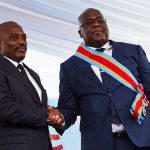
THE 2025 crisis in the Democratic Republic of Congo represents the latest chapter in a political rivalry that spans generations. The tension between Félix Tshisekedi and Joseph Kabila is not merely a contemporary political contest but an inheritance of their fathers’ complicated relationship. Étienne Tshisekedi, a longtime opposition leader, stood against Mobutu Sese Seko and later Laurent-Désiré Kabila, who seized power in 1997 after overthrowing Mobutu. When Laurent-Désiré Kabila was assassinated in 2001, his son Joseph inherited power at just 29 years old, establishing the first political dynasty in the DRC’s post-independence era.
Étienne Tshisekedi remained a persistent voice of opposition until his death in 2017, never achieving the presidency he long sought. When his son Félix emerged victorious in the controversial 2018 election, many saw it as the delayed fulfilment of his father’s ambitions. The initial power-sharing arrangement between Félix Tshisekedi and Joseph Kabila – widely believed to have been negotiated after disputed election results – always carried the seeds of future conflict, as both men sought to emerge from their fathers’ shadows while securing their own legacies.
The Current Crisis: A New Battlefield for Old Rivals
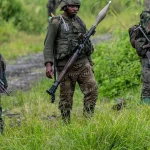
The 2025 alignment of Kabila with the Rwanda-backed M23 rebellion represents a dramatic escalation in this dynastic rivalry. By establishing himself in Goma and aligning with the M23’s political wing, the Alliance du Fleuve Congo (AFC), Kabila has effectively transformed a regional insurgency into a national challenge to Tshisekedi’s authority. This manoeuvre forces Tshisekedi to fight on two fronts: against an armed rebellion in the east and against Kabila’s political challenge to his legitimacy nationwide.
Tshisekedi’s decision to ban Kabila’s People’s Party for Reconstruction and Democracy (PPRD) and seize its assets on charges of high treason demonstrates the existential nature of the threat he perceives. However, this heavy-handed response risks backfiring by casting Kabila as a political martyr and potentially increasing his appeal among those disillusioned with Tshisekedi’s governance.
Implications for the DRC
For the DRC itself, this renewed rivalry threatens to unravel already fragile governance structures. The country’s vast territory – roughly the size of Western Europe – has never been effectively administered from Kinshasa, and the current crisis further fragments political authority. The M23’s establishment of parallel governance structures in captured territories, now bolstered by Kabila’s political legitimacy, creates competing power centres that undermine national cohesion.
Economically, the crisis jeopardises the DRC’s control over its eastern mineral wealth, which includes critical resources for the global technology industry. The M23’s expansion of control over mines producing coltan, cobalt, lithium, and gold threatens not only government revenues but also efforts to establish transparent supply chains free from conflict minerals. If Kabila succeeds in legitimising M23 control over these resources, it could entrench a system of resource exploitation that benefits political elites and armed groups rather than the Congolese people.
Regional Ramifications
The Tshisekedi-Kabila rivalry, now playing out through the M23 conflict, has profound implications for the entire Great Lakes region. Rwanda’s backing of M23 has already drawn accusations from the DRC government and international observers, while Tshisekedi’s outreach to Chad risks drawing in powers from outside the immediate region. The conflict threatens to reignite the complex regional alliances and proxy battles that characterised the devastating Congo Wars.
The massive displacement crisis, with over 7 million internally displaced and more than 1 million refugees, places enormous pressure on neighbouring countries, many of which face their own internal challenges. Uganda, Rwanda, Burundi, and Tanzania all harbor significant refugee populations from the DRC, straining resources and sometimes exacerbating local tensions.
Moreover, the instability in eastern DRC provides safe haven for various armed groups beyond M23, including the Allied Democratic Forces (ADF), which has pledged allegiance to the Islamic State, and the Democratic Forces for the Liberation of Rwanda (FDLR), composed partly of perpetrators of the 1994 Rwandan genocide. The continued operation of these groups threatens security across the region.
Continental Significance
For Africa as a whole, the DRC crisis presents a critical test for continental institutions and the principle of “African solutions to African problems.” The African Union and regional bodies like the Southern African Development Community (SADC) and the East African Community (EAC) have struggled to develop unified responses to the crisis, hampered by competing interests among member states.
The involvement of Kabila, a former head of state and once a significant figure in regional diplomacy, in what amounts to an insurrection sets a troubling precedent for peaceful power transitions across the continent. His willingness to ally with a foreign-backed armed group to challenge his successor undermines democratic norms at a time when many African nations are experiencing democratic backsliding.
Furthermore, the crisis in DRC threatens to divide the continent along lines of allegiance, with some nations supporting Tshisekedi’s government while others maintain relationships with Kabila or pursue their interests through engagement with the M23/AFC coalition. This fragmentation weakens Africa’s collective voice in international affairs and distracts from other pressing continental issues such as climate change, economic development, and pandemic response.
America’s Potential Role
The United States finds itself with significant leverage in this crisis, especially given Tshisekedi’s offer of preferential access to mineral resources in exchange for security assistance. This proposal comes as Washington has increasingly prioritised securing supply chains for critical minerals essential to renewable energy technologies and advanced electronics, many of which are abundant in the DRC.
The Biden-Harris administration faces a complex calculation: supporting Tshisekedi’s government maintains the principle of constitutional order, but risks entanglement in a protracted conflict with no clear resolution. Moreover, any perceived U.S. alignment with Tshisekedi against Kabila will be interpreted through the lens of great power competition, as Chinese firms have established significant presences in the DRC’s mining sector during Kabila’s presidency.
The optimal American approach would likely combine targeted security assistance to protect civilian populations and key infrastructure with assertive diplomacy aimed at reestablishing dialogue between Tshisekedi and Kabila. The U.S. could leverage its relationships with Rwanda and other regional powers to pressure all sides toward a negotiated settlement, while working through the UN Security Council to strengthen peacekeeping mandates and humanitarian responses.
Implications for Peacekeeping
The current crisis exposes the limitations of traditional peacekeeping approaches in the DRC. Despite the presence of MONUSCO, one of the UN’s largest and longest-running peacekeeping missions, the M23 has made significant territorial gains, and civilians remain vulnerable to violence. The mission has struggled with its mandate to protect civilians while respecting Congolese sovereignty and avoiding direct combat with armed groups.
Kabila’s alliance with M23 further complicates peacekeeping efforts, as the involvement of a former head of state blurs the line between insurgency and legitimate political opposition. Peacekeepers now face the dilemma of whether to treat M23 as a purely military threat or acknowledge its evolving political dimensions.
Moving forward, peacekeeping in the DRC may require innovation beyond traditional blue-helmet deployments. Hybrid missions involving the African Union, regional economic communities, and the UN could provide more comprehensive approaches. Additionally, peacekeeping must be coupled with robust political processes that address the root causes of conflict, including governance deficits, resource competition, and ethnic tensions.
The Path Forward
Breaking the cycle of conflict between the Tshisekedi and Kabila factions requires moving beyond personality-driven politics toward institutional solutions. International partners should condition support on genuine governance reforms, including decentralisation that gives eastern provinces greater autonomy while maintaining territorial integrity.
A credible peace process must address Rwanda’s security concerns regarding the FDLR while firmly rejecting its territorial ambitions in eastern DRC. Similarly, the legitimate grievances of communities in the east must be addressed without validating the M23’s violent methods or its external backing.
Ultimately, the DRC’s future depends on whether Tshisekedi and Kabila can transcend their fathers’ legacies and find common ground in the service of national interests rather than personal ambition. If they cannot, the country risks becoming the battleground for a new generation of conflict, with devastating consequences for its people and the broader region.
As this latest chapter in the Tshisekedi-Kabila rivalry unfolds, the stakes could not be higher—not just for these two political dynasties, but for the future of Central Africa and the continent’s aspiration for peace, democracy, and development.