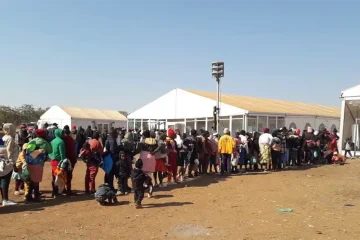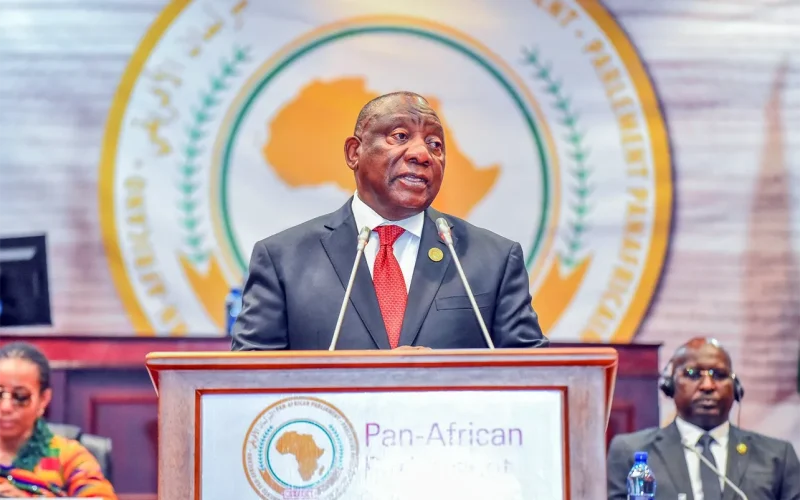
PRESIDENT Cyril Ramaphosa stood before the newly convened Seventh Legislature of the Pan-African Parliament on Monday and asked Africa’s elected representatives to imagine a continent “where people are not constrained by the strictures placed upon them by lines drawn on a colonial map.” It was a fitting line for the venue. It was a far harder one to square with the queues of Malawian, Zimbabwean, Mozambican and Nigerian nationals that have formed at deportation centres across South Africa in recent weeks – and with the undiplomatic silence still hanging between Pretoria, Accra and Abuja.
Delivered at Gallagher Estate under the African Union’s 2026 theme of water security, Ramaphosa’s address was, on its surface, a conventional set-piece: a recitation of South Africa’s contribution to continental institution-building since 1994, a call for Pan-African Parliament oversight of the African Continental Free Trade Area, and an appeal for “silencing the guns.” But it was the section on migration – delivered carefully, almost defensively – that carried the address’s real weight, arriving as South Africa’s two most vocal Pan-Africanist rivals on the continent, Ghana and Nigeria, continue to press Pretoria over its handling of anti-foreigner violence and a mass repatriation drive that has now processed more than 53,000 people.
A CRACKDOWN THAT WILL NOT STAY OFF THE RECORD
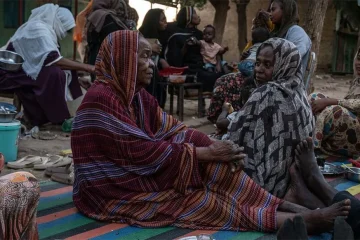
According to figures released by Justice and Constitutional Development Minister Mmamoloko Kubayi, 53,449 foreign nationals had been processed for deportation or voluntary repatriation as of 11 July – the overwhelming majority Malawian, alongside large numbers of Zimbabwean and Mozambican nationals. Within that total, Home Affairs recorded 1,159 Nigerians returned home, part of a wider repatriation of 2,615 people from countries beyond the Southern African Development Community, including Kenyans, Ugandans and citizens of the Republic of Congo.
The operation has not been bloodless. South African police are investigating the deaths of at least three migrants – two Mozambican, one Malawian – in the course of the crackdown. Nigeria’s government has separately alleged that two of its citizens were killed amid the anti-immigrant protests that have accompanied the operation; South African authorities have denied that those deaths were linked to the unrest. Ramaphosa himself announced measures last month to tighten border enforcement, while acknowledging what he described as rising tensions over immigration – tensions fuelled, in his telling, by protest movements claiming, without evidence, that foreign nationals are driving South Africa’s unemployment and crime rates.
“Migrants should not be conflated with those who enter or remain in countries in violation of immigration laws, nor made scapegoats for unemployment, crime or shortcomings in the delivery of public services.”
President Cyril Ramaphosa
It is precisely that framing Ramaphosa carried into the Pan-African Parliament chamber. He called for migration policy that combines “firm, fair and effective immigration management with an unwavering defence of human dignity.” It is a formulation designed to hold two positions at once – sovereign enforcement and Pan-African solidarity – and it is precisely that balancing act that Ghana and Nigeria say South Africa has failed to strike.
ABUJA’S PATIENCE WEARING THIN
Nigeria’s frustration has moved well beyond statements of concern. In May, Nigeria’s Ministry of Foreign Affairs summoned South Africa’s acting High Commissioner to Abuja over what spokesperson Kimiebi Ebienfa called documented mistreatment of Nigerian citizens and attacks on Nigerian-owned businesses, warning that the situation risked straining a historically cordial relationship. By late June, with an unofficial “March and March” deadline for undocumented foreigners to leave South Africa fuelling further unrest, Nigerians were reported to have stormed their own embassy in Pretoria seeking evacuation, and Abuja carried out a second coordinated airlift – 269 nationals flown home from Johannesburg aboard an Air Peace charter. Former Nigerian diplomats have since called for the routine summoning of South Africa’s ambassador until Pretoria can account for concrete steps to end the violence, arguing the crisis undermines the spirit of African unity Ramaphosa invoked on Monday.
GHANA TAKES IT TO THE AFRICAN UNION
Ghana’s response has been, if anything, more institutionally pointed. Accra formally requested a debate at the African Union’s Mid-Year Coordination Summit in Cairo in June on what its request explicitly termed “Xenophobic Attacks in the Republic of South Africa against African Nationals” – an unusual move by one AU member against another on the Union’s own floor. South Africa’s Department of International Relations and Cooperation acknowledged the request but pushed back on its characterisation of events, pointing to swift condemnation and law-enforcement action against what it called sporadic incidents. Ghana was not placated. President John Mahama’s government has evacuated some 350 Ghanaian nationals from South Africa, with more than 800 registered for voluntary return, and Accra cancelled a planned official visit by Ramaphosa that had been pencilled in for August, citing the cloud of tension the unrest had created.
Meeting Mahama last week, South Africa’s International Relations Minister Ronald Lamola insisted Pretoria “categorically rejects xenophobia, racism, homophobia and violence in all forms” – a reassurance Ghanaian officials, according to regional reporting, were not fully willing to accept.
THE GAP BETWEEN THE PODIUM AND THE BORDER POST
What makes Monday’s address notable is not that Ramaphosa avoided the subject – he did not – but how directly his continental rhetoric now runs up against the specific grievances of the two African states most invested in Pan-Africanist symbolism. Both Ghana and Nigeria built their post-independence foreign policies substantially around the protection of their diasporas; both have used Pan-African forums, not bilateral back-channels, to make their case against South Africa. Ramaphosa’s insistence to the Pan-African Parliament that migrants will continue to move in search of opportunity, and that the measure of Africa’s development will be the extent to which every African country offers its own citizens sufficient opportunity, dignity and hope, is a philosophically coherent Pan-African position. It is also, to officials in Accra and Abuja, close to beside the point while their nationals continue to be processed through deportation centres and, in Nigeria’s account, buried.
South Africa’s founding claim to continental leadership – as the state that has hosted the Pan-African Parliament since its inception and positioned itself as an architect of the African Union’s post-1994 institutional order – is not itself in question. What is now being tested, publicly and repeatedly, at AU summits and in recalled envoys, is whether Pretoria’s practice on the ground still matches the Pan-Africanism it continues to profess from the podium. Ramaphosa’s address gave the Pan-African Parliament a vision of a continent unconstrained by colonial borders. Ghana and Nigeria are asking, with rising insistence, why that vision has not yet reached their citizens, standing at South Africa’s.