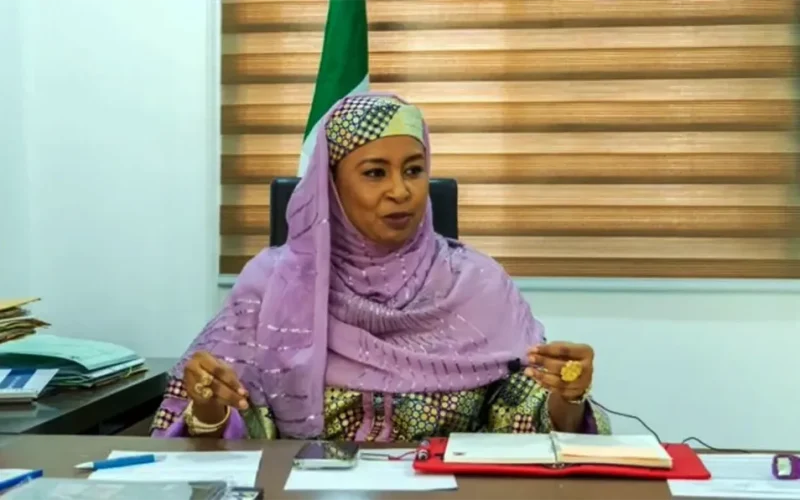
HALIMA Shehu, the suspended National Coordinator and Chief Executive Officer of Nigeria’s National Social Investment Programme Agency (NSIPA), has broken a long public silence with an extraordinary counter-offensive: a direct, unqualified denial that she diverted a kobo of the ₦44 billion ($30.9 million) at the centre of one of Nigeria’s most closely watched corruption sagas, paired with a claim that she was the one who first alerted the Economic and Financial Crimes Commission (EFCC) to the fraud.
In an open letter to President Bola Tinubu and in broadcast interviews, Shehu insisted that investigators traced no funds to her, her family, or any associate, and that the figures driving nearly three years of headlines are themselves in dispute. Her account, if accurate, would upend the narrative that has defined her public identity since January 2024: that of the official at the centre of a ₦44 billion money-laundering scandal.
“The allegations are false. I never transferred a kobo to any personal account.”
Halima Shehu
A Suspension, An Arrest, And A Report That Never Came
Shehu’s fall from office was swift and dramatic. Appointed in October 2023 to run NSIPA — the agency overseeing Nigeria’s flagship social intervention schemes, including the N-Power programme and conditional cash transfers to the poor — she was suspended by President Tinubu within ten weeks, on 2 January 2024, after the EFCC flagged what investigators described as suspicious movements of billions of naira from the agency’s accounts into private and corporate accounts allegedly linked to fronts. She was arrested that evening, held overnight, and released on bail the following day on condition that she report daily to EFCC headquarters in Abuja.
In the weeks that followed, the EFCC said it had traced and frozen roughly ₦30 billion of the ₦44 billion allegedly moved out of NSIPA’s accounts. A former Director of Finance at the agency was named as a co-suspect and reported to have fled the country. The former minister under whom Shehu had earlier served, Sadiya Umar-Farouk, was separately summoned over a related ₦37.1 billion allegation dating to the Buhari era.
What has not followed, in the two and a half years since, is a published outcome. The EFCC has neither laid public charges against Shehu nor released the findings of the investigation it opened against her. That silence is now the crux of her public campaign — and, this newspaper’s review of the record suggests, the real story behind the headlines.
The Whistleblower Claim
Shehu’s central assertion is not merely that she is innocent, but that she was the original source of the fraud allegation against her own agency. She says that on 21 December 2023 — eleven days before her suspension — she submitted a detailed letter to the EFCC, addressed also to the President, documenting the unauthorised movement of funds from the Central Bank of Nigeria account to what she called “various destinations,” including the release of a remaining ₦3 billion in COVID-19 relief funds into eleven accounts without her knowledge or sign-off. She says she separately reported the same irregularities to the Independent Corrupt Practices and Other Related Offences Commission (ICPC) around the same period.
Rather than being treated as a whistleblower, Shehu says, she was suspended barely ten days after filing her report and has since received no substantive response despite writing repeatedly to the EFCC, the Secretary to the Government of the Federation, the Minister of Humanitarian Affairs, and the presidency itself.
“I reported all of this to the EFCC, yet instead of being commended for speaking up, I faced reprisal.”
Halima Shehu
This newspaper has not independently verified the contents or authenticity of the December 2023 letter Shehu describes, and the EFCC has not publicly confirmed or denied receiving it. If genuine and if its timeline holds up, the letter would materially complicate the official narrative of the case — though it would not, on its own, exonerate her of the separate question the EFCC has raised: whether, as the agency’s chief accounting officer, she bears responsibility for the funds that moved regardless of who physically authorised each transaction.
Contesting The Numbers
Shehu has also directly challenged the figures that have anchored coverage of the case for nearly three years. She disputes claims that the EFCC recovered ₦39.8 billion linked to her, or that investigators discovered ₦17.8 billion in cash in her office — a claim she dismissed by noting that commercial banks themselves would struggle to hold that sum in physical cash, let alone a government office. She maintains that while funds did leave NSIPA’s accounts for commercial banks and payment service providers during her tenure, the money was not routed to any account she controlled, and that roughly ₦14.8 billion left the agency’s accounts without her authorisation, consent or knowledge.
She has framed her decision to manage more than 300 million US dollars in World Bank-supported cash transfer funds during an earlier posting — without, she says, any adverse finding — as evidence of a clean record that the current allegations contradict rather than confirm.
Analysis: A System That Cannot Say Yes Or No
What makes the Shehu case instructive well beyond Nigeria’s borders is not simply the scale of the alleged fraud — ₦44 billion, or roughly 27 million US dollars, is a serious sum even by the standards of a country accustomed to large graft figures. It is the length of the silence that has followed the allegation.
A citizen accused publicly, arrested, and suspended from a senior federal post in January 2024 has, by mid-2026, neither been charged in open court nor formally cleared. For Shehu personally, that limbo carries a heavy cost: reputational damage that a court appearance and a defence could, in principle, begin to resolve, but that an unresolved investigation cannot. For the Nigerian public, the same limbo carries a different cost — an inability to know whether ₦44 billion in intervention funds meant for the poor was actually recovered, partially recovered, or never really moved the way early reporting suggested.
This is where Shehu’s campaign, whatever its motive, lands on genuinely contested public-interest terrain. Publishing an EFCC investigation report is not typically how Nigerian anti-graft cases are resolved; prosecutions ordinarily proceed to arraignment and trial, where evidence is tested in open court rather than released as an administrative document. Shehu’s request that the President order the report’s release is, in that sense, procedurally unusual — but it is also a reasonable response to an unusual situation: a suspect held in reputational and financial limbo for two and a half years with no forum in which to contest the allegations against her.
It is also worth noting what Shehu’s account does not dispute. She does not deny that vast sums moved out of NSIPA’s accounts during a period in which she was the accounting officer. Her defence rests on authorisation and knowledge, not on the underlying fact that the money moved. Whether a chief executive can distance herself from unauthorised transactions occurring inside an agency she headed is, ultimately, a question for investigators and, if it comes to that, for a court — not for a press statement on either side.
What Remains Unanswered
The EFCC has not responded publicly to Shehu’s renewed claims, including her assertion that she filed a whistleblower report before her suspension. This newspaper sought to establish the current status of the investigation and found no public record of charges having been filed against Shehu, nor any published findings from the EFCC probe opened in January 2024. Under Nigerian law, as under the standards this publication applies to all reporting on unresolved legal matters, Shehu remains entitled to the presumption of innocence unless and until a court finds otherwise.
What the case does confirm, beyond the specifics of any one allegation, is a pattern that has recurred across several of Nigeria’s highest-profile corruption cases: dramatic arrests and suspensions that generate intense public attention, followed by investigations that appear to stall indefinitely once the cameras move on. For the hundreds of thousands of N-Power beneficiaries whose stipends were delayed in the very weeks this scandal broke, and for a public asked repeatedly to trust that accountability institutions are working, an unresolved file approaching its third anniversary is its own kind of verdict — regardless of how the underlying allegations are eventually settled.