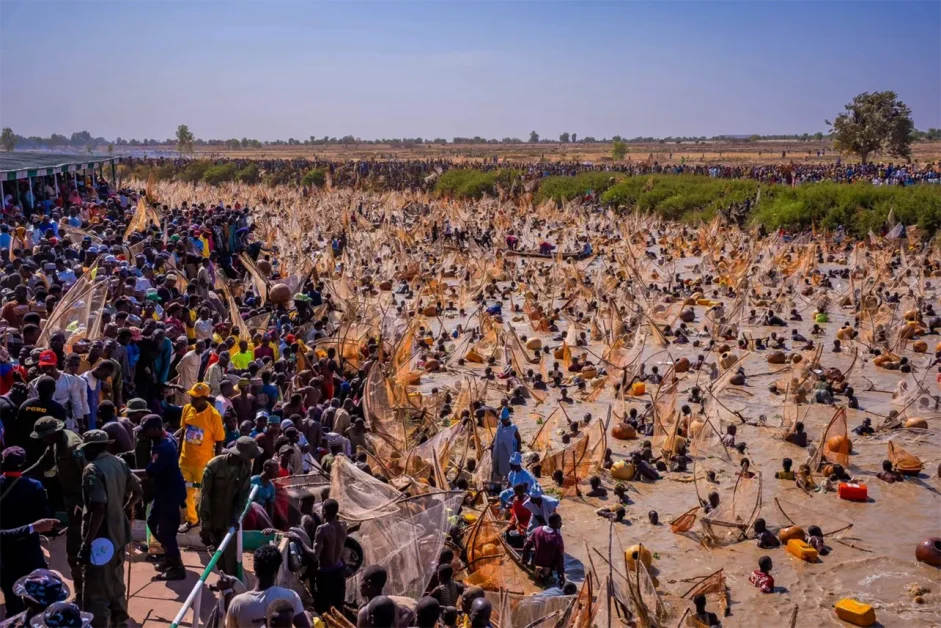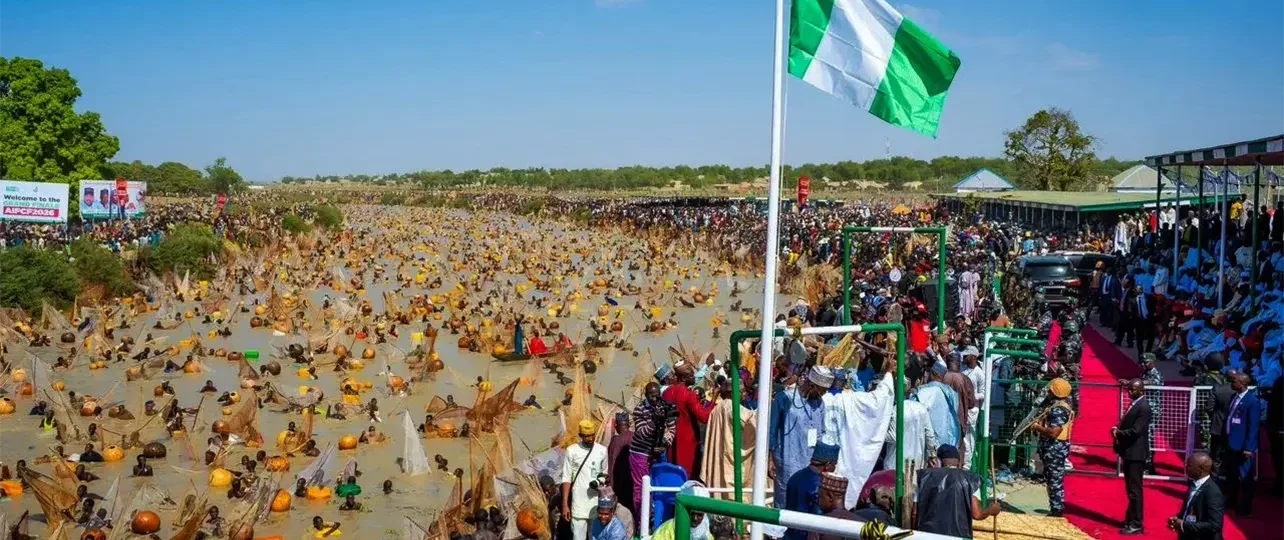

THE Matan Fada River doesn’t flow on February 15, 2026 – it explodes. Under a sun that hammers the Kebbi flatlands into submission, the sacred waters churn with over 50,000 bare-chested warriors from across West Africa, their war cries piercing the air as they plunge into the muddy torrent for the climax of the 61st Argungu International Fishing and Cultural Festival. No rods. No nets. Just calabash gourds clutched as shields and hands hardened by generations of defiance against a river once deemed cursed.
This is Kogin Argungu – the legendary fishing contest where 50-kilogram catfish become trophies, where muscle wrestles nature, where manhood is measured in silver scales thrashing skyward. The first leviathan breaks the surface, tail whipping fury, and the roar from tens of thousands of spectators, Sokoto herders, Hausa traders, Chinese tourists, Yoruba businessmen, shakes the earth itself.
President Bola Tinubu stands on the royal dais, watching not just a festival, but a resurrection.
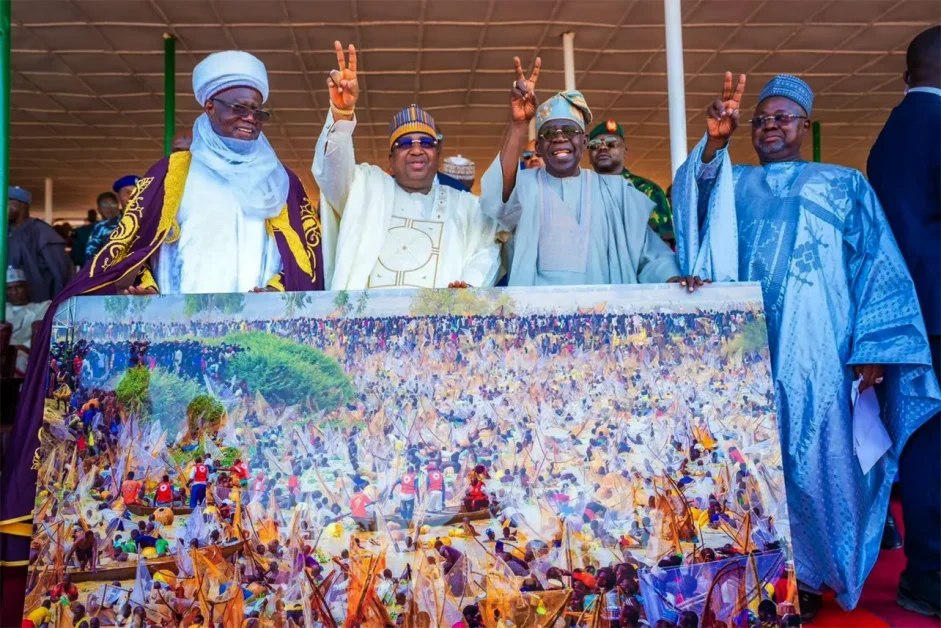
“Today in Argungu, I witnessed more than a festival,” he declares, voice cutting through the tumult. “I witnessed a people reclaiming their peace. The 61st Argungu International Fishing and Cultural Festival is proof that stability is gradually returning, that normalcy is taking root, and that our investments in security are yielding results.”
For the first time since 2009, the festival roars at full throat, uninterrupted by banditry, undimmed by terror, unbroken by the violence that choked Nigeria’s northwest for over a decade. Where once insurgents stalked the riverbanks and kidnappings silenced cultural life, now fishermen compete. Families celebrate. Commerce thrives.
“Over 50,000 fishermen gathered at Matan Fada,” Tinubu continues, his words deliberate, weighted with meaning. “Culture flourished. Competition thrived. Communities celebrated without fear.”
Heritage as Weapon, Culture as Commerce
Born in 1963 from Kebbawa defiance against colonial doubt and spiritual dread, the Argungu Festival is a UNESCO-recognised testimony to resilience. Legend speaks of a river demon subdued by ritual; history records a sultan’s challenge to prove his people’s mastery over nature’s fury. Saturday’s grand parade honours both.
Fulani horsemen thunder past in crimson turbans and indigo robes, scimitars flashing sunlight as their stallions foam at the bit. Jukun dancers whirl in raffia skirts and parrot feathers, anklets rattling ancient rhythms. Hausa griots pound talking drums that translate grief into glory, oppression into overcoming. The canoe races carve white scars across the river’s brown skin. Suya smoke spirals from riverside grills where meat sizzles over charcoal. Market stalls overflow with indigo-dyed kente, Benin bronze, Calabar beadwork, and leather talismans promising protection.
But culture here isn’t mere spectacle – it’s strategy.
“This is not accidental,” the President hammers home. “It is the product of coordinated security efforts, intelligence work, and community partnership. We will win the fight against insecurity. Our farmers, fishermen, traders, and families must live and work in safety.”
The numbers tell the story his rhetoric underscores: military checkpoints now guard every road into Argungu. Intelligence-sharing protocols between federal forces and traditional rulers have disrupted bandit networks. Community vigilantes, trained and equipped, patrol fishing settlements that once evacuated at dusk.
Tinubu leans forward, gaze sweeping the crowd: “Argungu is also a reminder that culture is commerce. Tourism is an opportunity. Agriculture is prosperity. We will continue to support Kebbi State and every state committed to food security, rural development, youth empowerment, and infrastructure growth.”
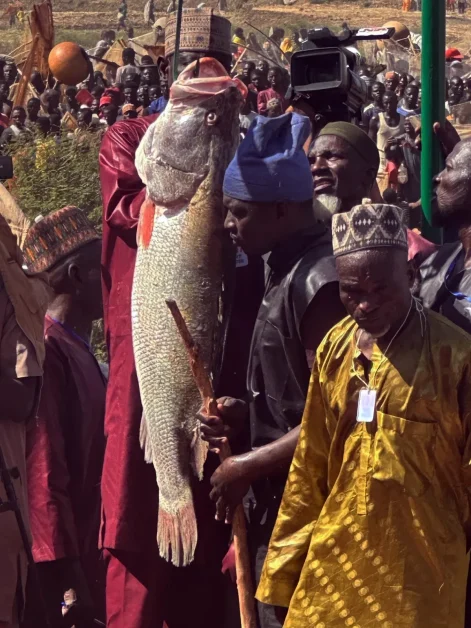
On the riverbank, reigning champion Malam Yusuf Garba hoists his prize catch – a 59-kilogram catfish, whiskers thick as rope, eyes still defiant. The crowd erupts. But the day’s revelation is Aisha Bello, a 24-year-old fisherwoman from Yauri whose 47-kilogram monster marks the highest-ever female finish. Her grin splits the dust on her face as young girls surge forward, chanting her name.
Governor Nasir Idris of Kebbi State, flanked by traditional rulers in embroidered babban riga, seals tourism partnerships with Chinese and UAE delegates. Memoranda are signed for hotel construction, airport expansion, and river dredging. The Emir of Argungu, Samaila Muhammad Mera, raises his staff in blessing as fireworks – red, green, white – paint the Nigerian flag across the darkening sky.
Fuji music detonates from speakers as night falls. Wasiu Alabi Pasuma commands the stage, voice soaring over percussion that rattles ribcages. Dancers sweat ecstasy. Elders nod approval. Children mimic the fishermen’s victory poses, already dreaming of next year’s contest.
The Calculus of Renewal
Tons of catfish are weighed, photographed, and auctioned. Proceeds fund schools, clinics, and wells. The festival’s economic injection – estimated at ₦8.7 billion this year – ripples through Kebbi’s economy: hotel occupancy at 100%, transport fares tripled, artisan sales surging 300%.
But President Tinubu’s final words frame the festival’s truest yield:
“Nigeria is moving forward. Peace by peace. Harvest by harvest. Community by community. Renewed Hope is alive in Argungu.“
The river, once a symbol of terror’s triumph, now mirrors torchlight and triumph. Where bandits once ruled, fishermen now reign. Where despair festered, possibility floods.
In Nigeria’s embattled northwest, rivers run fierce—and so, at last, does rebirth.