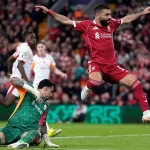
WELL, they said it couldn’t happen. They said the love was too deep, the bond too sacred, the goals too numerous. They said Mohamed Salah and Liverpool were written in the stars – a celestial pairing as permanent as the pyramids and as dependable as the Nile in flood season. They were wrong. On Tuesday, 24 March 2026, the sky fell in on Anfield. The Pharaoh announced his departure, and English football stopped breathing.
It was not a leaked rumour from some dubious agent in a Dubai hotel lobby. It was not a cryptic Instagram post requiring football’s finest code-breakers to decipher. The Egyptian King – 33 years old, 255 goals to his name, four Premier League Golden Boots hanging from his belt – sat himself down in front of a camera, gazed into a collection of silverware that would make a jeweller weep with joy, and delivered the words that shook the football world to its foundations: “Unfortunately, the day has come.”
Nine words. Six syllables. One earthquake.
“Unfortunately, the day has come. This is the first part of my farewell.” – Mohamed Salah, 24 March 2026
■ A CONTRACT. A CRISIS. A CURTAIN CALL.
Let us not pretend this came entirely from the blue. The storm clouds had been gathering since December, when Salah – who is usually about as confrontational as a Nile sunset – went full volcanic in an interview that had the Anfield faithful choking on their pre-match pies. He felt, he said, like the club was “throwing me under the bus.” He spoke of a broken relationship with manager Arne Slot. He questioned whether there were those within the club who simply did not want him there.
For a man of Salah’s diplomatic pedigree, this was the equivalent of detonating a tactical nuclear device in the middle of the Kop. The fallout was spectacular. He was dropped for three consecutive games – including against Leeds, which is rather like benching Michelangelo because a wall needs a quick coat of magnolia – and was subsequently left out of the squad for a Champions League match against Inter Milan. The King had been exiled in his own palace.
Then came the January reconciliation – fragile, patched-together, a diplomatic ceasefire rather than a genuine peace treaty. He returned from the Africa Cup of Nations, pulled on the red shirt, contributed four goals and four assists in nine matches before a muscle injury ended his run. But the damage, it seems, was done. Somewhere between the December detonation and the March announcement, a decision was quietly, finally made.
Here is the extraordinary detail that makes this story dizzying: Salah had signed a two-year contract extension in April 2025 — barely eleven months ago. That ink had scarcely dried before someone reached for the eraser.
■ THE NUMBERS DON’T LIE (AND THEY’RE WEEPING)
Before we dwell on the drama and the dysfunction, let us bow before the sheer, staggering, glorious statistical monument that Mohamed Salah leaves behind. Because if you are going to exit a stage, exit it like this:
435 appearances for Liverpool
255 goals — third all-time at Anfield
4 Premier League Golden Boots
2 Premier League titles
1 Champions League winner
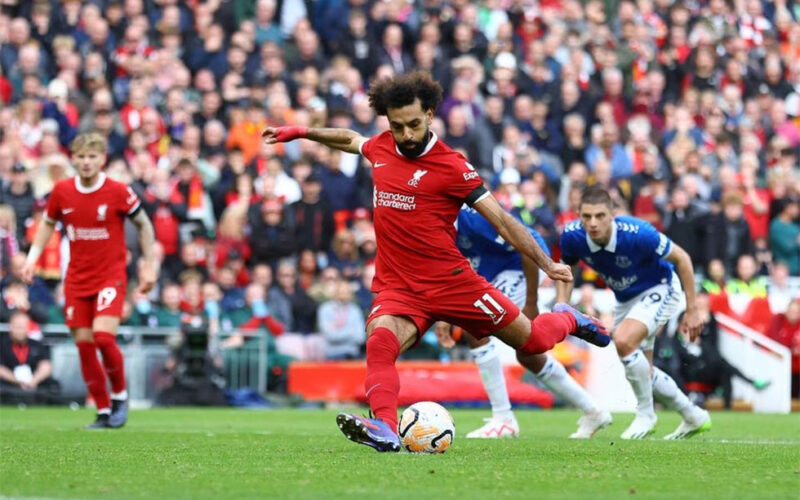
Add to that the FA Cup, two League Cups, the Club World Cup, the UEFA Super Cup, and a Community Shield, and you are looking at one of the most decorated individual careers in the history of the Premier League. The man did not just play for Liverpool. He redefined what was possible. He took the number 11 shirt and turned it into mythology.
He took the number 11 shirt and turned it into mythology. Liverpool without Salah is like the Nile without water — you can describe it, but you cannot quite believe it.
■ ARNE SLOT AND THE ART OF MISMANAGING GREATNESS
Let us be fair to Arne Slot. The Dutchman inherited a squad mid-transition, navigated a title defence of sorts, and has had to operate in the long shadow of the Klopp era – a shadow approximately the size of a Scouse cathedral. That is not easy. Nobody said it would be.
But. And it is a very large but, the kind that requires its own postal code. Slot’s handling of the Salah situation will be studied in football management courses for years to come, and not entirely for edifying reasons. When your most talismanic player goes public with accusations of being scapegoated, and your response is to bench him for three consecutive games including against Leeds United, you are not so much reading the room as you are refusing to acknowledge the room exists.
Liverpool’s league form this season has been, to employ the technical term, a complete calamity – two wins in ten games at the nadir of their crisis. The title defence lies in ruins. And yet the solution, apparently, was to place Mohamed Salah on the bench and watch proceedings with the faintly baffled expression of a man who has just been handed the controls of a spaceship and assumed it works like a bicycle.
To be clear: both parties, according to Sky Sports’ chief correspondent, reached a mutual agreement. Liverpool, it is reported, were not entirely displeased to shed wages said to be in the region of £350,000 to £400,000 per week. Salah, evidently, was not entirely displeased to seek a new chapter. But there is something deeply, achingly ironic about a club paying its greatest modern player that kind of money and not finding a way to keep everyone happy until the contract expired naturally.
■ THE FAREWELL THAT BROKE THE INTERNET (AND SEVERAL GROWN MEN)
The manner of Salah’s announcement deserves its own applause. While lesser players might have let an agent drop a whisper to a tabloid, or allowed the news to seep out through the usual murky transfer-window channels, Salah sat himself down, looked into a camera, and spoke directly to the people who matter most: the fans. He did not employ euphemism. He did not hide behind club-speak. He simply said goodbye – with grace, with warmth, with a dignity that should shame every executive who allowed this relationship to deteriorate.
The video, posted across his social media accounts alongside a highlights reel that had grown adults everywhere reconsidering their life choices, was a masterclass in emotional intelligence. “You gave me the best time of my life,” he told the Liverpool faithful. “I will always be one of you. This club will always be my home, to me and to my family.”
Liverpool, you broke something precious here. You had a Pharaoh and you let him slip through your fingers. At least have the decency to look mournful about it.
■ WHERE DOES THE PHARAOH REIGN NEXT?
The question on every football lip from Cairo to Casablanca, from Merseyside to Madrid: where does Mohamed Salah go next? The smart money, and there is considerable smart money involved given his reported weekly wages, leads to the Saudi Pro League. This is not speculation born of nothing – Salah himself admitted in May 2025 that discussions with Saudi officials had been, in his word, “serious.” Al-Ittihad had already attempted a loan swoop in 2024. The petrodollar pipeline remains very much open.
There is a certain poetic justice in the African continent’s greatest footballer potentially ending his elite career in the Gulf, collecting what will be a breathtaking final payday while his Premier League contemporaries slowly creak towards retirement. At 33 – 34 in June – Salah is not finished. He is not rocking gently on a porch somewhere recounting glories past. He scored 50 goals last season en route to the title. He had four goals and four assists in his last nine games before injury intervened this season. The man is still operating at a level that most Premier League forwards would consider the pinnacle of their careers.
He is not leaving as a fading footnote. He is leaving as the main chapter — and somebody else will have to write the sequel.
■ AN AFRICAN ICON LEAVES THE EUROPEAN STAGE
For those of us who track African football with the devotion it deserves, the Salah era at Liverpool was something more than sport. It was representation at the absolute summit. The Egyptian, the Arab, the African — at the very peak of the world’s most-watched football league, week after week, year after year, dismantling the notion that the beautiful game’s highest tier had specific geographic boundaries.
His four Golden Boots stand as a rebuke to every scout who passed, every club that hesitated, every assumption about what an African footballer could and could not achieve in the Premier League. When he is eventually celebrated at Anfield with the farewell he deserves – which Liverpool have promised will happen later in the year – the tributes will flow from every corner of the continent.
And there is still, crucially, football left to play. Liverpool have seven league games remaining, an FA Cup quarter-final, and a Champions League quarter-final still to navigate. A minimum of ten more games in red. Salah has stated his intention to give everything in these remaining weeks. The Pharaoh is not ready to be entombed just yet.
■ THE VERDICT
Mohamed Salah’s Liverpool story is not a tragedy. Let us be absolutely clear about that. Tragedies are for those who achieve nothing. This is something else entirely — a glorious, golden, occasionally chaotic love story that produced 255 goals, a sackful of trophies, four Golden Boots, and memories that will outlast all of us.
Is it ending in the most elegant fashion imaginable? Not quite. There was the December explosion, the public grievances, the benching, the frayed relationship with the manager, the contract terminated a year early. These are not the decorative flourishes of a perfect farewell. They are, however, entirely human. Even Pharaohs have messy endings.
But here is the thing about pharaohs: the pyramids outlast the politics. What Mohamed Salah built at Anfield will stand long after the January squabbles are forgotten footnotes. Long after the Slot era has run its course. Long after the contracts and the wage negotiations and the bus-throwing accusations have faded from memory.
The goals remain. The titles remain. The magic remains.
The King is leaving. The legacy stays forever.