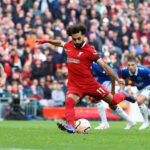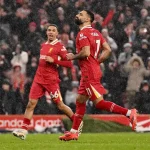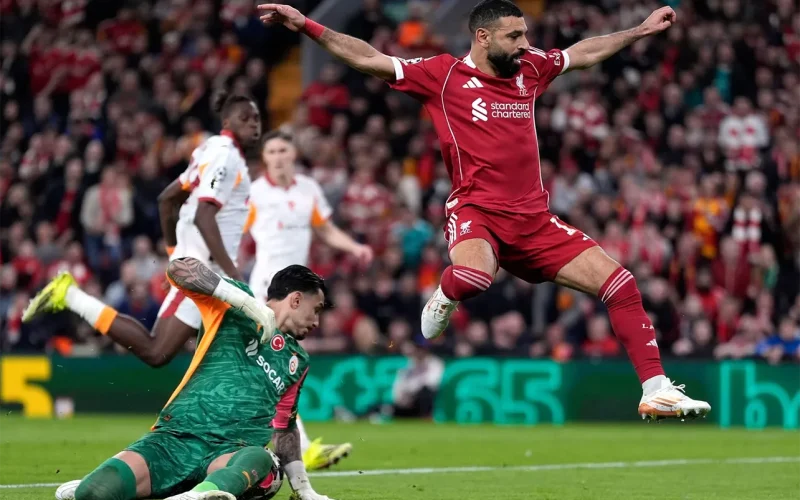
THE pass arrived like a whisper – sublime, perfectly weighted, finding its man in the churning chaos of a Champions League night. Mohamed Salah received it on the left flank, his first touch caressing the ball into space. One defender went. Then another. His body shifted, the threat telegraphed and yet utterly unstoppable: the outside of the boot, curling – curling – curling into the top corner, beyond the desperate reach of the Galatasaray goalkeeper.
Anfield erupted. But for Mohamed Salah, this was no ordinary goal.
It was goal number fifty. Fifty Champions League goals. Fifty moments of genius, accumulated over a decade of European nights that have redrawn what is possible for a boy from Nagrig, Egypt – for a man who carries Africa on his shoulders every time he pulls on that famous red shirt.
“Goal number fifty. The first African — ever — to reach this summit.”
No African player had ever stood in this particular place before. Not Didier Drogba in his pomp at Chelsea. Not Samuel Eto’o, devastating for Barcelona and Inter Milan. Not Jay-Jay Okocha, not Nwankwo Kanu, not Yaya Touré. For all their European brilliance, the continent had been waiting for someone to claim this summit. On Wednesday night at Anfield, Liverpool 4, Galatasaray 0, Champions League quarter-final first leg, Mohamed Salah became that someone.
History is rarely neat, and Salah’s path to fifty on this particular evening was gloriously, achingly human. The first half belonged to doubt. He missed a penalty. He spurned a chance that, on another evening, he converts in his sleep. Anfield held its breath. Here was the greatest African footballer of his generation, faltering on the biggest stage, one goal short of a milestone that the continent desperately wanted him to claim.
But this is who Mohamed Salah is. Not a machine. Not a highlight reel constructed in a laboratory. A man. A competitor. A competitor who walks back to the dressing room at half-time with something burning in his chest and returns to settle all debts.
The second half was a masterclass. One goal. Two assists. Liverpool’s engine, their heartbeat, their African king. By the time the final whistle sounded, the Reds had advanced to the quarter-finals with a 4-1 aggregate, and the football world had a new record to memorise.
The Numbers Behind the Legend
50 Champions League goals – a continental first
224 goals in the Premier League (as of March 2026)
429+ Liverpool appearances across all competitions
3 Premier League Player of the Year awards
5+ Africa Cup of Nations campaigns with Egypt
1 FIFA Best Men’s Player award wins
The statistics are staggering, but they only tell half the story. Salah’s achievement is not merely numerical. It is civilisational. He has played his football in an era when African players were admired but rarely canonised among the all-time greats. He has, with every goal, every assist, every Ballon d’Or conversation, insisted that Africa belongs at the very top table of world football.
A Liverpool Legacy Written in Red
When Salah arrived at Liverpool from Roma in the summer of 2017 for £34.3 million, the fee felt ambitious. What followed defied every superlative. In his debut season alone, he scored 44 goals, breaking the Premier League single-season record of 32 goals in a 38-game season. He won the Champions League with Jurgen Klopp’s Liverpool in 2019, the Premier League title in 2020, and the FA Cup and League Cup in 2022. He remade the club’s history. He remade himself.
But Salah’s genius was never solely about goals. It was about the way he played, the way he carried himself, the way he made Liverpool fans across Africa – and there are millions of them, from Lagos to Nairobi to Cape Town – feel seen. Every time Salah celebrated with his prostration, every time he scored and gazed skyward, he was sending a message: this is possible. This is ours too.
“Salah made Liverpool fans across Africa feel seen. Every goal sent a message: this is possible. This is ours.”
The Pharaoh’s Continental Mission
For Egypt, the weight Salah carries is unlike anything faced by players in wealthier footballing nations. He is not just the national team’s best player – he is the national team’s identity. The Pharaohs have not lifted the Africa Cup of Nations since 2010, and the heartbreak of narrow failures with Salah at their side – the 2017 final defeat to Cameroon, the penalty shootout exits – cuts deep. And yet he comes back. Every time.
He plays for a nation. He plays for a continent. And on Wednesday night at Anfield, surrounded by 53,000 voices singing his name in a Merseyside rain, he played for every African child who has ever laced up boots on a dusty pitch and dreamed of playing in a stadium just like this one.
The Young Prince in Barcelona’s Red and Blue
Salah’s historic evening was not the only record broken in the Champions League on a remarkable night for the competition. In Barcelona, a different kind of history was being made. Lamine Yamal, 18 years and 248 days old, scored his tenth Champions League goal in his club’s stunning 7-2 demolition of Newcastle United, becoming the youngest player ever to reach that milestone – surpassing the record previously held by Kylian Mbappé, who was 18 years and 350 days old when he achieved the same feat.
Barcelona’s 7-2 win was a statement of intent from a club rediscovering its swaggering best. Yamal, the Spanish-born son of Moroccan and Equatorial Guinean parents, is himself a child of the African diaspora – proof, if more were needed, that Africa’s footballing story is written not only on the continent but in every corner of the world where African blood runs and African dreams are dreamed.
Between Salah’s fifty and Yamal’s ten, the Champions League’s round of sixteen second legs delivered a night that will be referenced for decades. Dazzling experience meeting explosive youth. The torch in the hands of Africa’s past and Africa’s future, burning equally bright.
What This Moment Means
In the wider sweep of football history, Salah’s milestone will take its rightful place alongside the records of the game’s immortals. But it carries a significance that transcends sport. In a world where African achievement is too often minimised, qualified, or erased from the record books of greatness, this is unambiguous. First. African. Fifty. Champions League goals.
The number cannot be argued with. The history cannot be rewritten. And the curl of that ball — the sublime pass received, two defenders beaten, the body leaning left, the boot whipping across the leather, the net rippling, the Anfield crowd rising as one — that moment will live forever. Not just in the memory of those who were there, but in the hearts of an entire continent that has been waiting, for a very long time, for a moment exactly like this one.
“First. African. Fifty. The history cannot be rewritten.”
Mohamed Salah, son of Nagrig. Pharaoh of Anfield. The first African to score fifty Champions League goals. The record is his. The glory is Africa’s.