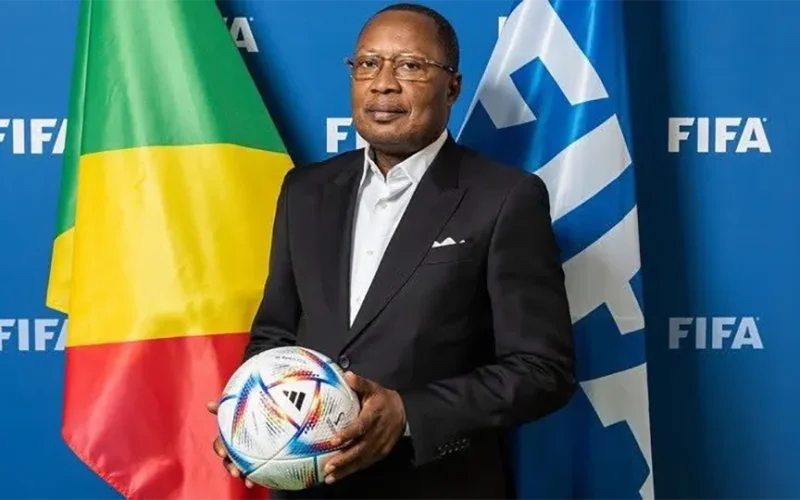
FIFA has moved to compound the legal ruin of the Republic of Congo’s football’s disgraced leadership, opening formal ethics proceedings against the head of the Congolese Football Federation (FECOFOOT) and two of his senior officials – both of whom had already been sentenced to five years in a criminal court before the world governing body acted.
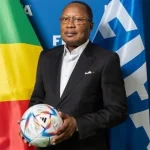
The investigatory chamber of FIFA’s independent Ethics Committee confirmed on Wednesday that it has initiated disciplinary proceedings against FECOFOOT president Jean-Guy Blaise Mayolas, General Secretary Wantete Badji, and Finance Director Raoul Kanda — all in connection with alleged financial misconduct involving FIFA funds.
FIFA’s announcement landed after the most consequential piece of the jigsaw had already fallen: Mayolas, his wife, and his son had been sentenced to life imprisonment by the Brazzaville Criminal Court on 10 March, following eight months of investigation into the federation’s finances. All three were tried and convicted in absentia — their whereabouts remain unknown.
“The other two have already been to jail. Now they face FIFA’s ethics chamber as well. There is nowhere left to hide.”
Badji and Kanda, for their part, were not spared by the Brazzaville court. Both received five-year prison sentences after being found guilty of money laundering, forgery, use of forged documents, and embezzlement. FIFA’s Ethics Committee proceedings now add a second front of accountability – one that could result in lifetime bans from all football-related activity.
A TRAIL OF DIVERTED FUNDS
The criminal trial established that approximately €1.1 million in FIFA-allocated funds was diverted – money designated for football development in one of Africa’s least-resourced football markets. The funds included a $500,000 grant awarded in 2020 for women’s football development, and approximately €429,000 from FIFA’s COVID-19 relief programme.
The impact on women’s football was particularly stark. Club presidents in the Congolese Women’s Championship filed a declaration with the Central Intelligence and Documentation Office alleging that only $20,000 of the $500,000 FIFA disbursed had ever reached the intended beneficiaries, leaving female footballers starved of resources while administrators allegedly enriched themselves.
Investigators further found that approximately $800,000 earmarked for constructing a national technical centre in Ignie, on the outskirts of Brazzaville, had largely disappeared. Eight years on, the facility remains incomplete – a physical monument to the corruption alleged against FECOFOOT’s leadership.
Prosecutors argued that Mayolas moved federation funds through a network of shell companies during his tenure as FECOFOOT president – a role he had held since 2018. He also served as a member of FIFA’s own Media and Communications Committee, a position that lent him international credibility while the alleged fraud was unfolding.
FIFA’S BELATED RECKONING
The timing of FIFA’s ethics announcement is not without irony. As recently as September 2024, when the Congolese government removed Mayolas from his post, FIFA had leapt to his defence – insisting that federation statutes required autonomy from state interference and that Mayolas was the legitimate federation president. In February 2025, FIFA suspended FECOFOOT itself for “third-party interference,” a decision that forced Congo to forfeit two 2026 World Cup qualifying matches against Zambia and Tanzania.
The suspension was eventually lifted in May after certain conditions were met, including the restoration of full control of federation headquarters to FECOFOOT’s executive committee. But even as FIFA fought to restore Mayolas to power, Congolese prosecutors were building the case that would ultimately land him a life sentence.
This is not the first time Mayolas and Badji have attracted FIFA’s adverse attention. Both received six-month bans in 2015 for violations related to gifts and benefits — at a time when Mayolas was still serving as FECOFOOT vice president. Those bans did not end their careers. They rose higher.
THE CHARGES FIFA IS NOW PURSUING
FIFA’s Ethics Committee confirmed that proceedings against all three officials are founded on prima facie evidence of potential breaches of the FIFA Code of Ethics, including: Article 29 (Misappropriation and misuse of funds); Article 25 (Forgery and falsification); Article 20 (Conflicts of interest); and Article 21 (Offering and accepting gifts and other benefits). FIFA noted the list of possible violations could be expanded as additional evidence emerges.
The three officials now formally in FIFA’s sights are:
| Official | Role | Criminal Sentence |
| Jean-Guy Blaise Mayolas | FECOFOOT President; FIFA Media & Comms Committee member | Life (in absentia) |
| Wantete Badji | General Secretary, FECOFOOT | 5 years |
| Raoul Kanda | Finance Director, FECOFOOT | 5 years |
WHAT IT MEANS FOR CONGOLESE FOOTBALL
The proceedings land on a federation that has already paid a heavy institutional price. FIFA’s suspension earlier in the football year compelled Congo to forfeit two 2026 World Cup qualifying matches – a direct consequence of the governance chaos that the Mayolas era produced. Those forfeits could yet prove costly in what remains a competitive qualification race.
The broader implications for African football governance are hard to overstate. The Mayolas case is already being watched across the continent as a test of whether criminal prosecution – rather than FIFA bans alone – can serve as a credible deterrent against the systematic looting of development funds. Observers note the bitter paradox: funds meant to grow women’s football and build infrastructure for the next generation of Congolese players were allegedly used to enrich those entrusted to protect them.
FIFA, for its part, sought to project a posture of institutional integrity. “FIFA remains committed to ensuring the responsible use of its funds worldwide and to safeguarding the integrity of football administration across all Member Associations,” the governing body said in its Wednesday statement, adding that no further comment would be made while proceedings are ongoing.
It is a statement that will ring hollow to those who recall FIFA actively defending Mayolas against government removal just 18 months ago – a position that, in retrospect, helped shield an accused embezzler from accountability.
Mayolas, his wife, and his son remain at large. Badji and Kanda face both their criminal sentences and FIFA’s ethics process. The investigatory chamber has confirmed that the list of potential violations may be extended as more evidence surfaces. For Congolese football, the reckoning has only begun.