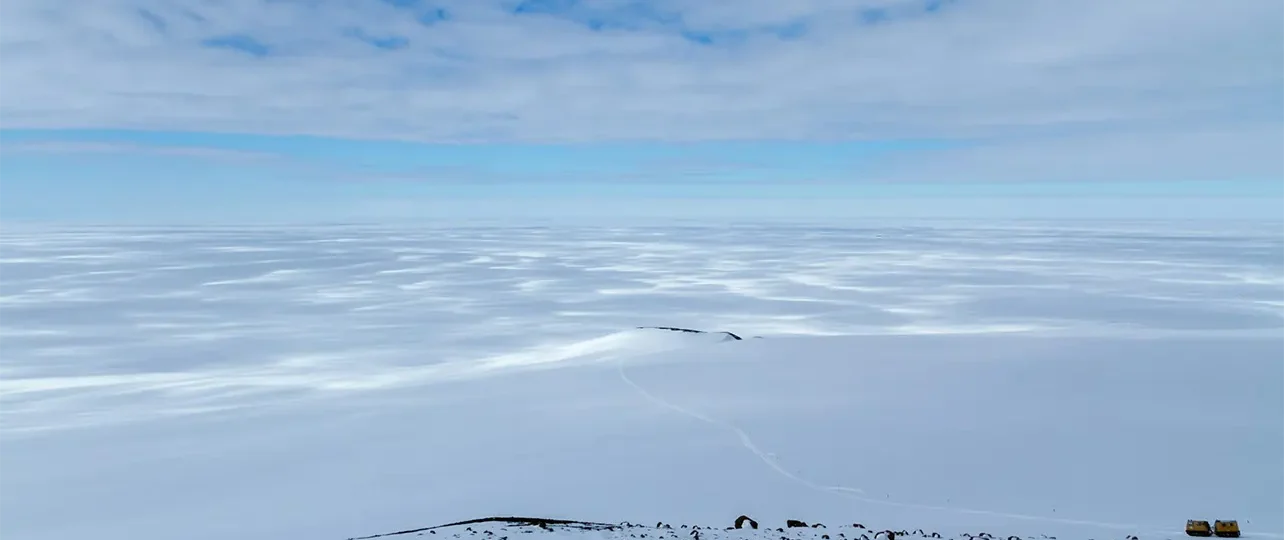

AROUND 370 million years ago, Earth gradually descended into the longest-lived and probably the most intense ice age witnessed by complex life: the Late Palaeozoic ice age. At its peak, huge continental ice sheets spread across much of the globe and the sea level fell by more than 100 metres. In all, this ice age lasted around 100 million years.
The transition in and out of the Late Palaeozoic ice age was one of the biggest climate transitions in Earth’s history, a turning point in the evolution of life and the environment. It significantly shaped the two periods of time that made up the end of the Palaeozoic era.
First, it led to the creation of iconic “coal forests” full of giant insects in the Carboniferous period during the ice age. It also paved the way for the rise of reptiles in the Permian period that followed.
I lead an international team of scientists who have just published research demonstrating, for the first time, that carbon dioxide (CO2) played a central role in this huge climatic transition.
The Late Palaeozoic ice age has long been a climate enigma. Atmospheric CO2 estimates for this period vary widely, and different reconstructions of the likely temperature vary by as much as 20°C.
The occurrence of glacial deposits throughout time has often been used to track the ice age. However, this approach is biased by the incompleteness of the geological record and has only loose time constraints. When attempting to reconcile the individual pieces of the puzzle, paradoxes have emerged, such as peak ice conditions coinciding with high CO2 levels.
Closely regulated by carbon
Our new study provides an original 80-million-year CO2 record that tracks the climate during the descent into and emergence from the Late Palaeozoic ice age. We did this by looking at the fossilised shells of ancient clam-like creatures known as brachiopods. These shells store chemical fingerprints such as boron isotopes, which enable us to calculate how much CO2 was in the atmosphere when the brachiopods were alive.

This type of CO2 reconstruction from Earth’s deep geologic past is entirely novel. Crucially, the reconstruction has a consistent timeline which enables us to bring together all pieces of the puzzle to demonstrate that the climate of the Late Palaeozoic era was closely regulated by CO2.
What did the Late Palaeozoic climate and CO2 look like? Our reconstruction showed that for part of this era, the Earth’s atmosphere sustained relatively low CO2 (about 330 parts per million or ppm), reaching minimum values of about 200 ppm about 298 million years ago around the boundary between the Carboniferous and Permian periods. The low atmospheric CO2 combined with less heat coming from the younger sun would have caused the intense “icehouse” conditions, with ice sheets extending as far as the planet’s mid-latitudes.
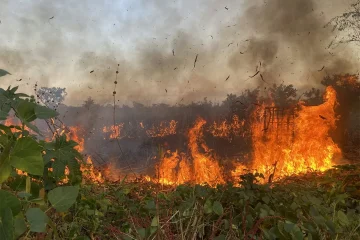
Our reconstruction also revealed an unexpected end to the icehouse period. Scientists previously thought that the Late Palaeozoic ice age gradually waned away, but our findings showed it ended much earlier. Around 294 million years ago, large-scale volcanic activity triggered a rapid rise – at least on geological timescales – in atmospheric CO2, and Earth became warmer and drier.
While the past couple of decades have brought much progress in the reconstruction of CO2 from Earth’s more recent past (in particular the past 60 million years where we have seafloor sediments), CO2 reconstruction from the rock record has been long considered challenging. As such, our study pushes the boundaries in the geological reconstruction of atmospheric CO2 and provides a key to unlocking its history to the beginning of Earth’s fossil record.
While CO2 is expected to play an important role, as demonstrated during the Late Palaeozoic, precise knowledge of past levels and changes is fundamental to understanding of every aspect of the Earth system. Addressing the remaining gaps and continuously refining records is crucial to fully grasp CO2’s influence on Earth’s climate and habitability—past, present and future.
Hana Jurikova, Senior Research Fellow, School of Earth and Environmental Sciences, University of St Andrews
- This article is republished from The Conversation under a Creative Commons license. Read the original article.