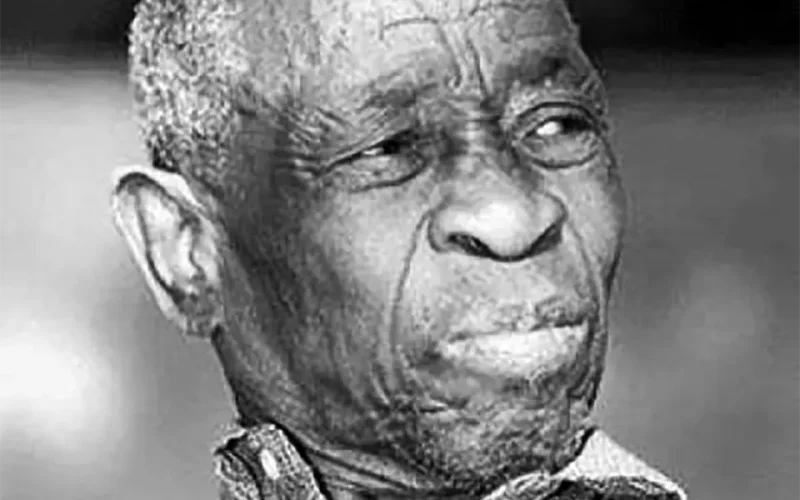
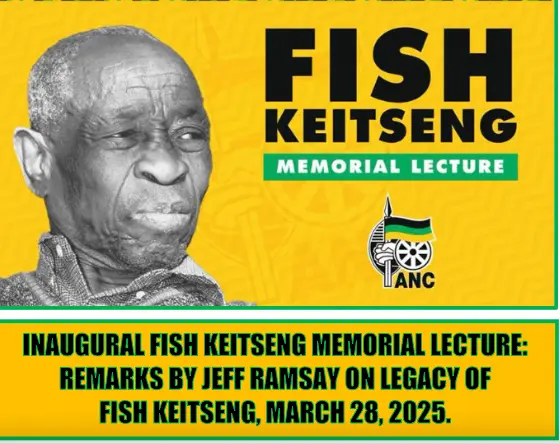
BORN in Kanye, Ntwaesele Thatayaone “Fish” Keitseng was one of the most remarkable persons I have had the privilege to know.
An ordinary man by origin, he left an extraordinary legacy through his tenacious commitment as a freedom fighter for the dignity and emancipation of Africa as a leading member of the African National Congress (ANC) and pioneer local nationalist.
In the latter role, he was a founder member of the Bechuanaland Peoples Party (BPP) and Botswana Independence Party (BIP) before helping to facilitate the formation of his ultimate political home, the Botswana National Front (BNF).
At the same time, without undermining the contributions of others, there can be little doubt that he was the most important Motswana member of the ANC during the early 1960s.
He was a Botswana patriot and a South African patriot because, above all, he was first and foremost a proud African patriot.
Following the path of most males of his village, in 1940, he graduated from the mundane toil of the cattle post to the hard life of a migrant labourer at the Gauteng mines.
There, he soon became politicised through his active membership in the African Mineworkers’ Union, then led by the legendary J.B. Marks, who was also a leading member of the ANC and South African Communist Party.
During this period he also stood out for his public defiance of Kgosi Bathoen II by refusing to enlist for wartime service in the African Pioneer Corps Instead, Keitseng fought for workers’ rights, playing an active role in the great 1946 Mineworkers strike, which was brutally suppressed by security forces.
He left the mines in 1947, joining the ANC in the same year. Having never attended formal education, Keitseng taught himself to read as well as speak English while working in a carpet store.
Beneath his deceptively simple persona was a true genius guided by a clear strategic vision.
In 1952, Comrade Fish first achieved wider political prominence, mobilizing support for the ANC’s Defiance Campaign in Newclare Township.
Four years later he gained wider notoriety and the praise name “Robinhood of Newclare” when he helped a large group of ANC detainees escape from police custody.
The subsequent police crackdown resulted in severe riots. Having already spent time in jail for his politics, Keitseng then approached his lawyer, Nelson Mandela, to turn himself in.
This resulted in the pair being arrested together, along with 154 other leading members of the ANC and associated organisations, who were then collectively charged with treason.
Fish was also jailed for his role in the Newclare riots resulting in him being incarcerated while other treason Trialists were out on bail.
Other Batswana prosecuted in the Treason Trial included Motsamai Mpho, Theo Mmusi, and Z.K. Matthews.
In 1959, the Apartheid authorities dropped their charges against Keitseng and deported him back to the Bechuanaland Protectorate as a prohibited immigrant.
At this point he chose to stay in Lobatse rather than his home village of Kanye, a choice he later explained in remarks at the Bechuanaland People’s Party (BPP) rally in Lobatse on the 25th of September 19 61: “We are far behind the times – other countries like Basutoland are on their way to freedom.
We must pull up our socks and start working for the future of our children.
I have been in the Union [of South Africa] in the same struggle and Verwoerd chased me, saying I am a dangerous element.
I came to the B.P. [i.e. the Bechuanaland Protectorate] and when I arrived in Lobatse I was told to go to Kanye, where I come from, but I refused, saying a brave dog when chased by someone does not go into the house but just stands by the door and starts barking at the enemy.
So I told them the administration that I wanted to stay at the border gate and bark at Verwoerd! “Some people are thinking that we are fighting against our chiefs, but this is not the case.
We want them to be Kings, like the Queen of England! Bareng is now a King because he is working hand in hand with Ntsu Mokhele of the Basutoland Congress Party.
“We don’t hate Europeans though they do some evil things to us; but we should not retaliate because we want to build a nation, and no nation is built on hatred.” While in Lobatse, Comrade Fish remained a key ANC leader in Botswana until the 1980s, working mostly as an escort for fleeing exiles moving north, including Nelson Mandela and Thabo Mbeki.
In 1962, his Peleng safe house also hosted the first ANC Congress in exile.
This crucial meeting brought together the underground internal and external wings of the movement for the first time.
Among the Congress’s decisions was its endorsement of the already initiated formation of Umkonto weSizwe and its campaign of armed struggle.
Keitseng, himself, was unable to attend the Lobatse Congress as he was at the time detained in Southern Rhodesia (Zimbabwe) with scores of others, including Thabo Mbeki, who had been captured by Rhodesian Security Forces in a, at the time unprecedented, dragnet carried out in collaboration with the Apartheid regime.
After weeks of detention and torture Keitseng, along with T. Mbeki and others were put on the then Rhodesia Railways train bound from Bulawayo to Mahikeng.
Fortunately, before the train’s departure, Keitseng was able to get word out of their plight.
As a result, the train was stopped in Palapye as a result of demonstrations organised by Motsamai Mpho and Klaas Motshidisi.
The freeing of the prisoners was to prove to be a major milestones in Botswana’s exercise of its sovereignty over the track.
In the early 1960s, Keitseng was also involved in the formation of the BPP and its labour union, the Bechuanaland Trade Union Congress.
After the BPP split in 1962, he stayed in the Independence Party for a short time before helping to found the BNF in 1965.
Comrade Fish’s behind-the-scenes role in the formation of the BNF is partially reflected in his memories of meeting Kenneth Koma in Moscow: “When I arrived at the hotel, there was a note at the reception telling me to contact him.
Koma collected me one time and took me to his place, which was close by. He said, “I understand that you are fighting for the party.
Why don’t you guys in the BPP come together? To be split in pieces is nothing. At first, I said I didn’t know, “I’m not a leader. I don’t know what they are fighting about.” “I stayed with him for a couple of days after the conference meetings were finished.
We mostly discussed Bechuanaland politics and the problems between Matante, Motsete, Mpho and the others. Koma wanted to know what was happening, so I told him all I knew.
We were both agreeing that disunity was killing the ordinary people’s politics. It was then that we first discussed building a United Front.
Koma wanted to build an alliance between the BPP factions and the trade unions to oppose the BDP, which was being backed by the British.
Before I left Russia, Koma gave me three letters addressed to Matante, Mpho and Motsete, offering his services in an effort to build the United Front.
But, the party leaders continued to act for themselves instead of the workers, which is why they lost to the BDP.” Keitseng subsequently played a behind-the-scenes role in the 1970s in thwarting efforts by the Apartheid Regime to try to infiltrate the BNF.
[His memoirs incorporate Dr. Koma’s account of a crucial 1972 incident] He never stood for office, however, until 1989, when he was elected a councillor in Gaborone.
In 1994 he chose to stand down to make way for younger cadres. Comrade Fish Keitseng truly lived a life worthy of remembrance.
Pula! Amandla Awethu!
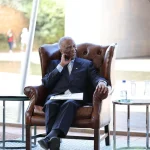
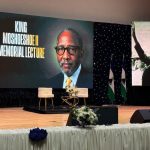
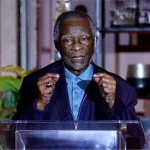
- This is an edited version of Jeff Ramsay at the Inaugural Fish Keitseng Memorial Lecture.