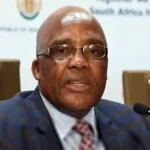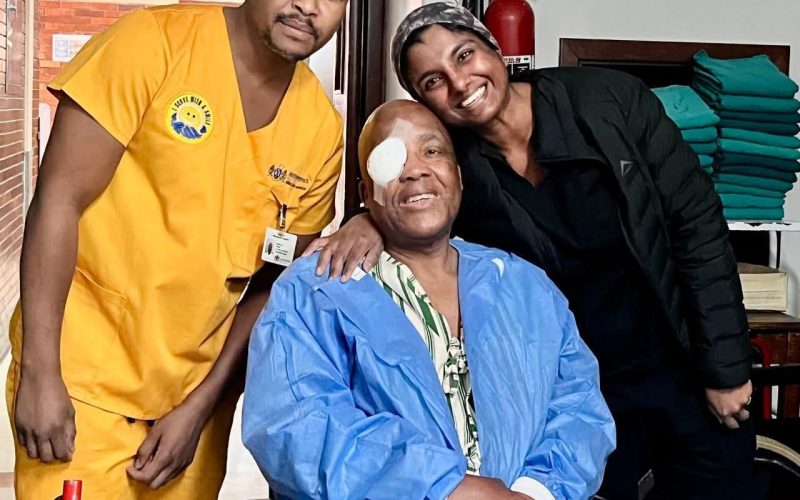
THE photograph tells a story more powerful than a thousand policy documents. There, in the corridors of Chris Hani Baragwanath Hospital – the largest hospital in the Southern Hemisphere – sat South Africa’s Health Minister Dr. Aaron Motsoaledi in a wheelchair. He’s dressed not in the tailored suits of political power, but in the humble uniform of every public hospital patient: striped green and white government-issue pyjamas topped with a light blue gown. A white cotton wool patch covers his right eye, testament to the surgery he has just undergone. Around him, the dedicated staff of Bara smile with quiet pride – they have just operated on one of the country’s most senior officials, and he trusted them completely with his sight.
This image captures something revolutionary in South African politics: a cabinet minister who doesn’t just talk about public healthcare – he stakes his own vision on it. In choosing to place his eyesight in the hands of surgeons at a public hospital, Motsoaledi demonstrated a level of faith in the system he oversees that is both rare and transformational.
The most fundamental principle of democratic governance is that those who wield power should be accountable to those they serve. Yet across South Africa – and indeed throughout Africa and the developing world – a glaring disconnect exists between the political elite and the citizens who elect them. This disconnect isn’t merely philosophical; it’s practical, profound, and perpetuating cycles of mediocrity that keep millions trapped in systems of substandard service delivery.
The statistics tell a damning story. In South Africa’s healthcare system, annual per capita expenditure ranges from R28 000 in the private sector to approximately R280 in the public sector, creating what amounts to two entirely different medical realities. While politicians and their families enjoy world-class private healthcare, the overwhelming majority of South Africans – those whose taxes fund both the public system and political salaries – are left to navigate persistent social inequality, poverty, unemployment, a heavy burden of disease and the inequitable quality of healthcare service provision.
This dual system isn’t limited to healthcare. The South African education system, characterised by crumbling infrastructure, overcrowded classrooms and relatively poor educational outcomes, is perpetuating inequality and as a result failing too many of its children, with the poor hardest hit. Meanwhile, the children of those making educational policy decisions attend well-resourced private institutions, insulated from the consequences of their parents’ policy choices.
In this context, Motsoaledi’s recent eye surgery at Chris Hani Baragwanath Hospital’s St John Eye Clinic stands as a beacon of authentic leadership. By choosing to undergo his procedure at a public facility Motsoaledi demonstrated something revolutionary in South African politics: genuine solidarity with those he serves. His consistent use of public health facilities isn’t just symbolic; it’s transformational. When a minister experiences firsthand the realities of the system he oversees, policy decisions become personal. Quality improvements become urgent. Accountability becomes automatic.
This is what servant leadership actually means – not the hollow rhetoric of campaign seasons, but the daily choice to share the lived experiences of constituents. When politicians use public transport, they understand the frustration of unreliable schedules and overcrowded conditions. When their children attend public schools, education policy becomes a family matter. When they rely on public hospitals, healthcare reform gains urgency beyond electoral cycles.
The current system creates what can only be described as governance by proxy – leaders making decisions about services they’ll never use for people whose struggles they’ll never share. How can someone who has never waited hours in a public clinic queue make informed decisions about healthcare capacity? How can parents whose children attend elite private schools understand the devastating impact of teacher shortages or inadequate textbooks? How can ministers who travel in blue-light convoys with VIP protection comprehend the daily terror of citizens dependent on under-resourced, overwhelmed police services?
This isn’t about imposing hardship on public officials – it’s about aligning incentives with outcomes. When politicians’ personal experiences are tied to public service quality, improvement becomes inevitable. The minister who must use public hospitals will ensure they’re properly staffed and equipped. The education official whose children attend public schools will prioritise infrastructure and teacher training. The safety minister who relies on regular police services will demand accountability and effectiveness.
The path forward requires more than voluntary gestures of solidarity, admirable as Motsoaledi’s example is. South Africa needs legislative frameworks that institutionalize this alignment. Parliament should pass laws requiring all senior government officials to use public services for their healthcare, their children’s education, and their daily transportation needs. These shouldn’t be suggestions or aspirational goals – they should be conditions of public service.
Such policies would trigger a revolution in service delivery. Suddenly, the same urgency applied to VIP security would extend to public safety. The same attention to detail lavished on ministerial healthcare would benefit community clinics. The same resources dedicated to ensuring politicians’ children receive quality education would flow to township schools.
Critics might argue this approach is punitive or impractical. They’re wrong. It’s restorative – restoring the fundamental link between governance and citizenship that democracy requires. It’s also practical in the most essential sense: creating direct, personal incentives for the people with power to improve systems that affect millions.
The example set by Minister Motsoaledi shouldn’t be exceptional – it should be standard. Every cabinet member, from national to provincial to local levels, should demonstrate their faith in public services by using them personally. Their families should share the same educational experiences as the families who elect them. Their medical care should come from the same facilities serving their constituents.
This isn’t about lowering standards for politicians – it’s about raising standards for everyone. When those with the power to fix systems must live with those systems daily, excellence becomes not just a campaign promise but a personal necessity.
The greatest tragedy of South Africa’s current trajectory isn’t just the persistence of inequality – it’s the institutionalisation of that inequality through a political class that has insulated itself from the consequences of its own governance failures. Real democracy requires leaders who don’t just represent the people but live like them, struggle with them, and succeed only when they succeed.
Motsoaledi has shown the way. The question now is whether South African democracy is brave enough to demand that all its leaders follow his example – not through voluntary nobility, but through the force of law and the power of genuine accountability. The time for comfortable distance between governors and governed is over. The era of servant leadership must begin.