
IT began with a kitchen knife, a dark street in north Belfast, and a man left fighting for his life. It ended — at least for the time being — with cities across the United Kingdom ablaze with rage, immigrant families fleeing burning homes, and the ghost of Britain’s dark nativist past haunting the present with terrifying familiarity.
On the night of Monday, 8 June 2026, at approximately 10:30 pm, Stephen Ogilvie, a man in his 40s, was attacked in a residential street in northern Belfast by a Sudanese national who pinned him to the ground and attempted to sever his head with a kitchen knife. Bystanders — including one extraordinary individual who waded in with a hurley stick — intervened to stop the attacker, saving Ogilvie’s life. Police arrived and arrested the suspect at the scene. Ogilvie was rushed to hospital in critical condition. By the time he appeared in court two days later, he had lost his left eye.
The suspect, identified by courts as Hadi Alodid, 30, a Sudanese national, had entered Northern Ireland from the neighbouring Republic of Ireland in 2023, applied for asylum, and was granted a five-year permit to remain. He was charged with attempted murder, making threats to kill, and possession of a knife in a public place. He was remanded in custody without bail. Police said the attack bore no indication of terrorist motivation, and they were not seeking any other suspects. The investigation into the motive remains active.
“The challenge we face with today’s online toxic nature is that people are incited by people who are faceless and know nothing about this brilliant, vibrant place.”
Jon Boutcher, PSNI Chief Constable
FIRE IN THE STREETS: BELFAST BURNS
By Tuesday evening, 9 June, Belfast was burning. The video of the attack — graphic, visceral, and unmistakably real — had spread across social media with the speed and velocity of an accelerant. Hundreds of protesters, many masked, mobilised across the city in response to calls circulating online for demonstrations against ‘mass immigration into their communities.’
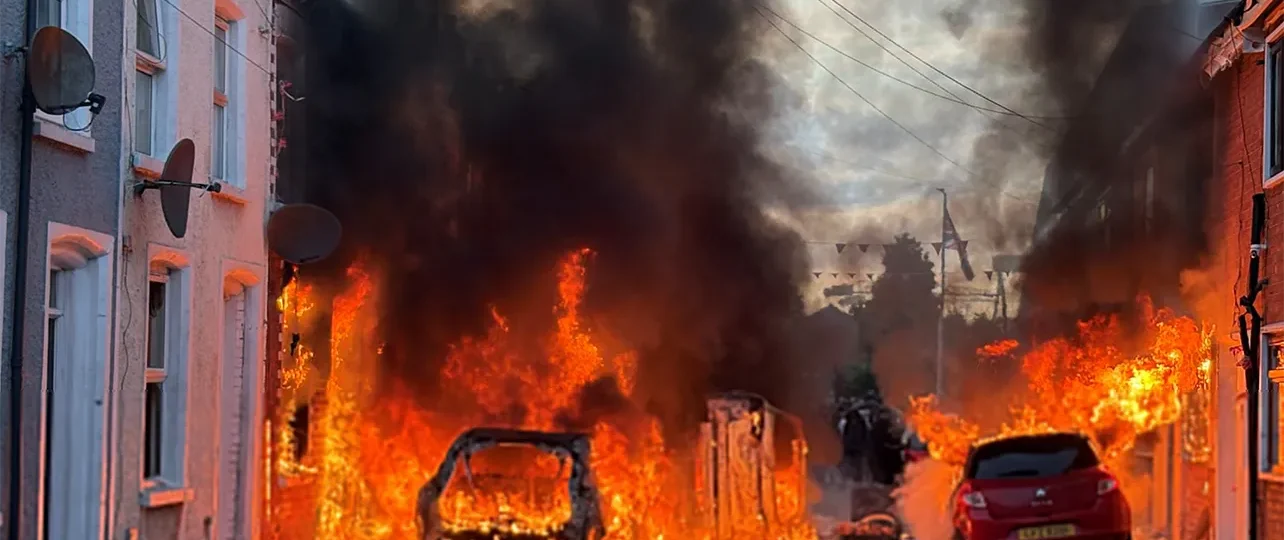
What followed was not a protest. It was, as at least one lawmaker termed it, a ‘race-based pogrom.’ Masked rioters set a public Glider bus alight on the Newtownards Road in east Belfast. Homes on Lendrick Street in east Belfast were torched, forcing terrified families — many of them long-settled immigrants — to flee with whatever they could carry. Translink, Northern Ireland’s public transport operator, suspended all services in and out of Belfast. At least three houses, a Middle Eastern supermarket, a bus and numerous vehicles were reduced to smoking ruins across the city.
The Northern Ireland Fire and Rescue Service responded to 62 separate incidents between 7 pm and midnight alone. Two police officers were injured. Disorder also erupted in Portadown, where a police car was set ablaze, and in Derry, where rioters blocked traffic in a show of solidarity with the anti-immigrant cause.
Naomi, a Muslim woman living near north Belfast, told CNN she was terrified for her children. ‘My daughter’s the only girl in hijab,’ she said. She had to collect her son early from school after he was subjected to racist taunts from classmates. A local pastor, Jack McKee, told the BBC that members of his church who had been part of the community for 20 years were ‘getting put out of their home.’
“There is no justification for the violence and disorder that we saw threatening our communities, nor for those who encouraged it, online or elsewhere. It is clear that people were targeted last night because of their background.”
Prime Minister Keir Starmer
THE DIGITAL ACCELERANT: MUSK, ROBINSON AND THE ONLINE MOB
In the old days of the Troubles, it took months to build a mob. In 2026, it takes hours — and the tools are in everyone’s pocket.
As Belfast burned, two men with millions of followers poured fuel on the fire from behind their screens. Tommy Robinson — real name Stephen Yaxley-Lennon, a British far-right agitator with multiple criminal convictions — issued calls for nationwide rallies. Elon Musk, the South African-born billionaire owner of X (formerly Twitter) and the world’s most powerful social media amplifier, shared and reposted a cascade of incendiary content denouncing the United Kingdom’s immigration system.
‘Only by protesting REPEATEDLY and LOUDLY will there be any change!!’ Musk wrote in direct response to Robinson’s call for demonstrations. In the hours that followed, X became an engine of mobilisation, with accounts across the far-right ecosystem using the Belfast attack to pour fuel on simmering resentment. Anti-immigrant calls went viral. Addresses of immigrant communities reportedly circulated. Videos of the knife attack were shared millions of times.
PSNI Chief Constable Jon Boutcher was blunt in his assessment. ‘The challenge we face with today’s online toxic nature is that people are incited by people who are faceless and know nothing about this brilliant, vibrant place,’ he said. His force announced that 200 additional officers would be deployed on Northern Ireland’s streets in the coming days.
NOT JUST BELFAST: THE SPREADING FIRE
The unrest was not confined to Northern Ireland’s capital. Within hours, it had spread with viral ferocity across the United Kingdom, feeding on a vein of anti-immigrant resentment that has been building for years.
Southampton had already been smouldering for a week, ever since the release of bodycam footage showing the death of Henry Nowak — a White student who had been fatally stabbed by a Sikh man in December and handcuffed by police during the chaos of the scene. Far-right leaders seized on the footage, framing it as evidence of institutional indifference to the killing of White Britons, and anti-immigrant protests turned violent in the southern port city.
Glasgow and Edinburgh in Scotland both saw protests. Belfast, Portadown, Derry and multiple towns across Northern Ireland descended into disorder. The spectre of the 2024 summer riots — when far-right mobs attacked mosques and hotels housing asylum seekers following the Southport stabbings, injuring more than 361 police officers and resulting in 1,840 arrests — loomed large over Britain’s political establishment.
The pattern was ominously familiar: a violent act by an immigrant or asylum seeker, real or alleged; a video clip decontextualised and weaponised on social media; far-right networks mobilising the aggrieved; and immigrant communities — entirely innocent of any wrongdoing — left to face the terror.
“This violence was clearly racially motivated and targeted at our minority ethnic community and police. It was racist thuggery, pure and simple, and any attempt to justify it or explain it as something else is misplaced.”
Assistant Chief Constable Ryan Henderson, PSNI (Ballymena riots, June 2025)
A NATION’S FRACTURE LINES: THREE YEARS OF POWDER KEG POLITICS
To understand what is happening on Britain’s streets, one must understand that the Belfast attack did not happen in a vacuum. It detonated on terrain that has been systematically prepared for years.
In June 2025, the Northern Ireland town of Ballymena erupted in two nights of savage anti-immigrant violence after an alleged sexual assault by two Romanian-speaking teenagers. Petrol bombs were hurled at the police. Homes were set alight. Rioters threw fireworks and masonry. Police deployed water cannon and plastic baton rounds. The riots resulted in 107 injured officers and 56 arrests. Two-thirds of Ballymena’s Roma population fled the town in the aftermath.
In the summer of 2024, the Southport stabbings — in which three young girls were killed at a children’s dance class — sparked the most widespread rioting in Britain in 13 years. The perpetrator, Axel Rudakubana, was a 17-year-old born in Wales to Rwandan parents, but false information circulated online that he was a Muslim asylum seeker. Mobs attacked mosques. Hotels housing asylum seekers were torched. Over 1,800 people were arrested. Crowds massed in Liverpool, Bristol, Hull, Manchester, Sunderland and Belfast, injuring hundreds of police officers.
In September 2025, an Ethiopian asylum seeker was jailed for sexual assaults in Epping, near London — sparking yet another wave of anti-immigrant demonstrations across the country.
What emerges from this pattern is not a series of isolated incidents but a coherent and recurring cycle: the far right and its allies have constructed an infrastructure of grievance that can be activated within hours of any violent incident involving a non-White migrant. The individual act becomes a symbol. The symbol becomes a cause. The cause becomes a riot. And immigrant communities — settled, lawful, contributing — bear the cost.
THE OPEN BORDER QUESTION: PEACE PROCESS UNDER PRESSURE
There is one dimension to the Belfast crisis that distinguishes it from the 2024 Southport riots and complicates the politics immeasurably: the Irish border.
Hadi Alodid, the suspect, entered Northern Ireland not directly from Sudan but from the Republic of Ireland — travelling across the open border that is a central pillar of the Good Friday Agreement, the peace accord that ended decades of violent conflict in Northern Ireland. He applied for asylum and received a five-year permit to remain.
Several politicians in Northern Ireland have used the attack to call for a review of this arrangement. It is a deeply fraught demand. The open border between Northern Ireland and the Republic is not merely an administrative convenience; it is the backbone of a peace architecture that cost thousands of lives to construct. To reimpose border controls would be to unpick the very architecture of the peace process. Yet to leave the arrangement entirely unreformed in the face of mounting public anxiety is politically unsustainable.
The Stormont leaders of all five major parties — Sinn Féin, the Democratic Unionist Party, the Ulster Unionist Party, the Alliance Party and the SDLP — issued a joint statement condemning both the knife attack and the subsequent rioting. It was a rare moment of cross-community unity. Whether it holds will depend on how long the disorder continues.
AFRICAN LIVES IN THE CROSSHAIRS
For Africans living in the United Kingdom — and for the continent watching from a distance — the Belfast riots and their aftermath carry particular resonance and cause for deep concern.
Hadi Alodid is Sudanese, a national of a country currently engulfed in one of the most devastating civil wars in the world. Sudan’s conflict, in which the Sudanese Armed Forces and the paramilitary Rapid Support Forces have reduced entire cities to rubble and displaced millions, has created one of Africa’s largest refugee crises. Thousands of Sudanese have sought safety in Europe and the United Kingdom. Their presence on British streets is, in significant part, the direct consequence of wars fuelled by international arms dealers, geopolitical rivalries and the chronic failure of the international community to achieve peace in the region.
Yet in the politics of the riot, this context is erased. What remains is a face and a nationality — both rendered synonymous, in the minds of the mob, with threat and invasion. In Belfast, a Middle Eastern supermarket was burned to the ground. Across the province, immigrant homes were targeted. A Muslim woman feared for her daughter in a hijab. These are African and Asian lives; the colour of their skin and the cadence of their prayers making them targets in a city that knows, better than almost any other in the Western world, what sectarian violence looks like when it is allowed to take root.
Elon Musk’s amplification of this crisis deserves particular scrutiny. Born in Pretoria, South Africa, wielding one of the most powerful information platforms in human history, Musk has repeatedly deployed X to fan the flames of anti-immigrant hysteria in the United Kingdom, the United States and elsewhere. The irony of an African immigrant — a man who has benefited enormously from the very freedom of movement he seeks to deny others — gleefully pouring petrol on the fears of working-class communities is not lost on observers from the Global South.
“Only by protesting REPEATEDLY and LOUDLY will there be any change!!”
Elon Musk, on X, amplifying Tommy Robinson’s call for anti-immigrant demonstrations across the UK, 9 June 2026
ANALYSIS: THE STRUCTURAL DISEASE BENEATH THE SYMPTOM
There are two things one can say about the Belfast riots that are simultaneously and completely true.
First: the attack on Stephen Ogilvie was barbaric, indefensible and utterly without justification. A man walking the streets of Belfast nearly lost his life and has lost his eye. His attacker should face the full weight of the law. The trauma visited upon him and his family is real. The horror felt by the community is legitimate.
Second: the violence that followed — the burned homes, the fleeing families, the torched bus, the Middle Eastern supermarket reduced to ash — was itself barbaric, indefensible and utterly without justification. It was, as the police said, racist thuggery. Innocent people who had nothing to do with the attack on Ogilvie were driven from their homes, had their businesses destroyed, and were forced to fear for their safety because of the colour of their skin and the country of their origin.
Both of these things are true. A society that cannot hold them both simultaneously — that allows the genuine horror of one crime to justify the collective punishment of an entire community — is not a society making a principled stand against violence. It is a society succumbing to it.
The United Kingdom’s immigration system is, by almost any measure, under enormous strain. The political class has repeatedly promised to reduce net migration and repeatedly failed. The asylum system is chronically backlogged. Public services in many working-class communities are stretched to breaking point. The resentment is real, even where its expression is not.
But the mob does not fix these problems. The mob does not reduce waiting lists, build more affordable housing, improve policing, or reform a broken asylum process. The mob terrifies a Muslim mother, burns a Syrian family’s home, and destroys a Middle Eastern shopkeeper’s livelihood — then goes home satisfied that it has done something. It has done nothing except inflict suffering on the innocent.
As Britain enters yet another summer of discontent, the question its leaders must answer is not merely how to restore order but what kind of country the United Kingdom wants to be. Because the choice between a nation that processes its genuine anxieties through democratic politics and one that defers them to the street mob is a choice that, once made badly enough times, becomes very difficult to unmake.