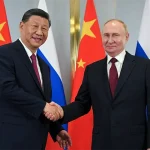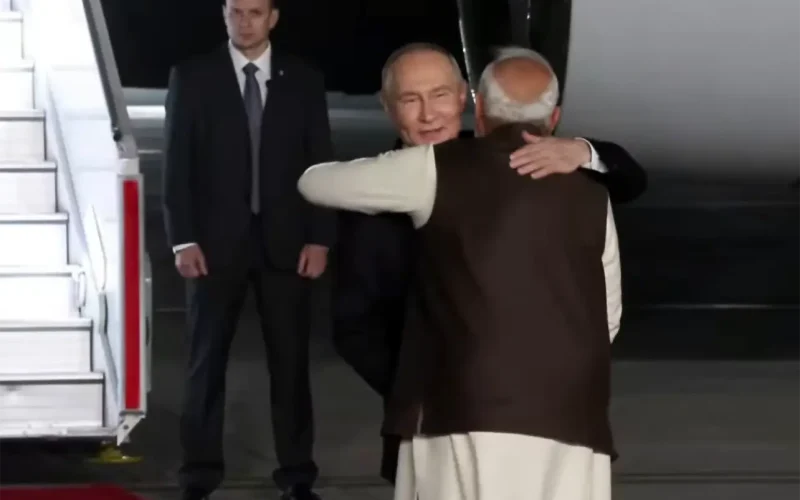
THE ceremonial embrace between Russian President Vladimir Putin and Indian Prime Minister Narendra Modi at New Delhi’s airport on Thursday evening carried profound symbolic weight far beyond diplomatic protocol. As two of the founding members of BRICS convened for their 23rd annual summit, their meeting crystallised the bloc’s accelerating transformation from an economic grouping into a geopolitical counterweight to Western-dominated institutions.
Putin’s first visit to India in four years arrives at an inflexion point in the global order. BRICS now encompasses approximately half the world’s population and accounts for more than 41 percent of global GDP measured by purchasing power parity, having expanded from five founding members to ten full members and nine partner nations. The bloc’s explosive growth underscores what analysts characterise as the most significant reconfiguration of global economic architecture since the Cold War’s end.
The New Delhi summit unfolds against a backdrop of extraordinary geopolitical complexity. Washington has imposed punishing 50 percent tariffs on Indian goods – the highest levied on any nation – with half representing direct punishment for New Delhi’s continued purchases of discounted Russian oil. The Trump administration’s aggressive trade tactics have forced India into a precarious balancing act between its historic ties with Moscow and its expanding strategic relationship with Washington.
Yet Modi’s decision to personally greet Putin on the tarmac – breaking with standard diplomatic protocol – and host him for a private dinner sent an unmistakable message. As Kanti Bajpai, visiting professor at Ashoka University, observed, the red carpet treatment signals to both Washington and Beijing that India “has options” and maintains “diplomatic hedging” that provides “a bit more bargaining room”.
The summit’s agenda reflects the breadth of bilateral ambitions. Russia and India are targeting expansion of bilateral trade to $100 billion by 2030 from $68.7 billion in fiscal year 2025, though the current relationship remains heavily skewed in Moscow’s favour due to energy imports. Indian exports to Russia stood at a mere $4.88 billion against imports of $63.84 billion, creating urgent pressure for trade diversification.
The Putin-Modi talks cannot be divorced from BRICS’s broader trajectory. At the bloc’s July 2025 summit in Rio de Janeiro, members issued a declaration calling for “a fairer and more representative international order” and a “revitalised and reformed multilateral system”. This language, while diplomatically calibrated, reflects growing frustration among Global South nations with what they perceive as Western-centric governance structures.
The bloc was founded in 2009 on the premise that international institutions were overly dominated by Western powers and had ceased to serve developing countries. That founding critique has only intensified as BRICS has matured. The group’s New Development Bank now funds infrastructure projects in local currencies, positioning itself as an alternative to traditional Western-led financial institutions.
Iran’s Supreme Leader explicitly framed BRICS membership as crucial for reducing dollar dependency, stating that member countries “must strive to eliminate the dollar in trade as much as possible”. This dedollarisation agenda, while aspirational and facing significant practical obstacles, represents a direct challenge to American financial hegemony.
India’s Strategic Tightrope
For India, the summit encapsulates the contradictions inherent in navigating today’s fractured geopolitical landscape. New Delhi is simultaneously negotiating a crucial trade deal with Washington while deepening its “special and privileged strategic partnership” with Moscow. India is pursuing a free trade agreement with the European Union while maintaining defence cooperation with Russia that has spanned decades.
During Friday’s formal talks at Hyderabad House, Modi emphasised India’s position on Ukraine, telling Putin: “India is not neutral – India has a position, and that position is for peace. We support every effort for peace, and we stand shoulder to shoulder with every initiative taken for peace.” The carefully worded statement reflects India’s refusal to condemn Russia’s invasion while maintaining rhetorical support for a peaceful resolution.
Moscow has been India’s top arms supplier for decades, and the Kremlin emphasised that discussions would cover “the scope of Russia-India special and privileged strategic partnership in politics, trade and economy”. Expected agreements include joint ventures in fertiliser production, Russian banking operations in India, and potential sales of additional S-400 missile defence systems.
Multipolar Reality Confronts Unipolar Legacy
The global political economy is undergoing a significant transformation as emerging powers challenge traditional Western institutional dominance through economic expansion, financial innovation, and joint diplomatic strategies. BRICS’s expansion from its original five members to include Egypt, Ethiopia, Indonesia, Iran, and the United Arab Emirates represents more than numerical growth – it signifies geographical diversification and increased collective economic weight.
In 2024, BRICS collectively achieved 4 percent GDP growth while worldwide growth stood at 3.3 percent. Leading growth projections for 2025 include Ethiopia at 6.6 percent and India at 6.2 percent, underscoring the bloc’s economic dynamism relative to mature Western economies facing stagnation.
The Putin-Modi summit also carries implications for BRICS’s institutional evolution. Putin emphasised that Russia would extend full support as India takes over the BRICS chairmanship next year, positioning New Delhi to shape the bloc’s agenda during a critical period of expansion and consolidation.
Weapons, Energy, and the Limits of Sanctions
Russia’s isolation following its Ukraine invasion has paradoxically strengthened its ties with non-Western partners. Emerging economies have largely replaced Russia’s lost trade with advanced economies, demonstrating how global commerce is rapidly reorganising around new growth centres despite Western economic isolation attempts.
For India, Russian energy imports surged after European nations curtailed purchases, though New Delhi has recently reduced Russian oil imports following U.S. sanctions on Rosneft and Lukoil. This reduction reflects not ideological alignment but pragmatic calculation in response to American economic pressure.
The defence relationship remains fundamental. India used Russian S-400 systems during its May air confrontation with Pakistan, demonstrating the strategic value of equipment that Washington has pressured New Delhi to abandon. Putin is expected to push for sales of Su-57 stealth fighters and additional S-400 batteries, deals that would further complicate India’s relationship with the United States.
Testing the Limits of Strategic Autonomy
Although internal rivalries and differing priorities complicate BRICS decision-making and limit its ability to present a fully unified political front, the group continues to advance cooperation in economic and developmental domains while expanding its global influence through membership growth. Tensions between India and China have never prevented annual summit meetings, suggesting pragmatic compartmentalisation of disputes.
The summit’s outcome will be measured not merely in signed agreements but in its demonstration of whether middle powers can successfully pursue strategic autonomy in an increasingly polarised international system. As Trump administration officials met with Putin in Moscow days before his visit to discuss Ukraine peace terms, the interconnected nature of contemporary diplomacy becomes apparent.
India faces what one analyst termed a “conundrum” – steps to strengthen ties with either Moscow or Washington risk setting back relations with the other. Yet this challenge also represents an opportunity. By demonstrating its ability to maintain productive relations with competing powers, India positions itself as an indispensable actor whose cooperation both Washington and Moscow actively seek.
Multipolar Order Takes Shape
The Putin-Modi summit in New Delhi represents more than bilateral diplomacy. It exemplifies the concrete emergence of what scholars describe as a multipolar international order – one in which emerging economies leverage collective weight to reshape rules written during an era of Western dominance.
Whether BRICS can translate its demographic and economic heft into coherent political influence remains an open question. The bloc’s members harbor divergent interests and competing visions. Yet the very fact that Putin received a ceremonial welcome in New Delhi while facing an International Criminal Court arrest warrant illustrates the limitations of Western-led enforcement mechanisms when major non-Western powers decline to participate.
As India and Russia announced multiple cooperation agreements spanning defense, nuclear energy, fertilizer production, and banking, the broader message resonated clearly: the unipolar moment has definitively ended. What replaces it – whether a stable multipolar system, regional spheres of influence, or something entirely novel – will be determined in forums like the one that convened in New Delhi this week, where two giants of the Global South charted their course through turbulent geopolitical waters.