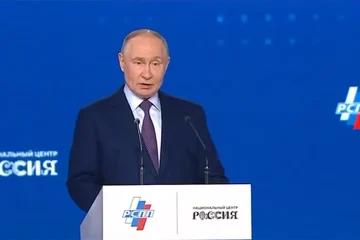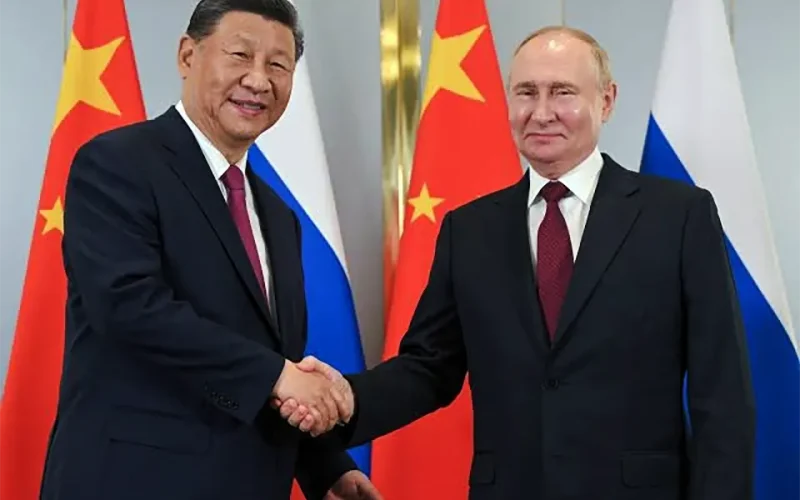
IN a summit laden with symbolic and strategic weight, Russian President Vladimir Putin and Chinese President Xi Jinping convened at the Great Hall of the People in Beijing, cementing what both leaders described as a relationship at an unprecedented level of depth and alignment. The meeting produced a sweeping joint statement on the further strengthening of their comprehensive strategic partnership and a separate declaration on the formation of a multipolar world order – twin documents that together constitute the most explicit articulation yet of a Beijing-Moscow vision for the post-unipolar age.
The talks, held first in a restricted format and then expanded to include senior delegation members, were followed by the signing of approximately 40 intergovernmental, interdepartmental and corporate agreements. The package spans trade architecture, renewable energy cooperation, digital financial infrastructure, scientific and technological innovation, and people-to-people exchanges. Together, the documents represent a qualitative deepening of a partnership that has grown rapidly in strategic scope since 2022.
THE ‘NEW TYPE’ PARTNERSHIP DEFINED
Central to both leaders’ public remarks was the concept of a “new type” of state relationship — one defined, they said, by mutual respect, deepening political trust, and immunity from third-party pressure. Xi marked the 30th anniversary of the China-Russia strategic partnership and the 25th anniversary of their Treaty of Good-Neighbourliness and Friendly Cooperation, announcing a mutual decision to extend the treaty. The framing was deliberate: longevity, not expedience, is what Beijing and Moscow want the world to read into this relationship.
“As permanent members of the UN Security Council and important major countries in the world, China and Russia should take a strategic and long-term perspective and work to make the global governance system more just and reasonable.”
Xi Jinping, President of the People’s Republic of China, Beijing, 20 May 2026
Putin echoed the sentiment, describing negotiations with the Chinese side as conducted in a traditionally warm, comradely and constructive atmosphere. The Russian president’s characterisation of bilateral relations as having reached an unprecedented level was not rhetorical excess: the data underpins it. Trade turnover between the two countries reached nearly US$240 billion in 2025, a figure that now anchors one of the world’s most consequential bilateral commercial corridors outside the Western-aligned system.
DE-DOLLARISATION: THE STRUCTURAL SHIFT
Perhaps the most consequential development confirmed in Beijing is the near-total completion of a bilateral de-dollarisation architecture. Putin disclosed that virtually all Russian-Chinese export-import operations are now carried out in roubles and yuan — a structural shift that, if sustained, represents one of the most significant departures from dollar-denominated trade in the post-Bretton Woods era.
The two governments have coordinated steps to shift settlements into national currencies, and Putin described the result as a stable system of mutual trade protected from external influence and negative trends on global markets. For the broader BRICS project — which has made financial multipolarity a central ambition — the Russia-China bilateral model now functions as a proof of concept, demonstrating the technical and political feasibility of large-scale trade settlement outside Western financial infrastructure.
| KEY AGREEMENTS SIGNED IN BEIJING |
| • Joint Statement on Comprehensive Partnership and Strategic Interaction |
| • Joint Declaration on a Multipolar World and New Type of International Relations |
| • Memorandum on mutual recognition of environmental certificates for electricity generation |
| • Approximately 40 intergovernmental, interdepartmental and corporate documents in total |
| • Launch framework for China-Russia Years of Cooperation in Education |
| • Extension of visa-free regime for Russian citizens in China until 31 December 2027 |
ENERGY, TECHNOLOGY AND THE GREEN TRANSITION
The energy dimension of the Beijing agreements extended well beyond hydrocarbons. Putin highlighted substantial potential for cooperation in renewable energy, specifically in the implementation of joint low-carbon generation projects, and confirmed that both countries are working toward mutual recognition of environmental certificates for electricity generation. A corresponding memorandum was concluded during the visit.
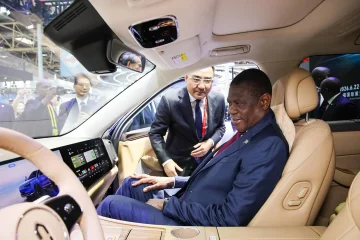
The two leaders also addressed the development of new joint value-added chains through advanced technologies. Putin cited the establishment of Chinese car brand production in Moscow and several Russian regions as an illustration of industrial integration already underway, alongside large-scale projects in non-ferrous metallurgy, chemicals, pulp and paper, biotechnology, pharmaceuticals, aircraft manufacturing and space exploration. Discussions also covered cooperation on critical elements and metals required for the broader adoption of green technologies — a domain in which both China and Russia hold strategic resource leverage over Western clean-energy supply chains.
PEOPLE-TO-PEOPLE DIPLOMACY AND EDUCATIONAL ARCHITECTURE
Beyond the geopolitical and economic dimensions, the summit produced a significant framework for educational and scientific cooperation. Putin and Xi jointly opened the Russia-China Years of Cooperation in Education, a programme Xi described as a strategic decision taken with the long-term development of bilateral relations in mind. The initiative encompasses hundreds of projects across higher education, secondary vocational training and school-level exchanges.
Putin disclosed that Russia and China have established 15 inter-university associations, with Saint Petersburg State University and Beijing’s Tsinghua University among those set to launch a new Chinese-Russian Institute of Fundamental Research. The scope of the programme signals that both states view knowledge diplomacy as integral to their long-term strategic relationship. Beijing also extended the visa-free regime for Russian citizens through 31 December 2027. In 2025, more than two million Russians travelled to China, while over one million Chinese citizens visited Russia.
“Russia and China are important trading partners for each other. In 2025, trade turnover reached almost US$240 billion — and practically all operations are now carried out in roubles and yuan.”
Vladimir Putin, President of Russia, Beijing, 20 May 2026
IMPLICATIONS FOR BRICS AND THE GLOBAL SOUTH
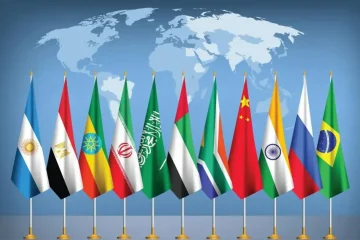
The Beijing summit must be read within its BRICS context. Both Xi and Putin explicitly affirmed their commitment to cooperation within BRICS, the Shanghai Cooperation Organisation, and other multilateral structures. Putin’s statement that Moscow and Beijing jointly uphold international law and cooperate effectively within the BRICS framework was not ceremonial — it was a political declaration directed as much at BRICS member states and the broader Global South as at Western capitals.
For Africa, the summit carries particular resonance. The African continent is the fastest-growing zone of BRICS engagement, with ten African states now holding full or partner status within the grouping. The deepening of the China-Russia axis within BRICS strengthens the bloc’s institutional capacity to offer African states genuine alternatives in trade financing, technology transfer, and energy investment — alternatives that do not carry the conditionality architecture of Western-aligned multilateral institutions.
The construction of a yuan-rouble settlement system also carries implications for African central banks increasingly exploring local currency arrangements with BRICS partners. If Beijing and Moscow have demonstrated at scale that de-dollarisation is operationally viable, African finance ministers and trade negotiators have reason to accelerate their own explorations of bilateral currency frameworks within the broader BRICS context.
ANALYSIS: SOLIDARITY WITH STRATEGIC SUBSTANCE
What distinguishes the May 2026 Beijing summit from prior Xi-Putin encounters is the degree to which stated commitments are now backed by structural architecture. The visa-free regime, the near-complete shift to national currency settlement, the 40-document package, the educational cooperation framework, the renewable energy memoranda — these are not declarations of intent. They are the institutional sinew of a relationship that has moved from strategic alignment to operational integration.
From a BRICS perspective, the summit consolidates the partnership between the bloc’s two most powerful founding members at precisely the moment when the grouping’s credibility as an alternative architecture for global governance is under the greatest scrutiny. A BRICS that can point to a functioning, treaty-anchored, trade-settled, people-connected China-Russia axis is a BRICS that can speak with greater authority to the Global South’s aspiration for a genuinely multipolar world.
Whether the broader membership can translate that bilateral momentum into collective institutional strength remains the defining challenge. The Beijing summit provides the axis. The work of BRICS — and of African states within it — is to build the wheel.