RUSSIAN President Vladimir Putin has issued a direct summons to Russia’s private sector to embed itself inside a new National Committee for Business Cooperation within BRICS – a body standing up at the precise moment that AI, autonomous systems, and digital platforms are redrawing the boundaries of economic power. The instruction, delivered at the congress of the Russian Union of Industrialists and Entrepreneurs (RSPP) on 26 March, is not merely an internal industrial directive. It is a geopolitical signal pitched squarely at the forty-plus percent of humanity that BRICS now represents.
Putin’s framing was unambiguous. The countries that advance in the next decade will be those that invest in new technologies – and Russia’s preferred vehicle for that advance, he said, is BRICS. For African member states and partner countries, the statement carries immediate strategic weight: Moscow is not simply seeking markets. It is building institutional infrastructure, with the Kremlin’s fingerprints on the founding documents.
THE COMMITTEE: ARCHITECTURE OF INTENT
The National Committee for Business Cooperation within BRICS was established by presidential decree in February 2026. Its inaugural meeting coincided with the RSPP congress – a deliberate choreography designed to signal private-sector ownership of what might otherwise have been dismissed as a state-bureaucratic exercise. Maksim Oreshkin, Deputy Chief of Staff of the Presidential Executive Office, was appointed Chairman. His dual role as the President’s Special Representative for Trade and Economic Cooperation with BRICS countries – and as Russia’s point man at the New Development Bank – makes him the connective tissue between political will and financial architecture.
The committee draws its membership from Russia’s largest companies, bringing the weight of concentrated industrial capital to bear on BRICS-wide ambitions. Putin urged the RSPP and the broader Russian business community to actively shape the committee’s proposals – a formulation that reads less like an invitation and more like a mobilisation order.
“In today’s world, those who invest in new technologies and continuously improve their efficiency are the ones advancing.”
Vladimir Putin, 26 March 2026
THE THREE TECHNOLOGIES THAT MATTER
Putin identified three cross-cutting domains where Russia intends to concentrate both domestic investment and BRICS-wide collaboration: artificial intelligence, autonomous systems, and digital platforms. The choice is not incidental. These are precisely the sectors where Western technology giants – and their associated regulatory, standards-setting, and intellectual property regimes – have historically set the rules.
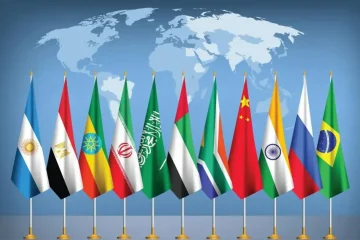
For BRICS economies in Africa, the implications are significant. Egypt, Ethiopia, and South Africa – all either full BRICS members or significant partner-country candidates – have variously articulated national AI strategies, digital infrastructure gaps, and industrial automation deficits that Russian technology cooperation could theoretically address. The committee’s mandate explicitly encompasses science, innovation, industry, agriculture, infrastructure, and logistics: in other words, the full productive spine of developing economies.
GEOPOLITICS BEHIND THE ARCHITECTURE
The launch of this committee does not occur in a vacuum. Russia remains under sweeping Western sanctions that have accelerated Moscow’s pivot toward BRICS as the primary arena for economic diplomacy. The bloc’s 2024 Kazan Summit elevated technology sovereignty as a defining theme, and the February 2026 presidential decree operationalises those commitments with institutional form.
Putin’s explicit identification of the Asia-Pacific and Southern Eurasia as the priority regions for technology collaboration – with BRICS as the platform – situates Africa as a secondary, though not marginal, theatre. For African policymakers, this calculus demands careful reading: Russia is building BRICS tech architecture from within, with or without African co-design. The question for capitals from Pretoria to Addis Ababa is whether they engage as architects or as eventual consumers of others’ blueprints.
The New Development Bank dimension adds another layer. Oreshkin’s chairmanship creates a direct channel between the committee’s project pipeline and the NDB’s infrastructure financing capacity — effectively allowing Russia to propose, shape, and potentially co-finance BRICS-wide technology projects through a multilateral vehicle that carries none of the bilateral sanction risk of direct Kremlin funding.
The NDB connection transforms this from a diplomatic gesture into a potential financing architecture — one that could rival Bretton Woods instruments on Global South terrain.
WHAT THIS MEANS FOR AFRICA
For African states, the emergence of a structured BRICS business cooperation mechanism on technology is a double-edged development. On one hand, it represents a concrete institutional channel through which African governments and companies can engage with Russian technology ecosystems – in agriculture automation, AI-driven logistics, or digital platform infrastructure – outside the dollar-dominated Western tech order.
On the other, it replicates a pattern Africa knows well: strategic partners arriving with institutional frameworks already built, inviting African participation within architectures designed elsewhere. The BRICS Business Council, in which Russia is also seeking to deepen its role, offers a parallel venue — but African member states must be deliberate about converting committee participation into genuine co-design leverage.
Putin’s signal to Russian business is ultimately a signal to BRICS partners: the bloc is moving from declaration to infrastructure. Whether African economies ride that infrastructure or simply receive it will depend on how actively their governments and private sectors engage the new committee’s work in the months ahead.