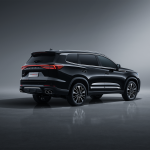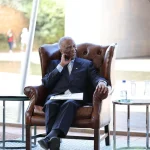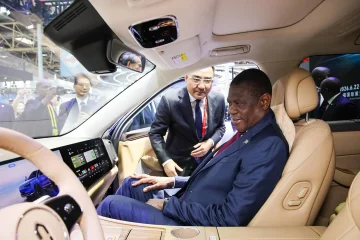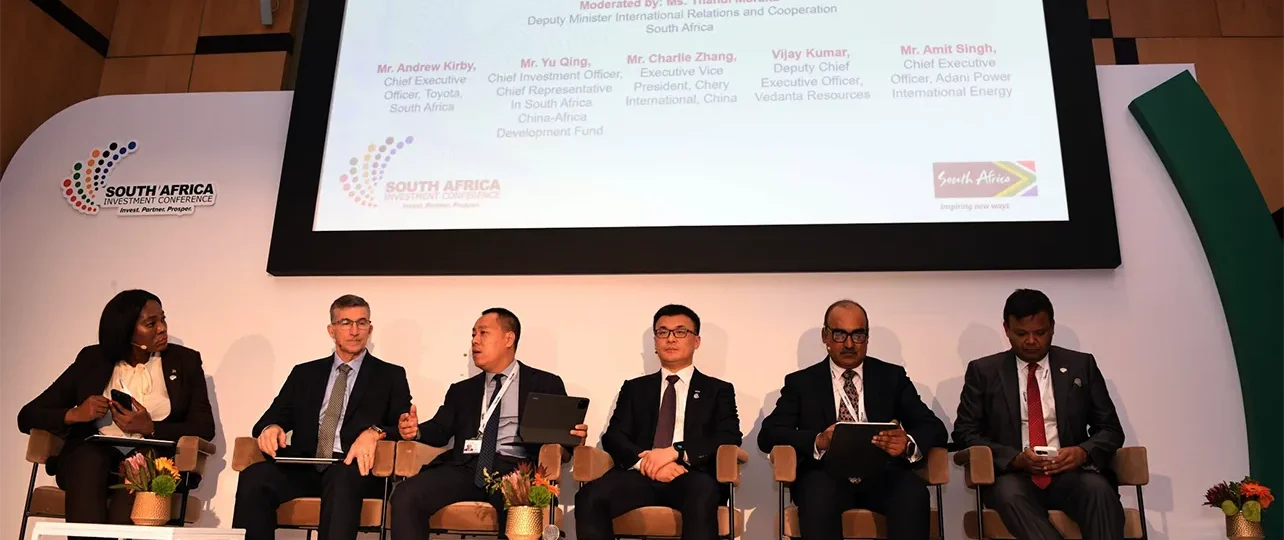

WHEN Charlie Zhang, Vice-President of Chery Auto and Executive Vice-President of Chery International, took to the floor of the sixth annual South Africa Investment Conference (SAIC 2026), he delivered more than a corporate announcement. He delivered a geopolitical statement: China’s largest privately owned automaker is planting a flag in South Africa’s industrial heartland, and it intends to stay.
Chery has confirmed a multi-billion-rand investment to recommission and retrofit the former Nissan manufacturing facility in Rosslyn, Pretoria — a plant that has produced vehicles since 1966 — transforming it into the anchor for the company’s African and European export ambitions. Nearly 3 000 direct and indirect jobs are expected to flow from the investment, spanning manufacturing, supply chain, and services.
“This investment is a vote of confidence in South Africa and a direct result of the unwavering support from our customers and dealer network over the past four years.”
Charlie Zhang, VP, Chery Auto
The announcement, made on Tuesday in Sandton, ended months of speculation that followed Nissan’s January disclosure that it had sold its Rosslyn assets as part of a global cost-cutting exercise. Chery outbid Chinese rival Great Wall Motors (GWM) for the site. Now, the company that re-entered South Africa only four years ago — and rapidly became the country’s third-largest selling automaker with approximately 50 000 units sold annually — is deepening its roots with a commitment that goes well beyond market access.
Retrofitting work will begin immediately, with Chery targeting mid-2027 as the date for the first locally produced vehicles to roll off the assembly line. The product mix, yet to be fully confirmed, is expected to include electrified vehicles — hybrids, plug-in hybrids, and battery-electric models — alongside conventional internal combustion engine models, positioning Rosslyn as a hub for both the African continent and export markets in Europe.
BRICS Solidarity in Steel and Silicon
For observers of the Global South’s economic architecture, the Chery announcement is more than a corporate milestone — it is a demonstration of what South-South industrial cooperation can yield. As Western multinationals have in some cases retreated from the African manufacturing landscape, Chinese firms have moved in the opposite direction, translating market share into manufacturing footprint.
Chery’s move is consistent with a broader pattern among Chinese automakers seeking to insulate themselves from tariff risks and regulatory headwinds in Western markets by diversifying their global manufacturing base. South Africa, with its established automotive infrastructure, skilled labour pool, and preferential trade access to African and European markets under the African Growth and Opportunity Act (AGOA) and its European Union trade agreements, offers a compelling platform.
Zhang was unequivocal on the strategic intent: “Chery’s investment in South Africa is not only an important step in the company’s globalisation development, but also our long-term commitment to the economic and industrial development of South Africa. Moving from an importer to a manufacturer deepens our roots in this country.”
Rosslyn Reborn: From Nissan’s Legacy to China’s Future
The Rosslyn plant carries the weight of South African automotive history. Since 1966, the facility has been synonymous with vehicle production in Tshwane, assembling Datsuns and Nissans for generations of South African drivers. Over recent years, however, it operated well below capacity as Nissan’s global fortunes declined. Its sale represented both an end and a beginning.
Chery has committed to retaining a significant number of workers from the former Nissan operation, prioritising continuity and institutional knowledge. Beyond direct employment, the company says it will actively develop a local supplier network to support the South African components and parts industry — a critical condition for meaningful localisation that goes beyond screwdriver assembly.
Industry analysts welcomed the announcement but noted the critical distinction between semi-knocked-down (SKD) assembly — which delivers limited developmental impact — and full, completely-knocked-down (CKD) manufacturing, which anchors supply chains and creates sustainable employment. Siyabonga Mthembu, motor sector leader at BDO South Africa, stated plainly: without progression from SKD to CKD, South Africa risks becoming a sales market rather than a manufacturing hub.
“Our presence in South Africa is not a fleeting venture, but a long-term commitment to the future. We aim to bring not only investment and innovative products, but also a solid assurance of industrial collaboration.”
Charlie Zhang, EVP, Chery International
R800 Billion and Counting: SAIC 2026 in Context
The Chery commitment arrived against a backdrop of extraordinary investment momentum. President Cyril Ramaphosa, in closing SAIC 2026, announced that South Africa had secured more than R800 billion in new investment pledges and commitments — a significant tranche of the government’s five-year, R2 trillion investment target.
Toyota’s announcement of a further R10 billion investment in its KwaZulu-Natal operations also featured prominently, reinforcing South Africa’s role as the continent’s pre-eminent automotive manufacturing hub. For a country whose vehicle market recorded its best March since 2007 — with 58 060 new vehicles sold, a 17.3% improvement year-on-year — the timing is propitious.
Kaamil Alli, spokesperson for the Minister of Trade, Industry and Competition, Parks Tau, said the investment demonstrated confidence in South Africa’s vehicle sector and its status as a preferred market for new original equipment manufacturers (OEMs). The government, he noted, is working to grow the automotive sector in alignment with the South Africa Auto Masterplan, with localisation and job creation at its core.
Deputy President Paul Mashatile, who met Chery International Southern Africa CEO Tony Liu on the sidelines of the conference, added diplomatic weight to the encounter, underlining the government’s active role in facilitating the investment.
The Bigger Picture: China, Africa, and the Auto Masterplan
Chery is not alone among Chinese brands eying South African soil for production. Beijing Automotive Industry Holding Co (BAIC) already operates an assembly plant in the Eastern Cape. Great Wall Motors, which owns Haval, is investigating production possibilities at the Mercedes-Benz East London facility. The question is no longer whether Chinese brands will manufacture in South Africa — it is how quickly, and how deeply, they will localise.
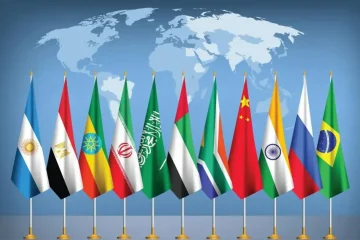
For BRICS partner nations watching from Brasilia, Moscow, New Delhi, and Beijing, the Chery announcement reads as proof of concept for the emerging model of Global South industrial cooperation: market entry, market leadership, and then productive investment — a virtuous cycle that serves both investor and host economy.
South Africa, for its part, is increasingly positioning itself as the gateway through which Global South capital enters the African continent. With trade agreements covering both the African Continental Free Trade Area (AfCFTA) and key European markets, Rosslyn’s revival is not merely a Pretoria story. It is a pan-African industrial narrative in its earliest chapters.
Chery expects its first South African-made vehicles to roll off the Rosslyn line by mid-2027. By then, the world’s geopolitical landscape may have shifted again. But the factory will still be there — concrete, steel, and thousands of workers — bearing witness to the moment that a Chinese automaker chose to build, not just sell, in Africa.
CHERY IN SOUTH AFRICA — KEY FACTS
Plant location: Rosslyn, Pretoria (former Nissan facility, operating since 1966)
Investment scale: Multi-billion rand — exact figure not yet disclosed
Job creation: Nearly 3 000 direct and indirect jobs (manufacturing, supply chain, services)
Timeline: 12–18 months to retrofit and recommission; first vehicles expected mid-2027
Product range: ICE and electrified vehicles (HEV, PHEV, BEV); exports to Africa and Europe planned
SA market standing: Third-largest selling automaker; ~50 000 units sold annually; ~150 dealerships
Brands in SA: Chery, Omoda, Jaecoo, Lepas, iCaur, Jetour
Competitor context: BAIC already manufacturing in the Eastern Cape; GWM is investigating East London
The African Mirror | Global South Media Network | gsmn.co.za