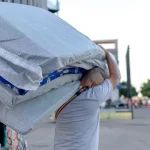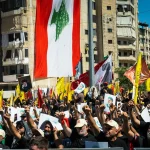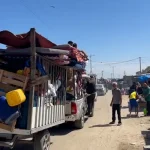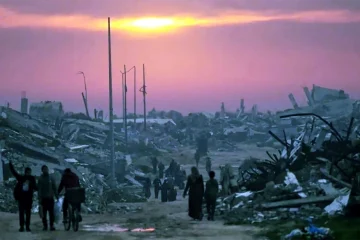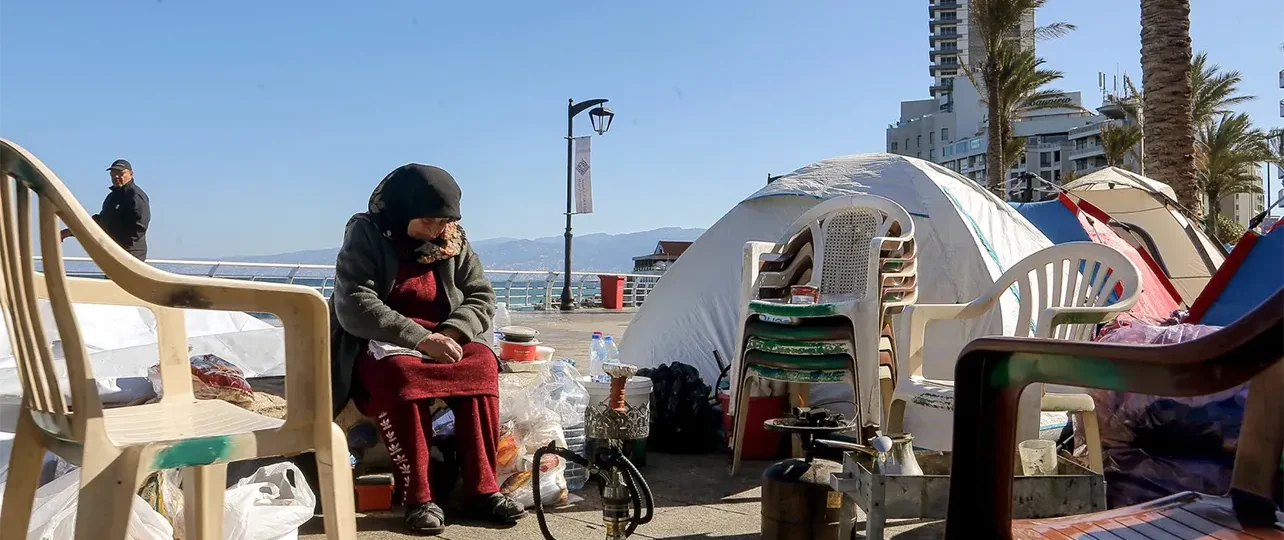

TWO weeks into Israel’s rapidly escalating bombardment and ground incursion in Lebanon, more than one million people have been forced to flee their homes. Entire villages across south Lebanon have emptied, while neighbourhoods in Beirut’s southern suburbs have once again watched residents pack belongings into cars and flee under mass evacuation orders.
Much like in late 2024, when nearly a million people in Lebanon were forced into displacement by fighting between Israel and Hezbollah, schools, municipal halls, and public buildings have been converted into emergency accommodation.
But as authorities and aid groups scramble to absorb the sudden wave of displacement yet again, a familiar problem is already emerging. While everyone seeking help is fleeing the same airstrikes, they are not all receiving the same help.
Migrant domestic workers, undocumented refugees, and other migrant labourers from African and Asian countries are being turned away from shelters, left to navigate the war largely on their own. Once again, people are being excluded from formal aid systems because they do not fall neatly into the categories through which humanitarian assistance is typically organised.
This is not a new oversight. It is a mistake the humanitarian system in Lebanon knows it has made before, and has failed to fix.
A displacement crisis layered onto an already fragile country
This new mass displacement is unfolding in a country already struggling to cope with intersecting and compounding humanitarian crises. Long before the latest escalation, Lebanon was hosting one of the highest numbers of refugees per capita in the world, including roughly 1.3 million Syrians (although only around 716,000 are registered as refugees), more than 200,000 Palestinian refugees, alongside an estimated 160,000 migrant workers from Ethiopia, Bangladesh, the Philippines, Kenya, and other countries.
Lebanon’s humanitarian response system has developed over the years of managing these overlapping populations. Aid is typically organised through parallel frameworks. One is run by the Lebanese government in collaboration with local humanitarian groups, designed primarily for Lebanese citizens displaced by conflict. The UN and international NGOs tend to coordinate help for other refugee populations, especially registered Syrian refugees who are already receiving help through the Lebanon Response Plan.
“The bombs don’t ask who you are. But when people arrive at shelters, suddenly those questions matter again.”
These systems help humanitarian actors coordinate large-scale responses, relying heavily on administrative categories such as citizenship status, refugee registration, and formal documentation. In moments of sudden crisis, those categories can determine who gains access to emergency shelters, food distributions, and cash assistance. “The system needs categories to function,” one humanitarian worker working in an international aid organisation* in Beirut explained. “But those categories also decide who gets help and who doesn’t.”
The problem is that war rarely respects these bureaucratic boundaries. Evacuation orders and airstrikes affect everyone living in targeted neighbourhoods across south Lebanon, Beirut suburbs, and, less frequently, targeted areas such as parts of Baabda and central Beirut.
Yet when Lebanese, Syrian, and Palestinian refugees and migrants flee, the aid system often begins sorting them again – separating those who qualify for assistance from those who do not. As one community volunteer involved in coordination for an informal shelter opened for migrants put it: “The bombs don’t ask who you are. But when people arrive at shelters, suddenly those questions matter again.”
Turned away from shelter
In the first days of the latest displacement wave, many people fleeing bombardment headed towards the same emergency shelters across the country. These official shelters are run by the government, and some by UNRWA, the UN’s agency for Palestinian refugees, with aid provided by or with various UN agencies and NGOs.
Echoing their experiences in 2024 and 2025, some migrant workers and undocumented refugees have been turned away because shelters prioritise Lebanese citizens or registered refugee populations. Others hesitate to approach shelters at all, fearing questions about their legal status or possible detention.

An undocumented Kenyan migrant domestic worker who fled bombardment in Beirut’s southern suburbs described arriving at a school that had been converted into a shelter, only to be told there was no space for her. “They asked if I was Lebanese,” she said. “When I said no, they told me the shelter was full.”
Community organisers and volunteers say these situations are becoming increasingly common as displacement grows and shelter capacity stretches beyond its limits. Many facilities are already overcrowded, and authorities are struggling to keep up with the demand for safe accommodation.
In the absence of clear options, some migrants and refugees are sleeping in cars, staying temporarily with friends, or relying on informal community networks. “We’re seeing people who escaped the same bombing,” one volunteer working at a migrant-run community kitchen serving warm daily meals to migrant men and women across the country said. “But when it comes to shelter, some people are simply not counted.”
An administrative and social blindspot
Wars have a way of exposing and amplifying the social hierarchies that structure everyday life. In Lebanon, the current displacement crisis is revealing how those hierarchies extend into humanitarian systems themselves.
For the hundreds of thousands now forced from their homes, displacement begins the same way: the sound of explosions, hurried phone calls between neighbours, children pulled from schools, bags packed in minutes. People flee the same streets, often in the same cars and buses, searching for safety wherever it might be found.

But once they reach the spaces where protection is supposed to begin, those shared experiences of war are filtered through administrative categories again. Citizens, refugees, migrants. Registered, unregistered. Eligible, ineligible. For many people living in Lebanon, those distinctions can determine whether a night of displacement ends inside a crowded classroom or in a car parked along the roadside.
As in previous waves of displacement, many Lebanese families are relying on informal support systems, staying with relatives or friends rather than in collective shelters, meaning that those seeking space in emergency accommodation are often among the most vulnerable, with fewer social or financial safety nets.
Wars have a way of exposing and amplifying the social hierarchies that structure everyday life.
In past wars, migrant workers and refugees also repeatedly struggled to access shelters, transportation, and emergency assistance. Civil society organisations and migrant community groups warned back then that large numbers of people were being left outside formal protection systems.
Yet the same dynamics are resurfacing again. Part of the problem lies in how humanitarian aid is structured. Assistance programmes are designed to operate at scale and under intense time pressure, which means they depend heavily on administrative categories. These categories help agencies identify target populations, allocate funding, and track who receives assistance.
But they also create blind spots. People who do not fall clearly within those categories, including many migrant domestic workers and undocumented migrants, can easily slip through the cracks of systems built around formal eligibility lists.
In Lebanon, where large numbers of migrants work under restrictive sponsorship arrangements and often lack secure legal status, those gaps can become particularly acute during emergencies. “The humanitarian system isn’t built to respond to everyone equally,” one aid worker involved in the displacement response said. “It’s built to respond to the people it already knows how to count.”
When displacement happens suddenly and at a massive scale, that distinction can determine who receives protection and who remains largely invisible within the response.

Counting displacement differently
In the absence of reliable access to formal humanitarian support, many migrants have turned instead to their own networks. Across Beirut and other cities, migrant-led organisations and informal community groups have been among the first to mobilise assistance. Community organisers have coordinated emergency shelter through churches and shared apartments, organised transport away from heavily bombed areas, and pooled resources to distribute food, medicine, and basic supplies.
These responses are often collective, improvised, and built on years of mutual support developed in response to the everyday precarity migrant workers face in Lebanon. Some initiatives operate through established migrant-led associations and community centres, while others emerge through informal networks of friends, neighbours, and WhatsApp groups that help people locate safe places to sleep or find transportation out of dangerous areas.
A small number of civil society groups and formal humanitarian actors have also worked to support migrants during the current crisis, providing emergency shelter, legal assistance, and evacuation support where possible. But these efforts remain limited compared to the scale of need, and much of the immediate assistance continues to rely on migrant communities themselves filling the gaps left by formal humanitarian systems.
Humanitarian systems cannot function without structure. But when help is given primarily through legal status rather than lived vulnerability, some of the people most exposed to violence become the least likely to find it. As more people flee the bombs seeking safety in Lebanon, this is a reminder that wars rarely create new inequalities. More often, they reveal the ones that were already there and force humanitarian systems to decide whether they are willing to see them.
*All of the sources quoted in this piece asked to remain anonymous for a variety of reasons, including lack of authorisation to speak to the media, concerns over personal safety, or fear of revealing their own undocumented status.