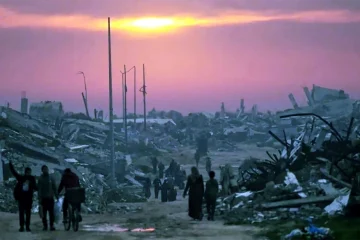

WHEN the first American and Israeli warplanes thundered over Tehran on the night of 28 February, Maryam — a schoolteacher in the city’s eastern Narmak district — packed two bags, grabbed her three children, and drove north through the night. She did not know where she was going. She only knew she was leaving. Thirteen days later, she is one of up to 3.2 million Iranians who have been internally displaced since the launch of joint US-Israeli military operations against Iran — a campaign that has, in less than two weeks, remade the human geography of one of the world’s oldest civilisations.
The figures, released on 12 March 2026 by the United Nations High Commissioner for Refugees (UNHCR), are staggering in both their scale and speed. Between 600,000 and one million Iranian households — representing up to 3.2 million people — are now temporarily displaced inside their own country, according to preliminary UNHCR assessments. The agency’s emergency response coordinator for the Middle East, Ayaki Ito, described the displacement trajectory as “a worrying escalation in humanitarian needs,” warning that the figure is “likely to continue rising as hostilities persist.”
The UN figures capture only those displaced within Iran’s borders. They do not account for the unknown number of Iranians who have attempted to flee across international frontiers — a figure that earlier reports from Turkey’s eastern Van province suggest is also significant. Nor do they capture the compounding human cost borne by Afghanistan’s already-vulnerable refugee population, hundreds of thousands of whom have been living in Iran under fragile conditions and who now face displacement upon displacement.
“This figure is likely to continue rising as hostilities persist, marking a worrying escalation in humanitarian needs.” — Ayaki Ito, UNHCR Emergency Response Coordinator
A CITY EMPTIES
The direction of movement is telling. Most displaced Iranians are fleeing Tehran and other major urban centres, heading north toward mountainous rural provinces — Alborz, Gilan, Mazandaran — in search of safety from the sustained aerial bombardment that US Central Command has internally designated Operation Epic Fury, and which Israel’s military is calling Operation Roaring Lion.
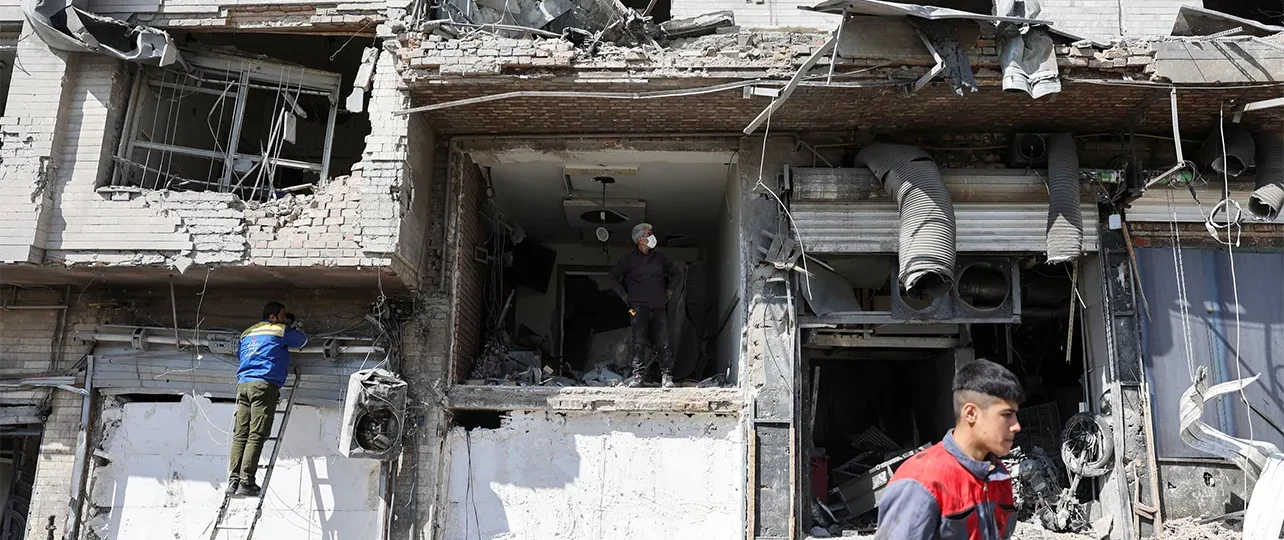
Tehran, a city of approximately 16 million people, has borne the heaviest weight of the air campaign. Strikes have hit military installations, nuclear-adjacent infrastructure, and — according to multiple international correspondents on the ground — densely populated residential neighbourhoods. Al Jazeera correspondent Tohid Asadi, reporting from the hard-hit eastern districts of the capital, described rescuers digging through mounds of rubble after multiple apartment buildings were struck in recent attacks. “We saw bodies taken out [of the rubble],” Asadi reported, “and the situation was far beyond what I can call disastrous.”
The supreme leader of Iran, Ayatollah Ali Khamenei, was killed in Tehran during the initial waves of US-Israeli strikes. His son, Mojtaba Khamenei, has since been elevated to leadership and has vowed, in a statement read on state television, to “avenge the blood” of Iranians killed in the campaign, while maintaining the closure of the Strait of Hormuz — a strategic chokepoint through which approximately 20 per cent of global oil transit flows.
THE FORGOTTEN DISPLACED: AFGHANS IN IRAN
Among the 3.2 million figures cited by UNHCR are an indeterminate number of Afghan refugee families — a community already living on the margins of Iranian society whose displacement now risks compounding into a second crisis within a crisis. Iran hosts one of the world’s largest Afghan refugee populations, many of whom fled their own country following the Taliban’s return to power in 2021. For these families — with limited support networks, without the legal protections that Iranian citizens possess, and in many cases without documentation — the war has stripped away the already-thin protections that made their lives sustainable.
“Families are leaving affected areas amid rising insecurity and limited access to essential services,” UNHCR’s statement noted, in language that applies equally to Iranian nationals and Afghan refugees. The agency has been working to adapt its existing infrastructure in Iran — operational reception areas, helplines, and ongoing support services — to the dramatically altered demands of wartime displacement.
Temporary shelters inside Iran have reached capacity. The humanitarian system built to respond to such crises has been kneecapped by US budget cuts — even as US strikes help produce the crisis.
A WAR CRIMES THRESHOLD
The targeting patterns of the joint US-Israeli air campaign have drawn mounting alarm from international humanitarian law experts. Refugees International, the Washington-based advocacy organisation, has warned that the campaign is “on course for cataclysmic civilian harm, displacement, and humanitarian need.” Its senior spokesperson, Jeremy Kondynyk, documented strikes on schools, multiple medical facilities, residential areas, and a water desalination plant — all of which enjoy explicit protection under the Geneva Conventions and customary international humanitarian law.
“It is difficult to regard the pattern of US strikes on civilian sites as mere tragic accidents,” Kondynyk said, “when the United States has systematically removed many of the safeguards that once helped prevent harm to civilians.” He cited comments by US Secretary of Defence Pete Hegseth dismissing what he called “stupid rules of engagement,” as well as his closure of the Pentagon office previously charged with minimising civilian casualties in order to maximise what Hegseth called “lethality.”
For its part, Iran’s military response has also struck civilian targets in Gulf states and urban areas, drawing condemnation from human rights monitors. The UN Secretary-General’s office confirmed that Iran has launched missile and drone barrages at US military positions and Gulf nations, with strikes reportedly hitting civilian infrastructure, including a desalination plant.
THE WIDER REGIONAL TOLL
Iran’s displacement crisis does not exist in isolation. The UN Secretary-General’s daily briefing of 12 March confirmed that across the broader regional theatre — encompassing Afghanistan, Iran, Lebanon, and Pakistan — more than 4.1 million people have been internally displaced since the escalation began on 28 February. A further 117,000 have sought refuge in other countries, with crossings into Turkey particularly documented in early March. In Lebanon, government figures indicate that more than 816,000 people have been registered as displaced as the conflict destabilises the region.
The UN has emphasised the urgent need to protect civilians, maintain humanitarian access corridors, and ensure that borders remain open to those seeking safety — obligations it notes are binding under international law. Whether those obligations will be honoured by any of the belligerents, in a conflict of this ferocity, remains deeply uncertain.
AFRICA’S STAKE
For the African continent, the human cost of this war is not abstract. The closure of the Strait of Hormuz has already sent oil prices to levels not seen since the 2008 commodity shock, with knock-on consequences for fuel costs, aviation, and food inflation across sub-Saharan Africa and North Africa alike. The IMF has revised its growth forecasts for the continent’s oil-importing economies downward. In South Africa, the rand has shed value against the dollar as risk-off capital flight punishes emerging markets.
Beyond economics, Africa’s principled posture on international law — expressed most visibly in the African Union’s calls for an immediate ceasefire and in South Africa’s consistent advocacy for a rules-based international order — is being tested by a conflict in which the world’s largest military power is striking a third country in a campaign that has produced, in thirteen days, one of the fastest-growing displacement crises on the planet.
In thirteen days, this war has produced more displacement than most conflicts generate in a year. The clock for civilians is not measured in geopolitical timelines.
NO CEILING IN SIGHT
What happens next is the question haunting every humanitarian assessment. UNHCR’s Ito was explicit: the 3.2 million figure is preliminary, and it is going up. The agency’s warning that “temporary shelters inside Iran have reached capacity” suggests that the displacement infrastructure is already overwhelmed — and the war shows no sign of drawing to a close.
Kondynyk of Refugees International was more direct: “If this evolves into a long-term war, and particularly if internal conflict emerges in Iran, the humanitarian consequences could worsen dramatically. A prolonged conflict risks creating displacement and humanitarian crises on a massive scale, even as US cuts have kneecapped the global humanitarian system built to respond to such crises.”
Maryam, the schoolteacher from Narmak, is reportedly staying in a relative’s house in a village south of Rasht, near the Caspian Sea. She has been unable to reach her school colleagues in Tehran for four days. She does not know when, or whether, she will return.
Her story is, in the arithmetic of this war, one of 3.2 million.