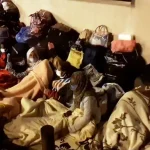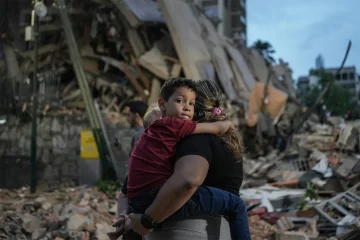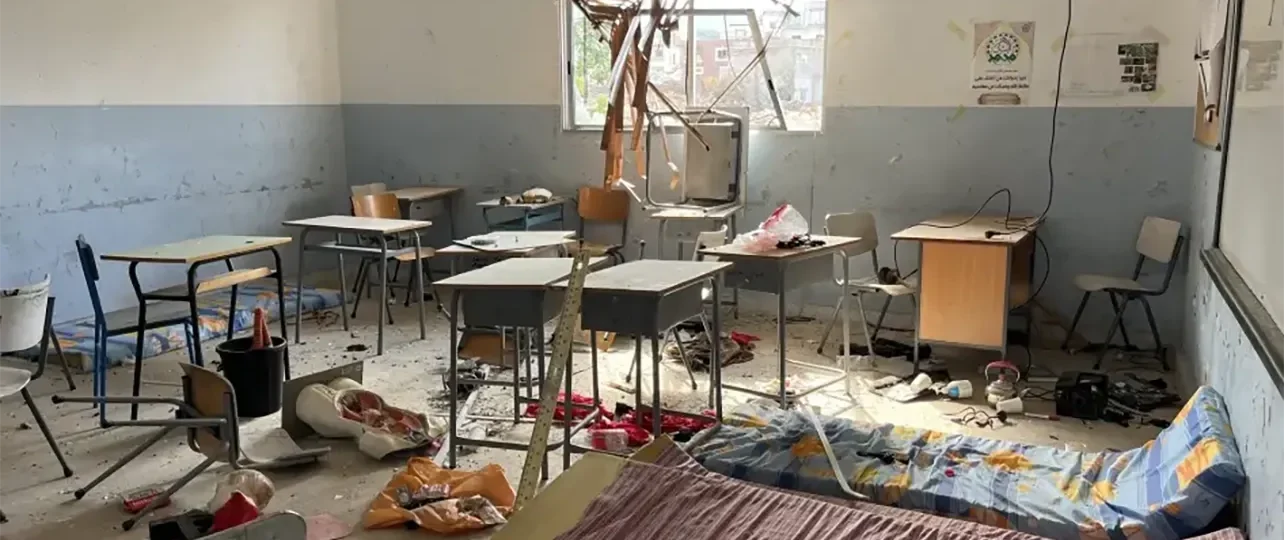

IN a school in Beirut’s Burj Hammoud neighbourhood, the desks have been pushed aside. Mattresses line the floors. Plastic bags stuffed with belongings hang from the pupils’ coat hooks. The children who once sat in these rows are now among the displaced – part of a swelling tide of humanity that, in less than two weeks, has transformed Lebanon’s education infrastructure into the country’s primary humanitarian shelter network.
This is Lebanon in March 2026: a country being shelled into displacement for the second time in eighteen months, its schools pressed once more into emergency service, and its humanitarian response system running on a fraction of the funding required to meet the need.
| “In a matter of hours, thousands of people were uprooted across southern Lebanon, Beirut’s southern suburbs, and the Bekaa.” — Karolina Lindholm Billing, UNHCR Representative in Lebanon |
The Scale of a Second Catastrophe
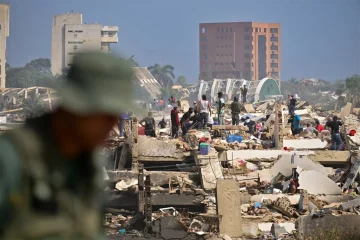
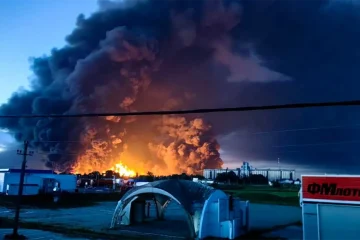
The latest escalation began in the early hours of 2 March 2026, when Israel issued evacuation warnings to residents of more than 53 villages and densely populated areas across Lebanon, followed by intensified airstrikes that forced families to flee within minutes. The speed and scale of displacement overwhelmed local authorities almost immediately.
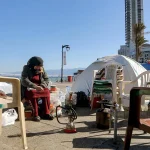
Within a week, more than 667,000 people had registered on Lebanon’s government displacement platform – an increase of over 100,000 in a single day – with numbers continuing to climb. Of those, approximately 120,000 are sheltering in government-designated collective sites. Hundreds of others have been found sleeping in cars, on roadsides, and on pavements in Beirut’s outer districts, unable to access formal shelter or lacking the financial means to rent private accommodation.
By 7 March, Lebanon’s Disaster Risk Management unit had documented 112,525 displaced people sheltering across 514 collective sites nationwide. Among them: more than 4,000 female-headed households, over 1,600 households headed by a person living with disability, and more than 5,200 headed by elderly persons – among the most vulnerable in any displacement scenario.
By 5 March, Lebanese authorities had already opened 399 emergency shelters across the country, the majority of them public schools. Of those, 357 were already at full capacity within days of opening.
| Of 399 emergency shelters opened within days of the escalation, 357 were already at full capacity by 5 March — the vast majority of them converted public schools. |
Children Displaced from Learning, Then from Safety
For Lebanon’s children – estimated at around 200,000 among the displaced, according to UNICEF – the crisis has compounded trauma upon trauma. Many were already living with the psychological residue of the 2024 hostilities. Now, the schoolrooms that were meant to mark their return to normalcy have become their emergency bedrooms.
UNICEF noted that the latest wave of displacement comes “adding to the tens of thousands already uprooted from previous escalations,” underscoring a pattern in which Lebanon’s civilian population has been denied durable safety between successive rounds of conflict. The United Nations Children’s Fund has indicated that 326 public schools would need to deliver adapted learning programmes – blended and in-person – to ensure some continuity of education, but this is contingent on funding that, so far, has not materialised at the required scale.
For Palestinian refugees inside Lebanon – a community of approximately 486,300 people who make up a particularly exposed subset of the displaced – the crisis has been especially acute. UNRWA activated emergency shelters on 4 March, opening its Siblin Training Centre in Saida Area and six school buildings at the Nahr el-Bared camp north of Tripoli. By 6 March, approximately 1,300 displaced people had been registered in UNRWA shelters, while community members in some areas were reported to have forced open school gates themselves in search of accommodation.
A Region in Motion: The Syria Spillover
The displacement is not contained within Lebanon’s borders. The crisis has opened a new, urgent cross-border dimension that adds complexity to an already overburdened regional humanitarian architecture.
According to Syrian authorities, more than 78,000 Syrians re-entered Syria from Lebanon following the 2 March escalation, alongside over 7,700 Lebanese nationals. The Syrian returnees include refugees who had been planning an orderly return to their country of origin in the coming months – plans now accelerated by fear, and complicated by the fact that many are arriving in communities still recovering from years of conflict and economic collapse.
UNHCR teams have been deployed at five major Syrian border crossings to provide emergency relief – mattresses, blankets, water containers, and solar lamps – to those arriving. The broader regional picture is one of cascading displacement: the Middle East escalation that began on 28 February, when the United States and Israel launched military strikes on Iran, has produced displacement pressures from Tehran to the Lebanese-Syrian frontier.
The Funding Chasm
The humanitarian response to Lebanon’s crisis is being conducted against a backdrop of catastrophic underfunding – a structural failure that risk analysts and aid workers have warned about for months, and which the March escalation has now laid bare in the most damaging possible way.
UNHCR’s Lebanon operation is currently funded at just 14 percent of its stated requirement of USD 472 million for 2026. That means for every seven dollars needed to respond to one of the fastest-growing displacement crises in the world, donors have collectively provided one. The Syria operation sits at 28 percent of its USD 324 million requirement. Iraq at 28 percent of USD 61 million. In South-West Asia, the Afghanistan response has received only 15 percent of its USD 454 million requirement.
In practical terms, UNHCR Representative Karolina Lindholm Billing confirmed that the agency is working to replenish country-level emergency stocks depleted by the pace of displacement — a pace that has outrun logistics. As of mid-March, UNHCR had delivered approximately 168,000 emergency items to more than 63,000 displaced people across over 270 collective shelters. Those items include mattresses, blankets, sleeping mats, sleeping bags, solar lamps, and jerry cans. They are essential. They are also a fraction of what is required.
Médecins Sans Frontières was direct in its assessment: Lebanon’s response plan is only 14 percent funded while contingency stocks remain critically low. MSF head of programmes in Lebanon, Jeremy Ristord, stated that the mobilisation of emergency and flexible funding must happen immediately, calling the needs immense and warning that tens of thousands of people require urgent protection, water, basic relief items, and healthcare access now.
| Lebanon’s UN humanitarian operation is 14% funded against a USD 472 million requirement. For every seven dollars needed, donors have provided one. |
Generational Trauma on Repeat
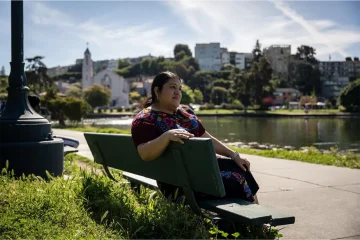
The human cost of this crisis cannot be adequately rendered in numbers alone. UNHCR’s Billing recounted visiting a Beirut shelter last week, where she met a woman in her nineties who had lost eleven members of her family in the 2024 attacks. That woman is now displaced again – in the same school, converted to a shelter, where she previously sought refuge. It is a detail that collapses the abstraction of statistics into a single, searing image of what repeated forced displacement does to people across the arc of their lives.
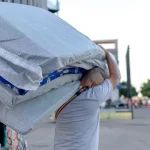
Testimony collected at evacuation points and shelters speaks of journeys lasting eighteen hours in gridlocked traffic – children, the elderly, and people with disabilities pressed into vehicles or onto trucks with whatever belongings could be gathered in the minutes between the bombing warning and the decision to leave.
Protection agencies have flagged that the combination of overcrowded collective shelters, overwhelmed sanitation infrastructure, and displacement-induced family separation is generating acute risks of gender-based violence, exploitation, and trafficking — particularly for women and girls. OCHA’s Flash Update of 7 March noted that protection monitoring in several governorates had flagged overcrowding conditions that exceeded safe standards, with inadequate sanitation facilities, lack of privacy, and insufficient essential supplies compounding vulnerability.
An African Lens: Why This Crisis Demands Global South Attention
Lebanon’s crisis is, in the dominant media framing, a Middle Eastern story. But it is also a story about the international humanitarian order – and about who that order protects, and on whose timeline. The countries of the Global South are disproportionately represented among those bearing the burden of the world’s displacement crises, and disproportionately absent from the donor tables that fund the response.
Africa itself hosts tens of millions of displaced people – from Sudan’s civil war to the DRC’s protracted conflict to the Horn of Africa’s compound crises of climate and violence. The same structural underfunding that has left Lebanon’s response at 14 percent is the condition that defines humanitarian response from Darfur to Kivu. The tools built to address mass displacement – UNHCR, UNRWA, the cluster system – are architecturally dependent on voluntary contributions from a shrinking pool of willing Western donors. When those donors disengage, the gap is not filled.
Lebanon’s schoolrooms-turned-shelters are a warning. The speed with which civilian infrastructure collapses under the weight of mass displacement – when funding is inadequate, when political will is absent, when the international community is slow to respond – is a warning that applies as much to Khartoum as to Beirut, as much to Goma as to the southern suburbs of the Lebanese capital.
What Comes Next
Lebanon faces the coming weeks with its shelter network at saturation, its humanitarian response critically underfunded, its health system under growing strain from the dual pressure of casualty management and the displacement of hospital capacity, and its population experiencing a second forced uprooting in under two years.
OCHA and UNHCR have called for safe, unhindered humanitarian access to be guaranteed across all affected areas – a call made necessary by documented attacks affecting healthcare personnel and facilities, and by the evacuation of two hospitals in Beirut’s southern suburbs following the 5 March displacement order. The Lebanese Red Cross and municipal authorities are distributing relief in hard-to-reach areas, but logistical constraints linked to damaged infrastructure, fuel shortages, and ongoing insecurity are limiting the reach of the response.
The question that haunts this crisis – as it haunts every underfunded humanitarian emergency – is not whether the international community has the capacity to respond. The capacity exists. The question is whether it has the will. So far, with Lebanon’s UN response at 14 percent funded and the region’s displacement crisis expanding by the hour, the answer has been an inadequate one.