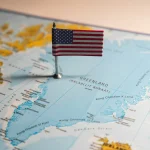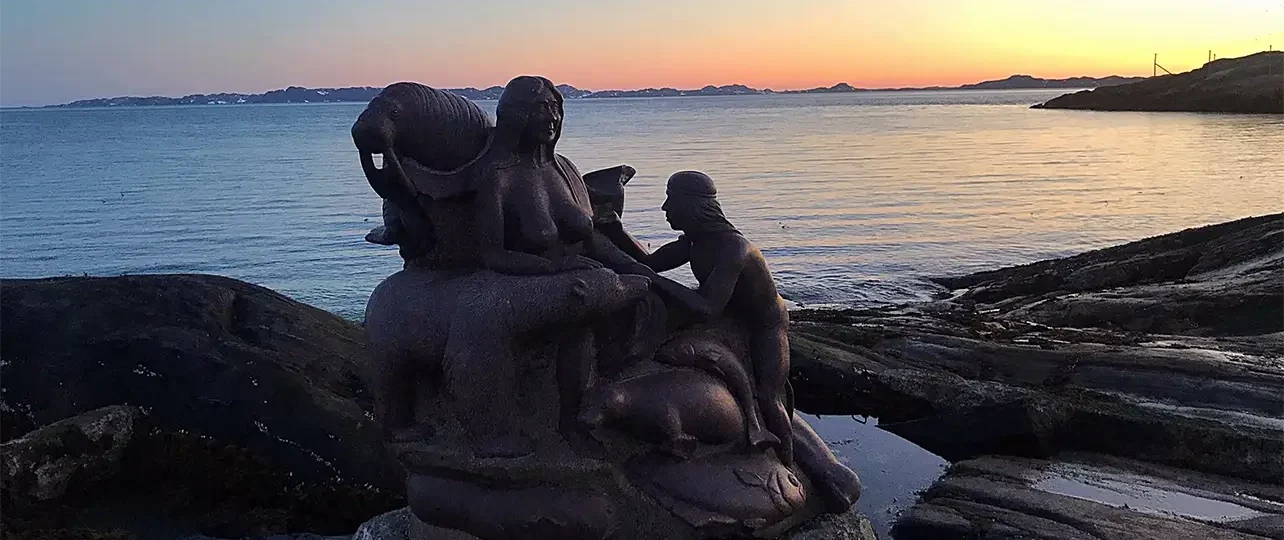

BY the harbour in Nuuk, the capital of Greenland, a statue of the Mother of the Sea, Sassuma Arnaa, sits on a small rock, half-submerged in the sea. In Inuit mythology, she governs the ocean and its creatures. When people act with greed or ungratefulness, her hair becomes tangled, trapping the animals and leaving people with nothing to catch or eat. Only when an angakok, a shaman, travels down to untangle her hair, the animals are released again.
By Victoria Julie Schou
Ifyou follow her gaze 50 metres up the hill, you meet another statue overlooking the city: Hans Egede, the Danish missionary who came to Greenland in 1721 to lead the colonisation. When he arrived, Inuit beliefs and figures like Sassuma Arnaa were banned, depriving many future Greenlanders from knowing their own roots and history.
To this day, frozen in a perpetual stare and locked in a silent confrontation across the water, the two statues serve as a quiet reminder that the legacy of Danish rule still influences life on the world’s largest island, and of the consequences of Denmark’s rapid modernisation of Greenland in the mid-20th century: entire communities relocated, children born to Danish men left legally unrecognised; others torn from their parents and sent to Denmark for educational purposes only to return unable to speak their own language; thousands of girls and women, some as young as 12, secretly fitted with contraceptive devices without their consent or knowledge in a bid to control the population – the so-called “Spiral Case”.
The colonisation and cultural changes had a long-lasting impact on Greenland, which today is a self-governing country within the Danish realm. Despite high living standards, many Greenlanders’ lives are shaped by feelings of inferiority, loss of language, and ruptured identity. And what emerges is a quiet, invisible crisis of sexual abuse, neglect and violence, alcohol addiction, and suicide.
If that isn’t a humanitarian crisis, what is it?
Why Greenland’s crisis threatens survival
It may not resemble a humanitarian crisis in the traditional sense of famine or war. But it is not merely social or psychological either. Only in a humanitarian crisis can we talk about a risk for survival. This is the case of Greenland, which has hadthe highest suicide rate in the world, counted per inhabitants. While the global average is nine suicides per 100,000 inhabitants annually, Greenland’s rate has remained extraordinarily high and consistent for decades, standing at 71.3 in 2022, and peaking in the 1980s at 120. In absolute numbers, 40 suicides in one year in 2022 may seem small compared with the mass casualties we experience around the world. But in a population of approximately 56,000 people, the loss is proportionally devastating, especially with the burden falling most heavily on young people, particularly men aged 20-24, with a worrying rise among young women too.
Of course, suicide is a complex phenomenon, and it can have a lot of underlying causes. But a study from BMC Psychiatry in 2023 found that the suicides in Greenland first began to rise in the 1960s, in parallel with Denmark’s rapid modernisation of the island and in tandem with other social problems. Today, 37% of children grow up in homes affected by alcohol, and the country has often held the record for most reported rapes per capita in the world. Ten years ago, one in three children had experienced sexual abuse, a figure that today stands at one in five. Especially affected are isolated settlements on the east coast such as Tasiilaq, where the former mayor, Asii Chemnitz Naru,p has described the situation as “a human, social and cultural death spiral”.
This raises a larger question: What happens to the humanitarian framework when a crisis is slow, inherited, and produced not by disaster but by history; when the leading cause of death is not war, hunger or disease, but suicide?
The political cost of redefining a crisis
Even though humanitarianism has gradually become a diluted concept, traditional humanitarianism is generally centred around crises that are visible and external. As sociologist Luc Boltanski has argued, humanitarianism is built arounda “politics of pity” that focuses on immediate and visible suffering. It elevates the present crisis and does not concern itself with the historical causes of the suffering, as well as its future. Conflicts, wars, displacement, and natural disasters are such events. They produce unmistakable signs of emergency: destroyed buildings, overflowing refugee camps, mass migration. And they demand immediate and material action.
But the crisis in Greenland does not fit that frame. There are no refugee camps, no bombed-out cities, no starving populations or barefooted hungry children on the streets. Instead, the harm is internal, invisible, and slow. It stems from historical power imbalances, cultural loss, and generational trauma.
Furthermore,it doesn’t fit the geographical aspect of the humanitarian frame either. Humanitarianism, as it is commonly practised, has a largely implicit border between the West and the Global South. The West is meant to appear as the responder, not the affected. So, when a crisis emerges in a Western nation, it challenges not only our understanding of what a crisis looks like but also where we believe a crisis can occur.
To admit that there is a humanitarian crisis in Greenland would therefore also be to acknowledge that colonialism itself has created the crisis, and thereby, that the West itself is the cause. And that would undermine the very fundamental understanding of humanitarianism, where the West is seen as the saviour. Not the culprit.
Rethinking what aid could look like
If we were to accept that a humanitarian crisis can take forms that are neither immediate nor visible, then the boundaries of what we call a humanitarian crisis begin to shift. And where to draw the line?
At the same time, our understanding of humanitarian crises is constantly being stretched, pulled, and expanded. There is an increasing recognition that it can happen anywhere in the world, while we are also becoming more aware of both our own and the media’s Eurocentric narrative on humanitarianism.
In Greenland, the problem is not loss of basic material needs, but a loss of identity, language, and culture. And the humanitarian framework doesn’t have the tools to respond to intangible cultural harm.
If we were to look at Greenland as a humanitarian crisis, what would the response then be? Normally, the default response is seen as aid in the form of food, water, medicine, and shelter. But in Greenland, the problem is not loss of basic material needs, but a loss of identity, language, and culture. And the humanitarian framework doesn’t have the tools to respond to intangible cultural harm. If we were to introduce this to the framework, it would demand a deeper understanding of the culture in which the crisis occurs. Starvation is starvation anywhere in the world. But loss of identity looks different from one place to another.
It would therefore be necessary to reflect on our understanding of aid and what aid could look like in the future. And maybe to recognise that we don’t need to respond to every crisis in the same way.
Could there be a place for what we might call an ideal, or non-material, form of humanitarian response?
In the case of colonial harm, many processes of recognition as a form of response have taken place in recent years. On 24 September, Danish Prime Minister Mette Frederiksen formally apologised to the Greenlandic women affected by the spiral case mentioned earlier, at a ceremony in Nuuk. It was a historical turning point in the relationship between the two countries and, without a doubt, one of the most moving experiences I have ever witnessed. What started out in anger, rage, and mourning ended – to some extent at least – in reconciliation and tears of joy.
For many of the affected women, the weight of a lifelong burden of shame and unspoken trauma was lifted off their shoulders. Even though it might have been purely symbolic, the word “sorry” served as a form of recognition. Of course, this kind of response also means that someone must take blame for the crisis, which is in stark contrast to our idea of humanitarianism as not taking any part at all.
What Greenland reveals about humanitarian blind spots
Another paradox lies at the heart of humanitarianism. Defined by the principle that all lives hold equal value, crises affecting small populations should command the same moral urgency as those affecting millions. Yet humanitarian attention is driven by scale, with high casualty numbers used as markers of urgency. This tends to overlook crises like Greenland’s.
But in less populated places, relatively small numbers can shatter entire communities. Greenland has 72 inhabited towns and settlements, and in 30 of them fewer than 100 people live. In such places, losses are never distant. The communities are isolated and interwoven, and each suicide reverberates widely. If all lives hold equal value, then proportional impact, not sheer scale, must also matter.
The humanitarian framework, in many ways, is political, as it surfaces power relationships between those affected by it, those responsible for it, and those who can help.
Overall, this is not to say that the largely quiet and invisible crisis in Greenland is more important than the much more visible crisis of the 305 million people in the world currently in need of urgent humanitarian aid, or the 25 to 40 million displaced people who have been forced from their homes through oppression and violence. Neither is it to diminish the very crucial work doneby humanitarian organisations.
But what it can do is to expose a blind spot within the framework of humanitarian architecture: the inability to recognise crises that do not manifest through immediate spectacle. It shows us that the humanitarian framework in many ways is political, as it surfaces power relationships between those affected by it, those responsible for it, and those who can help.
As Lyndsey Stonebridge, professor of Humanities and Human Rights, puts it, humanitarianism centres trauma and sympathy at the cost of history and politics. It spotlights the suffering but erases its causes and thereby transforms people from political subjects into objects of compassion.
Maybe it’s time to turn off the narrowed, focused spotlight and turn on the floodlight to respond to the needs of the whole human being, and not just the visible parts of suffering.
If you are in crisis, click here to find a helpline near you (via the International Association for Suicide Prevention).
–––––
The New Humanitarian puts quality, independent journalism at the service of the millions of people affected by humanitarian crises around the world. Find out more at www.thenewhumanitarian.org.