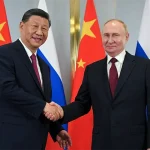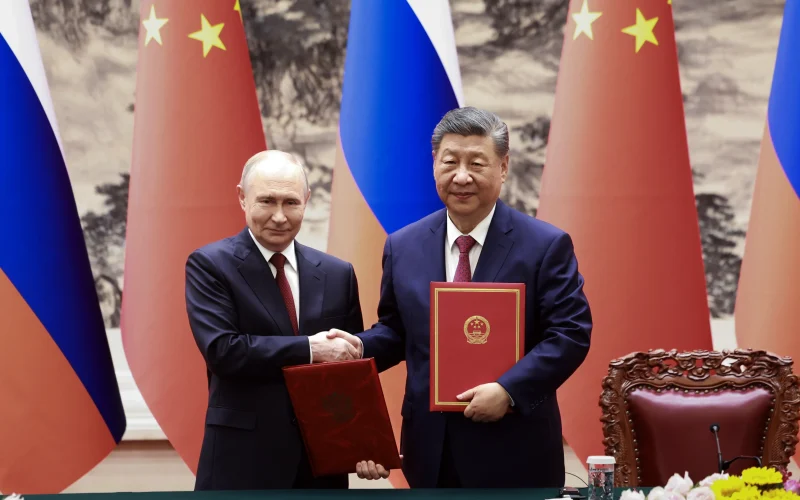
THERE are moments in history when the symbolism of a handshake speaks louder than any treaty. The meeting between Chinese President Xi Jinping and Russian President Vladimir Putin in Beijing on Wednesday was precisely such a moment – a summit that arrived not in a diplomatic vacuum, but in the eye of the most violent and consequential storm the international order has faced since 1945.
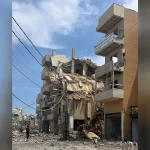
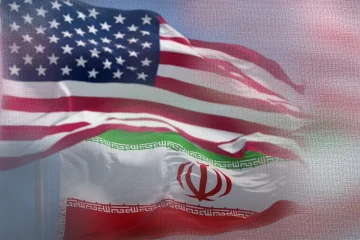
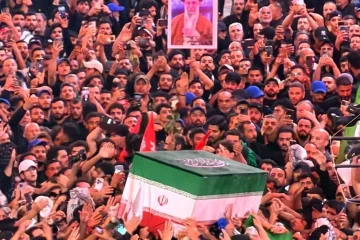
The world that watched these two men exchange courtesies at the Great Hall of the People is not the world it was even eighteen months ago. The United States and Israel are at war with Iran. Lebanon is once again being carved by Israeli airstrikes. Russia’s invasion of Ukraine continues to grind through its fourth year, consuming lives and treasure on a scale that strains comprehension. And the rules-based international order – that post-war construct so beloved of Washington and Brussels – is in the most advanced state of decomposition in living memory.
Against this backdrop, Xi and Putin did not merely meet. They declared, in the language of statecraft and symbol, that an alternative axis of global power is open for business.
“China-Russia relations have reached this level because we have been able to deepen political mutual trust and strategic cooperation.”
President Xi Jinping
A Summit Freighted with Meaning
The ceremony itself was layered with intent. Putin arrived to an honour guard and a gun salute – the full pageantry of state. Children waved Chinese and Russian flags. Alongside the formal bilateral talks, the pair were scheduled to conclude the day in the manner that Xi most reserves for leaders he regards as true peers: an intimate session over tea.
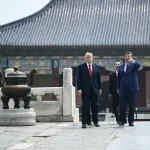
In Xi’s diplomatic lexicon, the tea setting is not incidental. When he hosted Putin in May 2024, the two men shed their ties and spoke in the open air of Zhongnanhai, the ancient imperial garden at the heart of Chinese power. It was a deliberate signal of warmth and equality. The contrast with last week’s more choreographed encounter with U.S. President Donald Trump – a stroll through a manicured garden, a tour of the Temple of Heaven, the polished theatre of managed optics – was not lost on observers.
Kremlin spokesman Dmitry Peskov waved away comparisons between the two visits, insisting people should focus on content rather than ceremony. But in great-power diplomacy, ceremony IS content. The manner in which a superpower welcomes another leader tells the world precisely where that relationship sits on the hierarchy of regard.
The Architecture of a Counter-Order
The substance of Wednesday’s summit was designed to reinforce the thesis that the China-Russia axis is not an opportunistic marriage of convenience, but an institutionalised strategic partnership with its own doctrine, its own declarations, and its own vision for the international order.
Xi and Putin jointly signed a statement on strengthening comprehensive strategic coordination, along with a declaration explicitly advocating for multipolarity in the global system. A joint declaration warned against what it called a drift back toward the ‘law of the jungle’ – a pointed indictment of what both governments characterise as the West’s willingness to wage wars, impose sanctions, and enforce rules it routinely violates itself.
Some twenty cooperation documents were signed at the summit, with another twenty reportedly in the pipeline. Patricia Kim of the Brookings Institution put it plainly: the symbolism of such an agreement alone, regardless of specific substance, ‘would reinforce the message that the China-Russia partnership remains strong, institutionalised, and coordinated across a broad range of strategic issues.’
In the grammar of this new geopolitics, every gesture is a message: the world is no longer Washington’s to organise alone.
Energy: The Pipeline That Wasn’t
For all the warm optics, Wednesday’s summit also revealed the limits – and the hard-nosed pragmatism – that undergird the relationship. Moscow arrived in Beijing with serious expectations around energy, specifically the long-stalled Power of Siberia 2 pipeline, a 2,600-kilometre system designed to carry 50 billion cubic metres of gas per year from Russia’s Arctic Yamal fields through Mongolia into China.
Russia has been pushing this deal for years. During Putin’s previous visit in September 2025, Gazprom claimed both sides had agreed to move the project forward. On Wednesday, the Kremlin said the two sides had reached a ‘general understanding on the parameters’ – diplomatic language that, translated, means almost nothing has been signed and the hardest negotiations lie ahead.
Xi spoke of energy cooperation as the ‘ballast stone’ in the China-Russia relationship. He did not mention the pipeline. The gap between that omission and Moscow’s ambitions speaks volumes about the actual balance of power in this partnership. China, as Russia’s largest oil buyer and a critical economic lifeline amid Western sanctions, holds the superior hand in these negotiations. Beijing is in no hurry. Key issues – above all, the price Russia will charge and the price China is prepared to pay – remain unresolved, and analysts believe finalising the deal could take years more.
Putin declared Russia a reliable energy supplier amid Middle East disruption. The subtext was unmistakable: with Iran under military assault and regional energy routes under pressure, Russia was positioning itself as the indispensable alternative. Whether Beijing will pay premium prices for that reliability is another matter entirely.
The Shadow of War — and of Washington
The meetings in Beijing cannot be read in isolation from the broader cauldron of global crisis. The US-Israel war on Iran, now dominating energy markets and reshaping shipping routes, has rattled governments from Lagos to Jakarta. For Africa and the Global South, the consequences – oil price volatility, rising food costs, displacement flows, airline disruption – are not abstractions. They are daily realities.
Russia and China’s joint declaration, with its language about resisting the ‘law of the jungle,’ is pitched directly at governments in the Global South who feel, with increasing acuity, that the rules-based order was never designed to serve them. Beijing and Moscow are not merely narrating this sentiment; they are actively courting it as the foundation of a new coalition.
There is also the unmistakable shadow of Trump. His visit to Beijing last week, which produced China’s confirmation of a 200-Boeing-jet purchase, alongside Beijing’s push for an extended trade truce and reciprocal tariff cuts, underscored that China is playing all tables simultaneously. Xi is not Putin’s partner to the exclusion of Washington; he is the consummate strategic balancer, extracting value from every relationship while committing to none completely.
In that sense, the China-Russia summit was as much a message to Washington as it was an expression of Sino-Russian solidarity: Beijing will not be triangulated, will not be forced to choose, and will extract maximum leverage from the very tensions that Washington is generating across the globe.
Xi is not Putin’s partner to the exclusion of Washington. He is the consummate strategic balancer, extracting value from every relationship while committing to none completely.
What It Means for Africa
For Africa, the Beijing summit carries implications that deserve sober analysis rather than reflexive alignment. The strengthening of the China-Russia axis deepens the strategic options available to African governments navigating an increasingly multipolar world. It also intensifies the competition for African partnerships, infrastructure contracts, and diplomatic support at the United Nations.
The joint call for multipolarity resonates on a continent that has long chafed under the double standards of Western-led institutions – the IMF’s conditionalities, the ICC’s selective justice, the Security Council’s paralysis on Palestine and the DRC alike. African leaders who have quietly welcomed the erosion of Western dominance will read Wednesday’s joint declaration with quiet satisfaction.
But Africa must also ask harder questions. A world governed by rival great-power blocs rather than universal rules offers African states agency only insofar as they are sufficiently organised and united to leverage that competition. A fragmented Africa, dependent on competing external patrons, gains little from multipolarity beyond the illusion of choice.
The African Union’s long-term interest lies not in choosing between Washington, Beijing, and Moscow, but in building the institutional coherence – economic, military, diplomatic – that would make Africa itself a pole in the emerging order. That is the project that Wednesday’s summit in Beijing, for all its grandeur, ultimately leaves unaddressed.
The View from History
Xi reportedly invited Putin to visit Russia next year. Putin called their ties truly unprecedented. The language of ‘dear friend’ and ‘old friend’ – terms both men have applied to each other over more than a decade – now carries the weight of wars survived, sanctions absorbed, and a shared conviction that the Western-led order is in terminal decline.
Whether that conviction is historically accurate, or whether it underestimates the resilience and adaptability of Western power, will be determined not in the tea rooms of Zhongnanhai but on the battlefields of Ukraine, in the rubble of Tehran’s infrastructure, in the voting chambers of the UN General Assembly, and in the quiet decisions of governments across Asia, Africa, and Latin America about which order they are willing to build.
What is already clear is this: the world of 2026 has more than one centre of gravity. The Beijing summit of Wednesday, May 20, did not create that reality – but it announced it, with full ceremony and quiet intent, to anyone still paying attention.