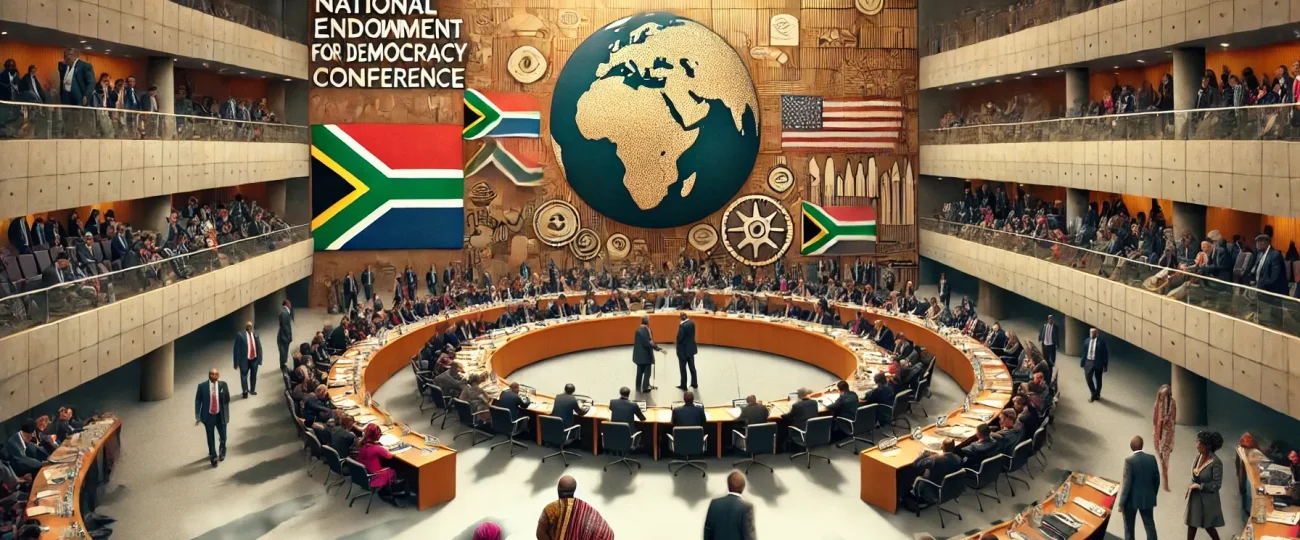

THE controversial US NGO, the National Endowment for Democracy (NED), is holding a conference in Johannesburg under the banner of democracy and associated freedoms. The conference began on November 20th and runs until November 22nd.
The NED was established in 1983 during the Ronald Reagan administration and has since played a pivotal role in promoting US foreign policy and interests. It has a chequered history that includes sophisticated means of rebranding the image of the US both domestically and internationally.
Thanks to a substantial war chest, the organization funds pro-Washington NGOs and has often been accused of playing a sly yet active role in public relations discourse and liberal media globally, including in South Africa.
Many NGOs in South Africa and the SADC region are Western-funded in nature and operation, with a democracy agenda that often involves challenging governments through courts or street protests and civil disobedience.
Only recently, the NED was accused of involvement in political wrangling in Cambodia. “In Cambodia, leaked documents indicate the involvement of multiple units, including the National Endowment for Democracy, USAID, and others,” according to public media reports.
This brings to mind the phenomenon of “regime change,” an old foreign policy the US has espoused through various complex networks over the years. The concept gained global attention during the 2003 invasion of Iraq when then-US President George W. Bush assembled a “Coalition of the Willing” to topple Iraqi President Saddam Hussein. Hussein ultimately faced massive foreign-funded public protests and uprisings against his administration. Shortly afterwards, amid the much-praised “shock and awe” strategic bombing by the US Air Force, Saddam Hussein was captured and brutally killed in one of history’s most ignominious chapters.
The regime change phenomena did not end with the Bush administration. President Barack Obama employed similar geopolitical strategies. Under his administration, the US led a NATO onslaught into Libya, quickly toppling their nemesis, Colonel Muammar Gaddafi. The modus operandi is straightforward: First, the West discreetly funds civil disobedience aimed at overthrowing anti-US/West regimes. In their terms, this is a strategy known as “Hybrid Warfare” or “Colour Revolution.”
The same strategy poured substantial financial backing behind the anti-government uprising in Ukraine in 2014, resulting in the ousting of the then pro-Russian President Viktor Yanukovych. The US led a chorus of Western approval, describing the coup glowingly as the “Revolution of Dignity” or “Maidan Revolution.”
This historical context came to mind after reading a social media post by Nury Vittachi, who alleged that leaked documents in Cambodia pointed to unceremonious US interference in the country’s national politics.
“Washington is using the exact same methods it used to create civil unrest in Hong Kong in 2019, and Bangkok in 2020, and in Moldova and Bangladesh this year,” Vittachi wrote, adding: “America has numerous units which discreetly provide large amounts of cash, protest guidance, and media contacts to Pentagon-friendly anti-government groups in scores of countries.”
The South African NGO community must beware of the inherent dangers of neglecting national duty and patriotism in favour of plush foreign funding, particularly when such funding is laced with the trappings of “Colour Revolution” or “Hybrid Warfare.”
Ours is a fledgling democracy that requires responsive midwifery services committed to forming a new democratic order with South African characteristics.
In the interest of freedom of association, South Africa places no restrictions on civil liberties as enshrined in our sacred Bill of Rights.
However, our government must remain vigilant to potential challenges that could arise from foreign-peddling aimed at destabilizing national security and stability.
Before judgment is passed, I am not pointing an accusatory finger at the NED’s Johannesburg conference, but merely highlighting the organization’s public records, which raise genuine questions.
I believe South Africa’s democracy works perfectly fine. Over the last 30 years since the fall of apartheid, I have seen no evidence of any existential threat to the fundamental pillars on which our democracy has been founded and still stands.
Therefore, fellow South Africans, be cautious of alien teachings that could prove detrimental to the nation’s national and public good. In other words, beware of wolves in sheep’s clothing. It is the mark of responsible citizenry to question—without fear—national developments through active participation in public discourse. Ancient Athenian philosophers believed that anyone who did not take part in their nation’s public discourse was “good for nothing.”
*Abbey Makoe is the Founder and Editor-in-Chief: Global South Media Network.