WHEN the polls closed in the Republic of Congo on Sunday, and the last voter departed polling stations largely emptied by civic despair, the formal machinery of what passes for democracy in Brazzaville ground into motion. Ballot boxes were sealed. Tallies began. Officials spoke of the process. But across the oil-rich Central African nation, most citizens had already arrived at their own verdict — long before any official count.
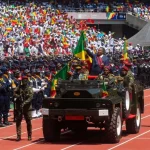
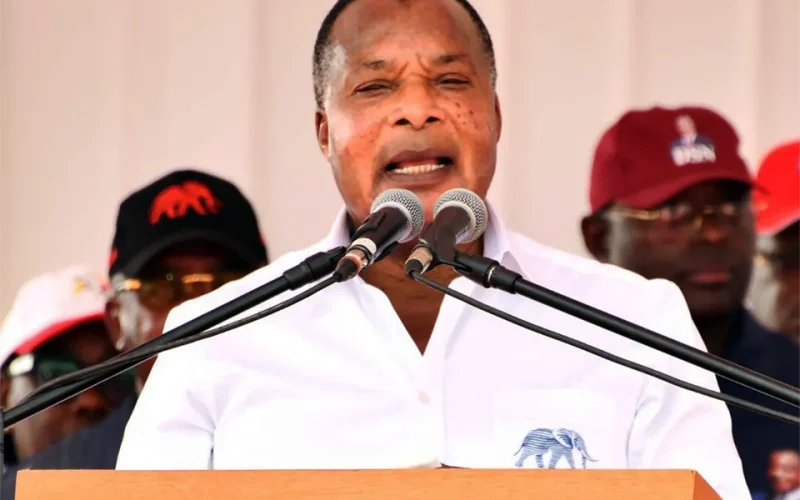
President Denis Sassou N’Guesso, 82 years old and in his fifth consecutive bid for the presidency, is expected to be returned to power by a margin that will raise no eyebrows among Africa’s weary watchers of managed democracy. He has ruled Congo-Brazzaville for 42 of the last 47 years. His face, plastered across the capital’s streets and avenues, was the only campaign that truly blanketed the country. The result, analysts say uniformly, is not in question.
“Everyone knows that, faced with his six inexperienced opponents, President Denis Sassou N’Guesso will be re-elected with a high score as usual,” said Clarisse Massamba, a teacher who voted at the Lycée Javoueh in Brazzaville, in remarks to The Associated Press. Her tone carried neither surprise nor protest. Only resignation.
THE ARCHITECTURE OF A FORGONE CONCLUSION
The conditions that made Sunday’s poll a foregone conclusion were not accidental. They were constructed methodically, over decades. A constitutional referendum in 2015 stripped away presidential age limits and term restrictions that had briefly constrained Sassou N’Guesso’s ambitions. The change was tailor-made for a man who had already treated the country’s political architecture as a personal instrument.
This time, six challengers stood against the incumbent. None, analysts confirm, commands a meaningful support base, a national campaign infrastructure, or the resources to contest seriously. Sassou N’Guesso was, reportedly, the only candidate who travelled the country to canvass votes. The asymmetry was not subtle — it was the point.
Two major opposition parties did not even participate, citing unfair electoral conditions and calling for a public boycott. Their absence was telling: when the rules of a contest are designed to guarantee one outcome, principled withdrawal can be the only honest response.
“Since the election is not a big issue, we shouldn’t cut off communication.”
Clarisse Massamba, teacher, Brazzaville — on the internet shutdown during polling
SHUTTING OUT THE LIGHT
As Congolese citizens went to the polls, the government moved with familiar efficiency to control the information environment. Internet access was severed nationwide — a standard procedure, authorities have made clear, during presidential elections. Traffic in and out of the capital, Brazzaville, was restricted. The digital blackout, now a recurring feature of Congo’s electoral calendar, was designed to contain the spread of results, organise dissent, or allow any external scrutiny to gain real-time traction.
The shutdown did not provoke widespread outrage on the streets. In a country where more than half of the 5.7 million population lives in poverty and nearly half — 47 percent — is under the age of 18, political disengagement has become a rational response to a system that offers no meaningful avenue for change. Low voter turnout on Sunday reflected not apathy, but a clear-eyed assessment of the situation.
A NATION RICH IN OIL, HOLLOWED BY MISRULE
The Republic of Congo sits atop one of sub-Saharan Africa’s most significant oil reserves. It is, by any measure of natural endowment, a country that should not struggle. Yet it does — profoundly. Public debt stands at 94.5 percent of gross domestic product, according to World Bank figures. Youth unemployment is structural, not cyclical. More than half the population is impoverished. The country’s wealth flows through mechanisms that have enriched a governing elite over four decades while delivering diminishing returns to ordinary Congolese.
Sassou N’Guesso first came to power in 1979, presided over the country’s first multiparty elections in 1992, stepped back — and then returned as a militia leader following the 1997 civil war. The pattern — power relinquished, power reclaimed by force, power subsequently legalised — is instructive. It reveals a political actor for whom formal democratic norms are instruments to be deployed or discarded depending on their utility.
CONGO AND THE SYNDROME OF THE LIFELONG PRESIDENT
Sassou N’Guesso is not an anomaly on the continent. He is, by length of tenure, Africa’s third-longest-serving head of state — ranking behind Cameroon’s Paul Biya and Equatorial Guinea’s Teodoro Obiang Nguema Mbasogo, two figures whose own democratic credentials are, at best, ornamental. Together, these three men represent a cohort of octogenarian rulers whose grip on power has outlasted generations of citizens who have never known an alternative.
The pattern challenges African institutions in ways that remain largely unresolved. The African Union’s Constitutive Act explicitly opposes unconstitutional changes of government. But the Act says considerably less about leaders who simply never leave — who instead rewrite constitutions, co-opt judicial systems, and exhaust oppositions through attrition rather than overt coup. Sassou N’Guesso’s continuation in power will not trigger any AU censure. That, too, is the point.
“When rules are designed to guarantee one outcome, principled withdrawal can be the only honest response.”
Analysis, The African Mirror
AFTER THE COUNT: WHAT CHANGES, WHAT DOESN’T
Official results are expected within two weeks. When they arrive, they will confirm what most Congolese already know. Sassou N’Guesso will continue. The debt will remain. The youth unemployment will persist. The internet, restored once the risk window has passed, will reconnect a population that had briefly been severed from the world during the staging of its own political ritual.
What Sunday’s election ultimately reveals is not the health of Congolese democracy — it reveals the distance between the formal architecture of democratic governance and the lived reality of political power in parts of Central Africa. Elections without genuine competition, held by governments that control the communications infrastructure and the security forces and the constitutional framework, are not elections in any meaningful sense. They are rituals of continuity, conducted at regular intervals, conferring international legitimacy at minimal domestic political cost.
The Congolese people deserved better. They have deserved better for 42 years. That they have not received it is not merely a failure of one man’s governance — it is a failure of the regional and international architecture that recognises these elections at all.