
SOUTH Africa’s President Cyril Ramaphosa has called for increased efforts to combat gender-based violence (GBV), describing it as “the second pandemic” South Africa must confront.
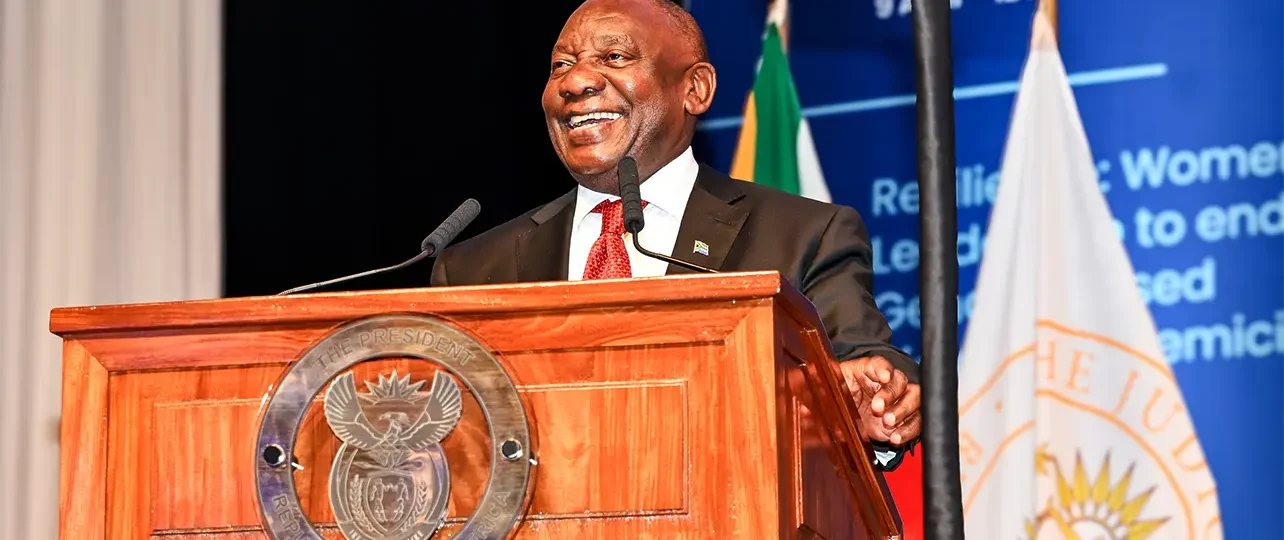
Speaking at the Biennial Conference of the International Association of Women Judges, Ramaphosa highlighted the country’s recent legislative reforms while emphasizing that legal changes alone cannot solve the crisis.
“At the time when the whole world was having to deal with the COVID-19 pandemic, I described GBV as the second pandemic our country had to address in terms of its scale, impact, and systemic nature,” Ramaphosa told the gathering of international jurists.
The president detailed South Africa’s journey since becoming a signatory to the Beijing Declaration and Platform for Action 30 years ago, noting the country’s progress in judicial representation while acknowledging continued challenges.
“Today, approximately 48 percent of judges in our superior courts are female, and 6 out of our 15 superior courts are led by women, including the Constitutional Court and Supreme Court of Appeal,” Ramaphosa said, highlighting the transformation from a time when “the bench had only three black male judges and not a single black woman.”
The president pointed to a troubling contradiction in many countries, including South Africa: strong laws advancing gender equality existing alongside persistently high levels of violence against women.
“It became clear there was a contradiction at play, with strong laws to advance women’s rights on one hand and stubbornly high levels of gender-based violence on the other,” he said.
In response to this gap, Ramaphosa outlined the trio of laws passed in 2022 to strengthen protections for survivors, following the 2019 Presidential Summit on Gender-Based Violence and Femicide.
“Suspects accused of serious and violent crimes against women were being granted bail and were absconding and re-offending. Courts were not applying prescribed minimum sentencing laws for crimes like rape, and serious offenders were receiving light sentences,” he explained.
The amendments addressed these issues by introducing new categories of sexual intimidation, expanding sex offender registration, regulating bail for violent offenders, and enabling online applications for protection orders.
Ramaphosa emphasized that gender-based violence “doesn’t happen in a vacuum” but results from “complex societal, cultural, and structural factors: unequal power dynamics between men and women, cultural norms and practices, unemployment, conflict, wars, and patriarchy.”
He also highlighted economic violence against women, noting that when women “are prevented from accessing financial resources and achieving independence,” they are effectively “condemned to poverty.”
The president called for a comprehensive approach beyond legal reforms, stressing that “laws cannot just be written – they must be enforced.”
“We must make men and boys part of the conversation to prevent gender-based violence,” Ramaphosa urged. “We should also as a society insist that women should have more control over their lives and economic independence, which will reduce their vulnerability to violence.”
Addressing the women judges directly, Ramaphosa emphasized their unique position to effect change: “As female jurists, you have particularly strong influence and can shift the broader judicial culture with respect to GBVF.”
The World Health Organization estimates that one in three women or girls have experienced physical or sexual violence at least once in their lifetime, a statistic Ramaphosa cited while noting that GBV “has become normalized and is being repeated across generations.”
The president’s address comes as South Africa continues to grapple with high rates of violence against women and children, despite its progressive legal framework.