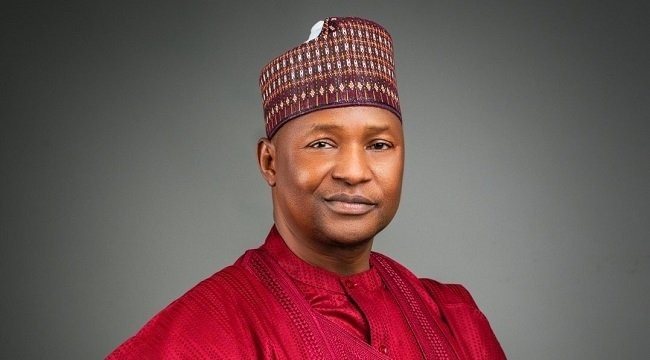
FOR eight years, Abubakar Malami held the most powerful legal office in Africa’s largest democracy. As Attorney-General of the Federation and Minister of Justice under President Muhammadu Buhari, he was the man who decided which corruption files moved and which quietly died, who instructed the Economic and Financial Crimes Commission on which “persons of interest” to pursue, and who stood before the world as the guarantor of Nigeria’s promise to recover stolen wealth. On Wednesday, the machinery he once commanded turned on him. Justice Joyce Abdulmalik of the Federal High Court in Abuja ordered the final forfeiture of 48 properties traced to Malami and his family – a portfolio the EFCC values at more than N212 billion and that stretches from a boutique hotel in Maitama to an entire university town in his native Kebbi State.
“The legal issue was not who owns the property, but how legitimate were the funds used to acquire them.”
Justice Joyce Abdulmalik
The irony sits heavily on the judgment. Malami spent his tenure lecturing Nigerians that “once crimes and criminality are concerned, nobody is an exception,” a line he used in 2016 to defend a Department of State Services raid on judges’ homes. That same doctrine of non-exception has now been turned against the man who coined it. The court’s reasoning was unambiguous: this was not a criminal conviction but a civil, non-conviction-based forfeiture, in which the burden shifts to the person holding suspect wealth to prove it was lawfully earned. Malami and fourteen co-respondents, mostly family members and associated companies, tried and failed. Justice Abdulmalik held that they had done no more than assert ownership, without producing the paper trail of income, tax and lawful transaction that could account for a fortune built on such a scale.
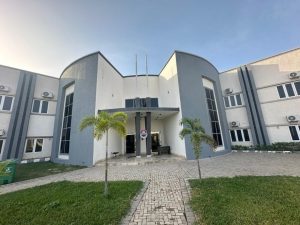
What makes the ruling more than a routine asset-recovery story is the shape of the empire itself. This was not a scattering of undeclared bank accounts. It was a built environment: Rayhaan University’s permanent, temporary and third campuses in Birnin Kebbi, complete with its own radio station, mosque, staff quarters and agro-allied factory; the Azbir Arena, an entire commercial precinct combining a hotel, printing press, gallery, gardens, clothing line, pharmacy and supermarket under one brand; and, in Kano, a 131-room hotel and its adjoining mosque. Add to that a cluster of luxury duplexes and hotels in Abuja’s most expensive districts – Maitama, Asokoro, Wuse II – some purchased for hundreds of millions of naira and subsequently “enhanced” in value into the billions. The picture the EFCC put before the court was of a public servant who did not merely accumulate money quietly, but who built visible, branded infrastructure across three states and the federal capital while drawing a minister’s salary.
That visibility is itself an indictment of a system. Much of this property acquisition unfolded during, not before, Malami’s time in office, with key purchases traced to 2018, 2020 and 2022 – years in which Malami sat atop the same anti-graft architecture meant to catch exactly this kind of conduct. His long tenure was already a byword for controversy inside Nigeria’s legal establishment: allegations that his ministry hijacked a sitting senator’s corruption file from the EFCC and quietly withdrew the charges; reports to the House of Representatives that recovered loot worth billions of naira passed through his office; and lingering questions from the P&ID arbitration saga, in which England’s courts came close to allowing a shell company to seize Nigerian state assets over a gas deal his ministry was accused of mishandling. Civil society groups spent years asking why a man drawing this level of scrutiny remained in one of the most powerful offices in the federation for the entirety of Buhari’s presidency. Wednesday’s judgment reads, in part, as the belated answer.
For the EFCC, the case is a marquee win in a system that has often struggled to convert headline arrests of politically exposed persons into concluded asset recovery. Malami is separately facing a 16-count money laundering charge, alongside a wife and son, over an alleged N8.7 billion scheme – a criminal case still winding through the same Federal High Court and entirely distinct from Wednesday’s civil forfeiture. That the civil track has now closed with a decisive win for the state, even as the criminal track continues, illustrates why non-conviction-based forfeiture has become the anti-graft agency’s preferred instrument across the continent: it does not require the years-long grind of a criminal trial, only a court satisfied that unexplained wealth cannot be accounted for. Malami’s lawyers argued the properties were legitimately declared to the Code of Conduct Bureau in 2019 and 2023, and accused the EFCC of inflating valuations to mislead the court. The judge was unmoved, holding pointedly that the legal question was never who held title to the properties, but whether the money that built them could be traced to anything lawful.
The politics around the ruling is not incidental. Malami has spent the past year positioning himself for a return to public life, securing the African Democratic Congress governorship ticket for Kebbi State ahead of 2027 even as the fraud trial proceeded – a reminder of how routinely Nigerian politicians treat pending corruption charges as a manageable inconvenience rather than a disqualifying one. Wednesday’s judgment complicates that trajectory considerably. A candidate who has just lost a N212 billion portfolio to the state, on a finding that he could not explain his own wealth, carries that fact into every campaign stop.
Beyond Malami himself, the case lands as a marker for how seriously Nigeria’s institutions are willing to test their own former gatekeepers. Non-conviction-based forfeiture has repeatedly stalled in Nigerian courts on jurisdictional technicalities and drawn-out appeals, and pan-African anti-corruption advocates have long argued that recovery regimes only earn public trust when they reach past mid-level officials to the architects of the system itself. A former Attorney-General – the one Nigerian official whose signature could authorise or halt any prosecution in the land – losing a fight to prove his own legitimacy is precisely the kind of case that tests whether accountability in Africa’s largest economy applies only downward, or whether it can, occasionally, reach the very top.