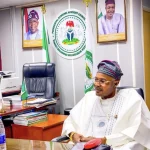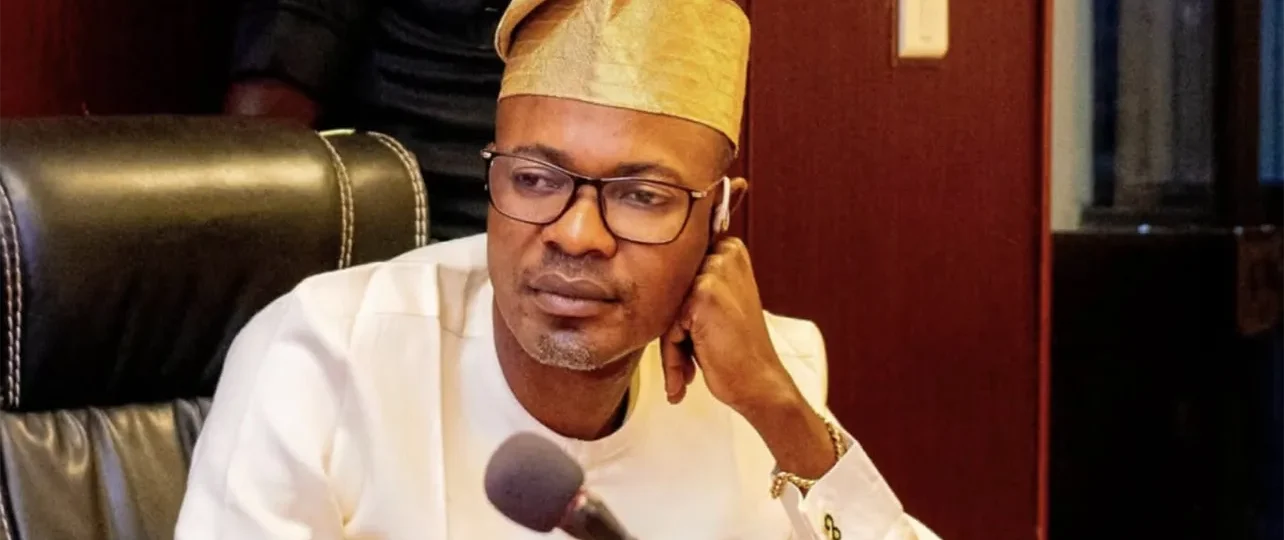

A US-based lobbying and public affairs firm, Von Batten-Montague-York, says it intends to report to the Trump administration what it calls the suspicious timing of the arrest of Adeniyi Adeyemi, the self-styled Director-General of Nigeria’s Presidential Foreign Investment Promotion Council (PFIPC). There is a problem baked into the claim: Nigerian prosecutors, a Federal High Court and the Presidency itself have all said, on the record, that the PFIPC does not exist and that Adeyemi was never appointed to lead it.
The firm, in a statement posted on its X account, said Adeyemi’s arrest came “just as we were preparing for him to speak with senior members of President Donald Trump’s Administration,” and that his arrest occurred shortly after it became public that the firm was in contact with him, and just before he was expected to hand over documentary evidence and a sworn statement. Those materials, the firm said, were destined for senior Trump administration officials who had asked for all available information on Adeyemi’s allegations against unnamed Nigerian officials. The firm’s managing partner, Karl Von Batten, had separately said he had already briefed members of the President’s team and planned to engage members of the US Congress.
We learned a short time ago that Mr. #Adeyemi has been arrested by Nigerian law enforcement just as we were preparing for him to speak with senior members of President @realDonaldTrump's Administration.
— Von Batten-Montague-York, L.C. (@batten_von) July 15, 2026
We are told that his arrest occurred shortly after it became public that we… https://t.co/bbgzBQzWpO pic.twitter.com/qCBiflh46z
That framing raises an immediate and unavoidable analytical question: on what basis would any US administration, or any member of Congress, treat a sworn statement from a man Nigerian courts have charged with forgery, impersonation and fraud, in his capacity as head of an agency the Nigerian government insists never existed, as credible state intelligence? A lobbying firm asserting that a fabricated Director-General was about to hand Washington evidence does not establish the evidence’s worth. It establishes, at a minimum, that the firm either did not verify Adeyemi’s claimed office before engaging with him or verified it and proceeded regardless.
What the record actually shows
The PFIPC controversy began in earnest on 17 October 2025, when the Office of the Chief of Staff to President Bola Tinubu, Femi Gbajabiamila, petitioned the Department of State Services and the Nigeria Police Force over what it described as forged appointment letters circulating under its name. Investigators allege the documents carried fake signatures, forged official seals, fabricated reference numbers and an unauthorised reproduction of the Nigerian Coat of Arms, all designed to project the PFIPC as a legitimate federal agency. Police arrested Adeyemi ten days later, on 27 October 2025, at an office he had been operating within the Federal Secretariat Complex in Abuja.
Presidential spokesperson Bayo Onanuga has said investigators found that Adeyemi used the forged documents to open a Central Bank of Nigeria account by misleading officials in the Office of the Accountant-General, though no government funds were ever moved into it. Adeyemi was granted administrative bail after 23 days in custody, on medical grounds, before resurfacing in the media to reassert that Gbajabiamila had appointed him. He has separately claimed he paid ₦400 million through an intermediary to secure the position — an allegation now the subject of a separate petition to the Economic and Financial Crimes Commission by those he says lent him the money.
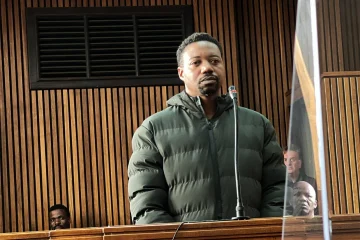
The Nigeria Police Force filed an eight-count charge against Adeyemi on 27 November 2025, covering conspiracy, forgery of presidential documents and false impersonation, alongside two co-accused, identified only as Femi and Anu, who remain at large. The case, before Justice Mohammed Umar at the Federal High Court in Abuja, has been adjourned repeatedly, with Adeyemi appearing only once since arraignment began. On 14 July 2026, after a fifth failed appearance, Justice Umar issued a bench warrant, rejecting defence arguments that Adeyemi had stayed away over threats to his life. “The court will help him be alive,” the judge said, ordering his arrest and setting 30 September 2026 for arraignment. If convicted on the forgery counts, Adeyemi faces up to 21 years in prison without the option of a fine.
A lobbying push built on an unresolved premise
Von Batten-Montague-York’s statement tagged an extensive list of US institutional accounts, including House and Senate Foreign Affairs committees, the State Department, the Bureau of African Affairs, the White House, Secretary of State Marco Rubio, Chief of Staff Susie Wiles and members of Congress, alongside American and international media outlets. That level of institutional targeting is more consistent with a public pressure campaign aimed at a Washington audience than with a considered assessment of Adeyemi’s underlying credibility. Nowhere in the firm’s public statement is there an acknowledgement of the forgery and impersonation charges already before a Nigerian court, nor of the Presidency’s repeated, on-record position that the PFIPC has no legal existence.
None of this forecloses the possibility that Adeyemi’s broader allegations against unnamed officials merit scrutiny; Nigerians have ample recent reason to demand accountability from their institutions. But a foreign lobbying firm asserting, without independent evidence, that a Nigerian head of state’s chief of staff engineered a court-ordered arrest specifically to silence a US briefing is a serious claim that deserves the same evidentiary standard the firm says it wants applied to Adeyemi’s own material. So far, none has been produced publicly. The firm has not explained who retained it, what it has independently verified of Adeyemi’s underlying allegations, or why it engaged with a figure whose claimed office was already the subject of an active federal forgery prosecution.
The episode sits inside a wider pattern this publication has tracked across the continent: domestic African legal and governance disputes being exported into the American political arena, where they can be repackaged for lobbying, congressional testimony or media cycles far removed from the courts actually adjudicating the underlying facts. Whatever the outcome of Adeyemi’s trial, the more consequential story may be how easily a fabricated federal agency and its self-appointed head found a hearing in Washington before either was tested in an Abuja courtroom.