THIS year marks the 30th anniversary of the Beijing Declaration and Platform for Action.
Signatories to this historic agreement were enjoined to domesticate its principles, commitments and goals, and translate them into concrete national actions.
South Africa, like many of the countries represented in the IAWJ, is a signatory to the Declaration.
The impact of this landmark document has been profound and far-reaching in shaping our country’s policies and practices around gender equality.
We saw and continue to see this document as outlining a comprehensive agenda for addressing key challenges that women face in areas like health, education, economic participation, cultural practices, and societal and political representation.
We understood that gender-based violence affects women and girls and that the impacts of GBV are profound, including physical injury, long-term mental health problems, and even death.
It is patently clear that GBV also contributes to wider social issues, such as perpetuating cycles of poverty and inequality.
We know that GBV doesn’t happen in a vacuum.
It is the result of complex societal, cultural, and structural factors: unequal power dynamics between men and women, cultural norms and practices, unemployment, conflict, wars, and patriarchy.
Furthermore, there is economic violence against women when they are prevented from accessing financial resources and achieving independence, thereby condemning them to poverty.
Given all this, we had to embark on a number of efforts to combat GBV including legal reforms, public awareness campaigns, support services for survivors, and initiatives aimed at changing societal attitudes around gender roles and power dynamics.
We set ourselves the task of reviewing existing laws and developing new policy frameworks to promote gender equality, and ensuring these were matched by the necessary resources.
In the post-Beijing years, we passed progressive legislation such as the Domestic Violence Act, the Maintenance Act, the Sexual Offences and Related Matters Amendment Act, and others.
The cornerstone of the reform process, of course, was our first democratic Constitution with its promise of equality and human rights for all.
South Africa’s legal trajectory has been much like that of other countries with respect to legislative reform in support of gender equality in the wake of Beijing.
Arguably, our experiences have also been similar to those of other countries in terms of the varied and uneven impact of those reforms.
Gender-based violence continues unabated across the world, even in countries with progressive laws advancing gender equality.
At the time when the whole world was having to deal with the COVID-19 pandemic, I described GBV as the second pandemic our country had to address in terms of its scale, impact, and systemic nature.
The World Health Organisation estimates that one in three women or girls have experienced physical or sexual violence at least once in their lifetime.
Much like a disease outbreak, the impacts of GBV are long-lasting and severe.
Much like a pandemic, it is contagious in that gender-based violence has become normalized and is being repeated across generations.
In giving effect to the laws in place to combat gender-based violence, our courts have also had to address the factors that allow GBVF to become entrenched.
Much like there are vectors for disease, there are GBVF vectors, such as a culture of silence, impunity, and insufficient or poorly applied laws.
With respect to applying the law fairly in cases of gender-based violence, the composition of the bench matters, particularly with respect to outlook.
Of course, one cannot go by perception or assumption. One can have progressive and reform-minded male jurists as much as one can have conservative, anti-reform female jurists.
Yet we strive to ensure there is greater female representation on the bench because it is a transformational imperative.
As South Africa, we have come a long way from a time when the bench had only three black male judges and not a single black woman.
Today, approximately 48 percent of judges in our superior courts are female, and 6 out of our 15 superior courts are led by women, including the Constitutional Court and the Supreme Court of Appeal. At the level of the magistracy, more than half of our magistrates are female.
As female jurists, you have a particularly strong influence and can shift the broader judicial culture with respect to GBVF.
I know this is front and centre in the IAWJ’s work. Your advocacy has resulted in commendable progress in areas such as improving courtroom procedures to make them more survivor-centric and streamlining the procedures for obtaining protection orders.
A central issue is overcoming the blind spots in the law and the legal system that work against the rights and interests of survivors.
For the fight against gender-based violence to be strengthened and have a measurable and sustainable impact, it is critical that these deficiencies are addressed to bring about change.
As South Africa, we have recent experience with this.
I last addressed you as the IAWJ back in 2022 – which was the year that we passed a trio of laws to strengthen the legal framework and offer greater protection to survivors.
Allow me to briefly sketch some context.
Three years prior, in 2019, we convened the first Presidential Summit on Gender-Based Violence and Femicide in response to the alarming rise in violence directed against women and children.
It was a historic summit that brought together officials, policymakers, activists, and civil society organisations to develop a clear, comprehensive response to GBVF.
The outcome was the adoption of the National Strategic Plan, which is centred around six pillars, one of which is strengthening the criminal justice system and offering greater protection to survivors.
There was an overwhelming consensus at the Summit that the laws of the land were not effectively protecting women and children from abuse and violence.
Suspects accused of serious and violent crimes against women were being granted bail and were absconding and re-offending.
Courts were not applying prescribed minimum sentencing laws for crimes like rape, and serious offenders were receiving light sentences.
Survivors of domestic violence were experiencing secondary victimization by the police and the courts.
It became clear there was a contradiction at play, with strong laws to advance women’s rights on one hand, and stubbornly high levels of gender-based violence on the other.
It then became necessary to examine whether the issue was with survivors not achieving justice through our courts, with lack of implementation of the law, or with deficiencies in the laws themselves.
Though these factors all played a role, gaps in the law were identified as a serious challenge contributing to uneven application.
This was found to be widespread across the judicial system, from the magistracy to the lower and higher courts.
In 2022, following an extensive public consultation process, we amended three existing laws as part of the wider effort to combat GBVF.
Amendments were made to the Criminal Law (Sexual Offences and Related Matters) Amendment Act to introduce a new category of sexual intimidation, and to expand the scope of the National Register for Sex Offenders.
The Criminal and Related Matters Amendment Act was amended to regulate the granting and cancellation of bail, to regulate sentences for offences committed against vulnerable persons, and to advance the right of complainants to participate in parole proceedings.
Lastly, the Domestic Violence Act was amended to expand the existing definitions of domestic violence and to enable survivors to apply for protection orders online.
In response to these amendments, our Department of Justice and Constitutional Development was tasked with developing regulations to facilitate their implementation.
This work is ongoing; just last month, regulations were passed to give effect to the amendments to domestic violence legislation.
Closing the gaps and loopholes is also in the best interests of our courts, providing clarity and promoting consistency in the application of the law.
This, as we know, is particularly important when it comes to the issuing or denying of bail, and to sentencing itself.
Justices, Ladies and Gentlemen,
Inasmuch as the courts are enjoined to dispense justice with neither fear nor favour, we are all familiar with the famous legal maxim: “Not only must Justice be done; it must also be seen to be done.”
In the context of gender equality, and within the context of high levels of gender-based violence more specifically, what do we mean?
It means laws cannot just be written – they must be enforced.
It means that perpetrators must be held accountable and that the sentences they are given should reflect the seriousness of their crimes. When judicial discretion is exercised in a prescribed minimum sentencing regime, the reasons for departure must indeed be substantial and compelling.
It means fairness, and this doesn’t only apply to an accused’s right to a fair trial. It also applies to fair treatment of survivors of GBV by our courts, and that they should not be subjected to bias and victim-blaming.
Here one also includes the requirement in some jurisdictions that testimony from child victims and complainants in sexual offences cases be treated with caution.
South Africa abolished the cautionary rule in 1998 in the State versus Jackson – with the court ruling that it was based on false assumptions about the reliability of women’s testimony and was no longer appropriate to modern law.
However, several countries still have versions of this rule, including in Africa.
The advocacy of female jurists and the IAWJ must be brought to bear in this regard because the cautionary rule as applied to female complainants in sexual offences cases runs contrary to a commitment to fighting GBV.
That justice must be seen to be done is critical in the fight against gender-based violence and femicide.
When women and girls who have experienced gender-based violence have confidence and trust in the legal system, they are more likely to report these crimes and to assert their rights.
Fostering confidence in our courts and in the rule of law is key, and the IAWJ stands at a unique intersection of leadership, advocacy, and jurisprudence.
The IAWJ is a catalyst for change.
As women judges, your lived experiences provide insight into the realities behind the cases, and you have the power to reshape how the law is interpreted, how justice is delivered, and how society evolves.
This conference is an opportunity to sharpen our collective commitment to the law that heals, courts that transform, and systems that centre humanity.
In addition to utilizing the law, we need to embark on many other efforts to combat gender-based violence and femicide and have a multifaceted approach that will include education and spreading awareness about the importance of gender equality from a young age.
We must make men and boys part of the conversation to prevent gender-based violence.
We should also as a society insist that women should have more control over their lives and economic independence, which will reduce their vulnerability to violence.
I wish you well in your deliberations, and I am confident that the outcomes of this conference will make a significant impact in advancing the fight against gender-based violence and femicide.
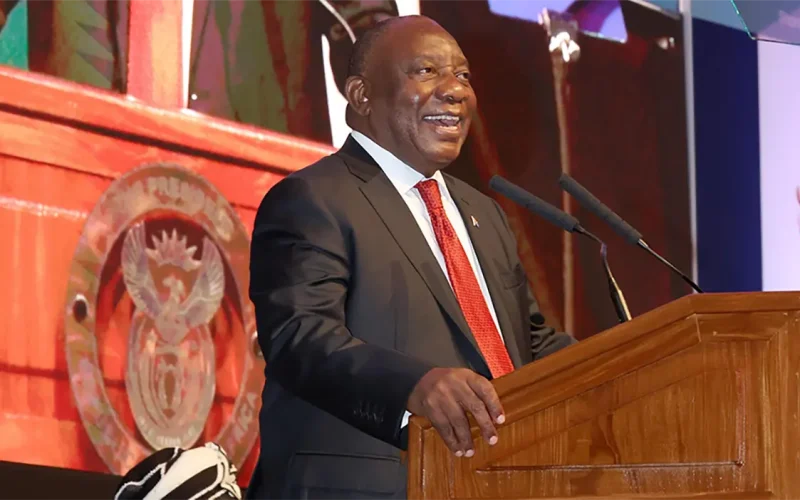
- This is an edited version of a keynote address by President Cyril Ramaphosa at the Biennial Conference Of The International Association Of Women Judges.