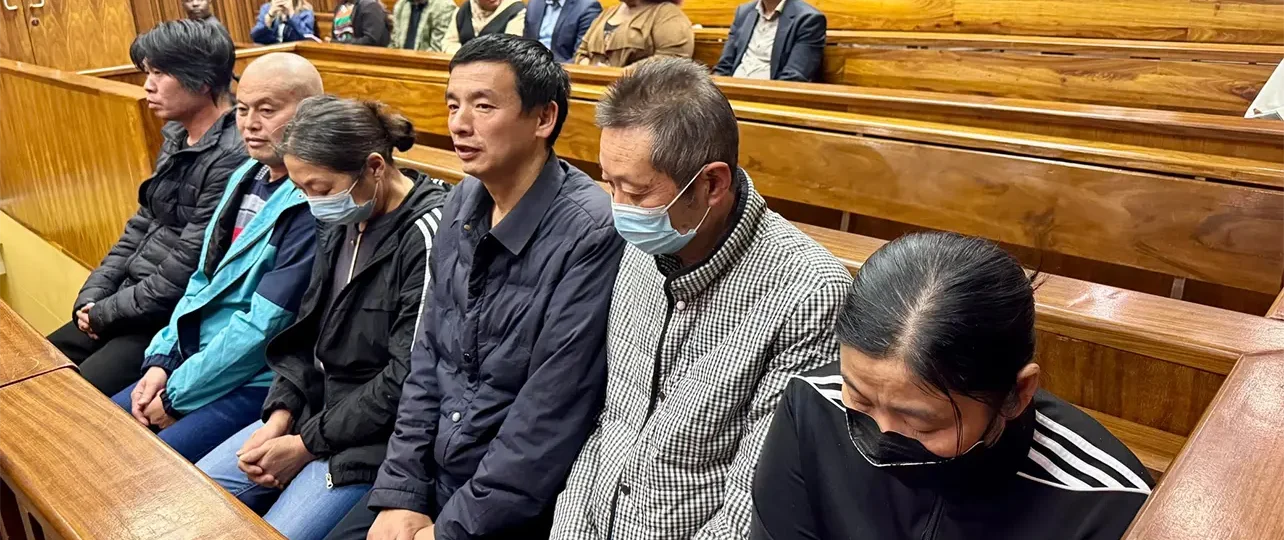

SEVEN Chinese nationals received effective 20-year prison sentences Tuesday after being convicted of trafficking 98 Malawian workers, including three minors, in what prosecutors described as one of South Africa’s most egregious labour exploitation cases.
The Johannesburg High Court sentenced Kevin Tsao, Shu-Uei, Chen Hui, Qin Li, Jiaqing Zhou, Ma Biao, Dai Junying, and Zhang Zhilian to a combined 52 years each – 20 years for human trafficking, 10 years for kidnapping, 22 years for labour law violations, and three years for financial facilitation. However, the sentences will run concurrently, resulting in an effective 20-year term for each defendant.
The court also imposed a R300,000 fine on their company, Beautiful City, which operated the factory where the trafficking victims were enslaved.
Six-Year Investigation Exposes Systematic Exploitation
The case originated from a November 12, 2019, raid on Beautiful City’s factory in Ekurhuleni, prompted by a tip-off about illegal immigrants. The joint operation by the Directorate for Priority Crime Investigation (DPCI) and Department of Labour inspectors uncovered more than 100 workers living in appalling conditions.
Warrant Officer Lulama Kona’s investigation revealed a sophisticated trafficking network that smuggled Malawian nationals into South Africa in trucks without legal documentation. Victims were initially placed at various factories in Croesus, Boksburg, and Benoni before being transferred to Beautiful City.
Workers endured dangerous conditions without protective clothing, resulting in severe injuries, while being paid below South Africa’s minimum wage. The systematic exploitation kept victims trapped in a cycle of bonded labour with no means of escape.
Economic and National Security Impact
Senior State Advocate Valencia Dube argued that human trafficking has become “a scourge” affecting not only individual victims but South Africa’s economic stability and international standing. The prosecutor emphasised that such crimes contribute to the country’s greylisting by international financial bodies and exacerbate unemployment by displacing local workers with exploited foreign labour.
“The accused blatantly disregarded the rule of law,” the NPA and DPCI said in a joint statement. “They came to South Africa to commit crimes by exploiting vulnerable people who were sold false promises of employment.”
Court Shows Leniency Despite Severity
Despite the gravity of the charges, the court deviated from prescribed minimum sentences, noting that the defendants were not the business owners. The judge acknowledged the prevalence of human trafficking in South Africa while considering the victims’ inhumane treatment as an aggravating factor.
The court accepted the state’s characterisation of trafficking as “an ongoing criminal process,” reflecting growing public frustration with foreign nationals involved in such crimes.
Landmark Victory in Anti-Trafficking Efforts
The convictions represent a significant victory in South Africa’s fight against human trafficking, coming after nearly six years of investigation and legal proceedings. The case demonstrates the country’s commitment to dismantling sophisticated criminal networks that prey on vulnerable migrants seeking economic opportunities.
“Human trafficking remains a scourge, and as law enforcement, we are committed to dismantling and eradicating this criminal network,” authorities stated, signalling continued vigilance against such operations.
For the 98 Malawian victims who endured years of exploitation, Tuesday’s sentences provide long-awaited justice while sending a strong message that South African courts will impose severe penalties on those who profit from human misery.