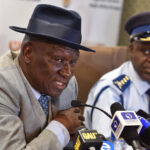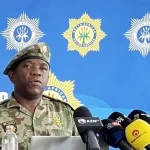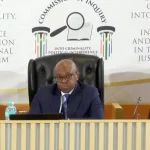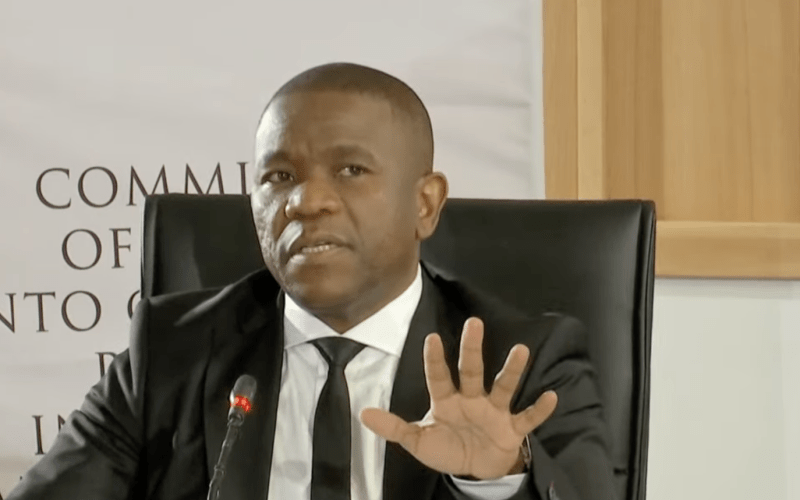
LIEUTENANT-GENERAL Nhlanhla Mkhwanazi, Police Commissioner in KwaZulu-Natal, in South Africa, has delivered devastating testimony before the Madlanga Commission of Inquiry, accusing two former Police Ministers of criminally interfering in police operations to protect a high-ranking officer from disciplinary action.
In explosive revelations that have rocked the country’s law enforcement establishment, Mkhwanazi detailed how former Minister Bheki Cele allegedly orchestrated a calculated campaign to derail disciplinary proceedings against Major General Feroz Khan, a deputy national commissioner at Crime Intelligence.
Testifying on his third day before the commission, Mkhwanazi painted a picture of brazen ministerial interference that struck at the heart of police independence. He revealed how Cele personally called him with an unprecedented demand: remove the key prosecutor from Khan’s disciplinary hearing.
The target was Dumisani Khumalo, the Zululand District Commissioner, who was set to lead the state’s case against Khan. Cele’s supposed justification? He needed Khumalo for a crime-fighting team in Gauteng, allegedly at the Premier’s request.
But Mkhwanazi wasn’t buying it. “I found Cele’s request strange because he knew that the former minister did not like Khumalo,” the Commissioner testified. Even Khumalo himself “laughed off the suggestion.”
The plot thickens with allegations involving a shadowy figure named Brown Mogotsi, described as a “fixer” with intimate connections to top politicians and police brass. Mkhwanazi suspects Khan leaked sensitive intelligence to Mogotsi, citing a damning text message where Mogotsi warned him about discussions in a crime intelligence meeting.
The smoking gun? When Mkhwanazi asked Mogotsi for meeting documents, he was told: “General Khan will brief you.”
Even more alarming, Mkhwanazi revealed that current but suspended Police Minister Senzo Mchunu’s office had confirmed Mogotsi as a “close friend of the minister.” Chief of Staff Cedric Nkabinde even provided Mogotsi’s contact details to the Commissioner.
In a stunning twist, Mkhwanazi accused the media of being weaponised in the cover-up conspiracy. He pointed to the suspicious timing of a year-old story that suddenly resurfaced, alleging his involvement in derailing a drug cartel investigation at Richards Bay correctional facility.
Following the story’s publication, Khan’s attorneys immediately questioned Mkhwanazi’s impartiality – a move the Commissioner clearly sees as coordinated.
Despite the alleged ministerial pressure campaign, the disciplinary hearing proceeded. In a twist that validates Mkhwanazi’s integrity, Khan was acquitted. “I could not find a single thing wrong that General Khan did. He stopped the people (police officers) who wanted to steal the drugs,” Mkhwanazi testified.
However, the Commissioner made clear that while Khan was cleared on the specific charges, suspicions remain about his relationship with the controversial Mogotsi.
The personal toll of the alleged interference was evident in Mkhwanazi’s testimony. “I was very upset. He disappointed me as a person who is a former minister of police,” he said of Cele, revealing he has never spoken to the former minister since that fateful phone call.
These allegations strike at the foundation of police independence in South Africa’s democracy. If proven true, they reveal a pattern of political interference that undermines the rule of law and compromises criminal justice operations.
The Madlanga Commission’s findings could have far-reaching consequences for how South Africa’s political and law enforcement establishments operate, potentially triggering criminal investigations and fundamental reforms to protect police independence.
As the commission continues its work, these bombshell revelations have already sent shockwaves through the corridors of power, raising serious questions about the integrity of South Africa’s criminal justice system and the politicians who oversee it.