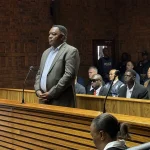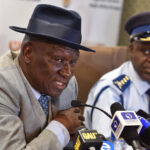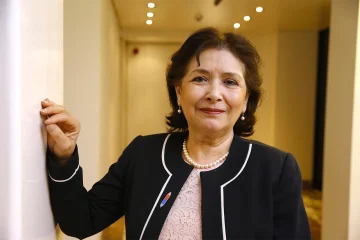
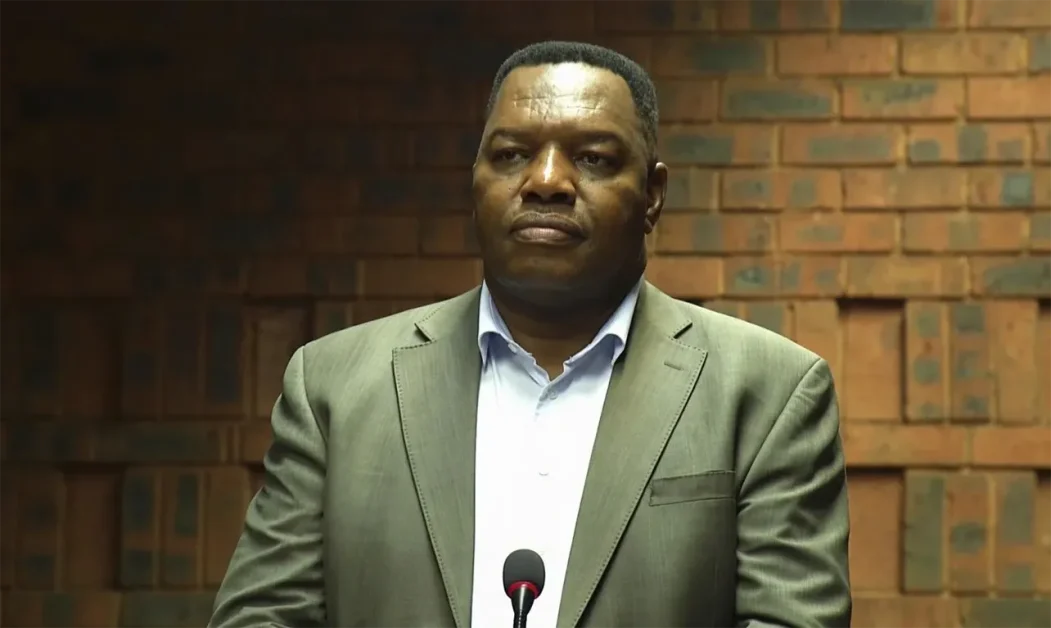
IN a carefully calibrated address from the Union Buildings in Tshwane on Thursday, President Cyril Ramaphosa announced what many South Africans had come to regard as inevitable: the precautionary suspension of National Police Commissioner General Fannie Masemola, who appeared in the Pretoria Magistrate’s Court earlier this week facing four counts of contravening the Public Finance Management Act (PFMA). The charges relate to his approval of payments under a R360-million health tender awarded to a company linked to alleged organised crime figure Vusimuzi “Cat” Matlala – a contract that was subsequently found to be irregular and cancelled.
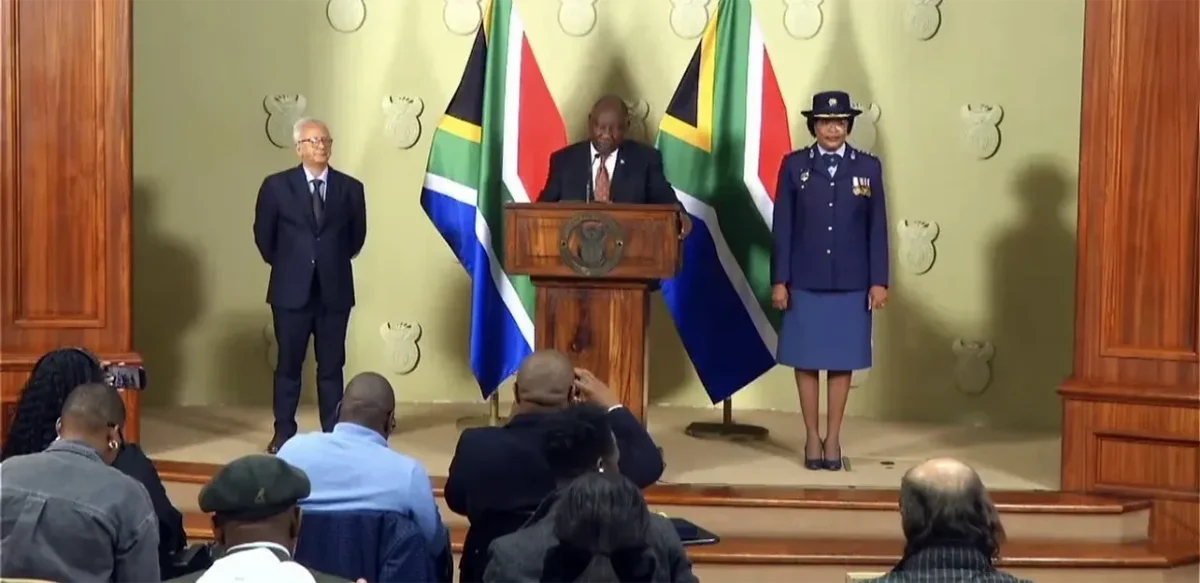
Ramaphosa was at pains to draw a legal and conceptual distinction between the charges Masemola faces and an outright corruption allegation. “In consideration of the seriousness of these charges and the critical role of the National Commissioner in leading the fight against crime, I have agreed with General Masemola that he be deemed to be on precautionary suspension pending the conclusion of the case,” the President told a briefing attended by acting Police Minister Firoz Cachalia.
The framing was deliberate. By emphasising that the suspension was precautionary and not premised on a finding of guilt, Ramaphosa sought to preserve both the principle of due process and the institutional credibility of the SAPS – an institution already under intense public scrutiny following a cascade of revelations at the ongoing Madlanga Commission of Inquiry.
The Medicare24 Tender and the PFMA Charges
The charges against Masemola centre on his role in approving payments linked to the Medicare24 Tshwane contract, a wellness services tender awarded to a company connected to Matlala, a figure the Madlanga Commission has identified as central to a sophisticated criminal syndicate alleged to have deeply infiltrated the state’s security apparatus. The contract, valued in the hundreds of millions of rands, was subsequently cancelled after it was found to be irregular. Masemola is one of 13 SAPS officers facing prosecution. The case returns to the Pretoria Magistrate’s Court on 13 May 2026.
The PFMA, which sets out the fiduciary duties of accounting officers and other senior officials in the management of public funds, has increasingly been invoked by prosecutorial authorities as a mechanism to hold senior officials accountable for procurement irregularities – even where outright personal enrichment cannot be immediately proven. The National Prosecuting Authority has indicated it has a robust case.
Ramaphosa’s Message: Accountability Without Destabilisation
In his statement, Ramaphosa took care to stress that the suspension does not amount to a concession of wrongdoing, and explicitly declined to appoint a fitness-to-hold-office commission of inquiry into Masemola, saying the law must be allowed to take its course without parallel interference. “We must hold firm to the values of our Constitution and, in this case as in all cases, allow the law to take its course,” Ramaphosa said.
“It is understandably a cause of great concern for all South Africans that the National Commissioner of Police is in court facing criminal charges. However, we should not allow this development to weaken our determination or diminish our ability to fight against crime and corruption.”
The President also outlined the broader framework within which the suspension must be understood. “In the State of the Nation Address in February, I said that our primary focus this year is on stepping up the fight against organised crime, corruption, and violence. For this fight to be successful, it is vital that our law enforcement agencies are capable, ethical, and effective,” he said.
That accountability drive has, in recent months, moved from rhetoric to action with striking speed. Unlike the protracted follow-through from the Zondo Commission into State Capture, the executive has responded to Madlanga Commission testimony with near-real-time consequences – a fact Ramaphosa implicitly acknowledged when he said the SAPS task team investigating matters arising from the commission “has made significant progress, leading to a number of arrests.”
Puleng Dimpane: The CFO Steps Into the Breach
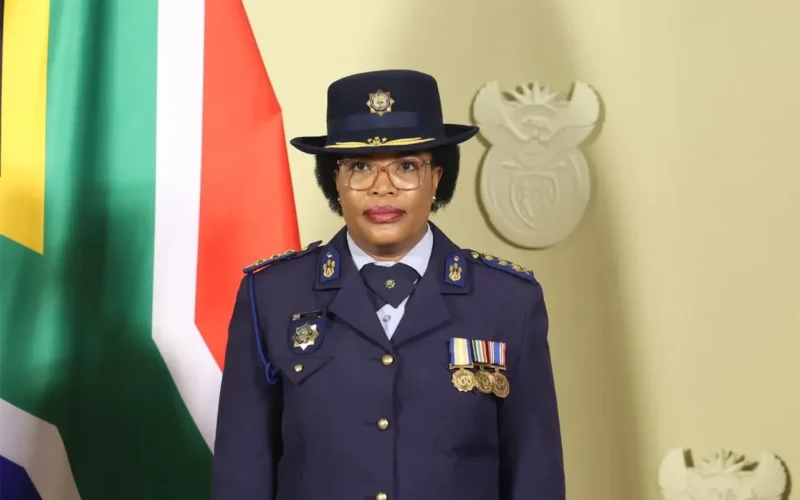
To fill the leadership vacuum, Ramaphosa appointed Lieutenant-General Puleng Dimpane as acting National Commissioner of Police – a choice that, given the specific nature of the charges driving Masemola’s suspension, carries its own symbolism. Dimpane has served since 2018 as the SAPS Divisional Commissioner for Financial Management Services and effectively functions as the service’s chief financial officer.
“Lieutenant-General Dimpane is currently the Divisional Commissioner for Financial Management Services of the SAPS and has a long and distinguished career both in the SAPS and in other public institutions,” Ramaphosa said. “Having been in the police service for close on two decades, she has extensive experience in policing, strategic management, financial management, and governance. Lt-Gen Dimpane has a reputation for professionalism and integrity.”
Her institutional knowledge of the SAPS financial architecture – including the procurement systems that have been identified as the central vectors of corruption in both the Zondo and Madlanga Commissions – makes her appointment functionally logical. Dimpane herself has previously raised questions about the Medicare24 tender in her capacity as CFO, though she later faced parliamentary probing over the manner in which it was nonetheless awarded. She has also been questioned about the escalating budget – exceeding R435-million – of the Political Killings Task Team, the unit that sits at the very heart of the Madlanga Commission’s origins.
Ramaphosa made clear that overhauling procurement would be the immediate operational priority for the acting commissioner. “A key area of attention for the Acting National Commissioner and the police leadership is to urgently address weaknesses in the procurement of goods and services. In the report of the Zondo Commission and through the proceedings of the Madlanga Commission, procurement has been identified as the source of corruption, abuse of office, and instability within the police service,” he said.
There is, however, an awkward structural reality accompanying Dimpane’s appointment. She steps into a SAPS command structure where most top positions are now occupied by acting officials – a situation Ramaphosa acknowledged was not ideal. “Yes, we do have too many people acting in positions, and we are going to address that specific issue,” the President told reporters. He nonetheless maintained that it would have been “irresponsible” not to fill the top post.
The Madlanga Commission: How a KZN Top Cop Upended the System
The institutional crisis now demanding Dimpane’s steady hand traces its origins to a dramatic media briefing on 6 July 2025, when KwaZulu-Natal Provincial Police Commissioner Lieutenant-General Nhlanhla Mkhwanazi went public with explosive allegations of systemic corruption and political interference within the South African criminal justice system.
Mkhwanazi alleged that a powerful organised criminal syndicate – later described in commission testimony as the “Big Five” Cartel – had successfully penetrated the SAPS, the National Prosecuting Authority (NPA), and intelligence structures. He further alleged that then-Police Minister Senzo Mchunu had colluded with criminal elements in an attempt to disband the KwaZulu-Natal Political Killings Task Team (PKTT), a specialised unit he headed that had been investigating political assassinations in the province. Mkhwanazi registered a criminal complaint against Mchunu.
President Ramaphosa responded within days, announcing a judicial commission of inquiry – the Judicial Commission of Inquiry into Criminality, Political Interference and Corruption in the Criminal Justice System – chaired by retired Constitutional Court Justice Mbuyiseli Madlanga. Hearings commenced on 17 September 2025, with Mkhwanazi himself as the first witness, followed by Masemola’s own corroborating testimony days later. The commission has since drawn testimony from crime intelligence leaders and anonymous witnesses, exposing the alleged reach of Matlala’s network into state institutions.
The PKTT, whose protection Mkhwanazi fought for, was itself born of a long history of political bloodshed. Established in KwaZulu-Natal as a response to a wave of intra-party killings linked to corruption in local government – documented by the earlier Moerane Commission of Inquiry, established in 2016 – the task team subsequently expanded its mandate to include the Eastern Cape and investigations into the killings of traditional leaders.
Mkhwanazi: The Conscience of the Commission
Lieutenant-General Nhlanhla “Lucky” Sibusiso Mkhwanazi, 53, born in Pietermaritzburg, joined the SAPS in 1993 and has since forged a reputation as one of the most operationally fearless figures in South African policing. He has served as head of the elite Special Task Force, as acting National Commissioner as far back as 2011 – when he was just 38 years old – and as KZN Provincial Commissioner since April 2021. He has recently been reappointed for a second five-year term, with KZN Premier Thami Ntuli citing improving crime statistics as justification for the renewal.
Mkhwanazi is widely credited with stabilising KwaZulu-Natal through direct operational leadership against extortion rings, illegal firearms networks, and organised crime syndicates. Unlike many officials who testify at commissions of inquiry from a defensive posture, Mkhwanazi has remained the driving force behind the Madlanga Commission’s revelations – the source of its genesis and the principal architect of the evidentiary record that led, among other consequences, to the court appearance that has now brought down his superior.
Ramaphosa, notably, did not address the specific future role of Mkhwanazi in Thursday’s statement – a silence that itself speaks. With Masemola suspended, the SAPS command architecture in flux, and the Madlanga Commission continuing its work, Mkhwanazi’s institutional standing has arguably never been higher – nor the pressure on him greater. The SAPS task team investigating commission-related matters, which has already secured multiple arrests, continues to operate with his province as its epicentre.
A Force at a Crossroads
South Africa’s police service enters this new chapter carrying both the weight of institutional damage and the evidence of genuine renewal. Ramaphosa noted that contact crime has declined over the past two financial years, attributed largely to improved police visibility. Work on the Organised Crime Strategy, the implementation of the Integrated Crime and Violence Prevention Strategy, and the SAPS-SANDF collaboration against gang violence, illegal mining, drug trafficking, and kidnapping continue to register tangible results.
But the deeper challenge – rebuilding the SAPS as an institution whose senior ranks can be trusted not to be captured by the very criminal networks they are mandated to fight – is the work that Lieutenant-General Dimpane now inherits. As Ramaphosa put it in his closing remarks: “We must not allow anything to destabilise the police service or undermine the morale of those entrusted to protect our people.”
Whether the appointment of a financial officer to command a force at war with organised crime proves prescient or provisional will depend, in large measure, on what the Madlanga Commission uncovers next — and how quickly the institutions of the state continue to act on what it finds.