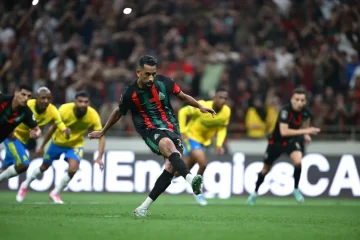
FROM the sun-scorched dunes of the Sahara to the lush highlands of East Africa, a revolution was unfolding. Four proud nations had already punched their tickets to football’s greatest stage, and on this electric week, the desert was about to roar once more.
Algeria: The Desert Warriors Return
In Oran, beneath a sky painted in twilight hues of crimson and gold, the Stade Miloud Hadefi trembled with anticipation. Though technically Somalia’s home fixture, fate had conspired to gift Algeria a coronation on their own soil—and fifty thousand voices rose as one, ready to witness history.
The Desert Warriors had been absent from the world stage for twelve long years, their last appearance a bittersweet memory from Brazil 2014. But redemption was in the air, thick and intoxicating.
When Mohamed Amoura struck in the seventh minute—a perfectly placed volley from Riyad Mahrez’s curling cross—the stadium erupted like a volcano releasing years of pent-up longing. The ball had barely nestled in the net when Amoura was buried beneath a wave of green and white.
Twelve minutes later, Captain Mahrez himself stepped forward, his shot ricocheting off the turf before arrowing into the roof of the net. The architect had become the executioner. This wasn’t just a qualification match; it was a symphony, and Mahrez was conducting with the precision of a maestro.
In the 58th minute, the captain turned provider once more, his cross finding Amoura unmarked at the back post. The striker’s header was emphatic, sealing his brace and Algeria’s destiny. Eight goals in the campaign for Amoura—a striker in the form of his life, playing for a nation rediscovering its voice.
Final whistle: Somalia 0-3 Algeria
Twenty-two points. Unassailable. Untouchable. The Desert Warriors were going to North America—to Canada, Mexico, and the United States—where they would write the next chapter of their story. Fifth World Cup. First, since that heartbreaking extra-time loss to Germany in Brazil. This time would be different.
Egypt: The Pharaohs Awaken
While Algeria celebrated in Oran, Egypt had already secured their throne. The Pharaohs’ 3-0 demolition of Djibouti confirmed what the continent had long suspected: Egypt was back, and they meant business.
Under Hossam Hassan’s guidance, Egypt had been nothing short of magnificent. Nineteen goals scored, only two conceded—numbers that spoke of a team perfectly balanced between steel and silk. Seven clean sheets told the story of Mohamed El Shenawy’s goalkeeping mastery, while Mohamed Salah’s nine goals whispered of attacking genius.
This was a team transformed. In Russia 2018, they had arrived with hope but departed with disappointment, winless and wondering. Now, with Salah in his prime, Trezeguet’s experience, and the explosive youth of Omar Marmoush and Mostafa Mohamed, the Pharaohs possessed fangs that could bite any opponent.
For a nation whose World Cup history stretched back to 1934—the pioneering days when Africa was barely represented—this was more than qualification. It was validation. Three previous appearances, zero wins, zero advancement from the group stage. These ghosts haunted every Egyptian football fan. But this squad, this blend of seasoned warriors and hungry youngsters, felt different.
Morocco had shown Africa what was possible with their semi-final run in Qatar. Now Egypt believed: Why not us? Why not the Pharaohs?
Tunisia and Morocco: The Trailblazers
They had qualified earlier, but their presence loomed large. Morocco, the Atlas Lions, had captivated the world in Qatar, becoming the first African team to reach a World Cup semi-final. Their success had ignited something primal across the continent—proof that African football could compete with anyone, anywhere.
Tunisia, the Carthage Eagles, brought their own legacy—six World Cup appearances, the most of any African nation. Consistent, resilient, never to be underestimated.
Together with Egypt and Algeria, four North African giants would carry the continent’s hopes to North America. But the story was far from over.
The Battle for Survival
Across the continent, other nations clawed and scraped for their chance at glory. In Blantyre, Equatorial Guinea failed to show up for their match against Malawi, handing their opponents a lifeline in the race for the playoff spots. Four best runners-up would get one final chance—a November showdown for Africa’s last possible ticket to the tournament.
Uganda’s Cranes soared in Francistown, Jude Ssemugabi’s header sinking Botswana and lifting Uganda three points clear of third place. The dream was alive. One draw against already-qualified Algeria, and they would secure that precious runner-up position.
In Maputo, young Abdoul Karim Traore announced himself to the continent with a brace for Guinea. Just eighteen years old, he struck in the second minute and again in the 59th, his winner slipping through Mozambican hearts and ending their World Cup dream. Sometimes football’s cruelty is matched only by its capacity to birth new stars.
Liberia’s revival was equally dramatic. In Monrovia, they tore into Namibia with the hunger of the desperate. Ayouba Kosiah’s third-minute penalty set the tone, Sulahmana Bah’s composed finish nine minutes later sealed Namibia’s fate, and Edward Ledlum’s late strike made it emphatic: Liberia 3-1 Namibia. The Lone Star was burning bright, just one point behind the Brave Warriors in the race for second place.
And in a fiery encounter in Burundi, ten-man Harambee Stars of Kenya clung to their dreams. Bonfils-Caleb Bimenyimana’s reckless fifth-minute challenge earned him a red card and left his team battling against the odds for 85 minutes. But numbers don’t always tell the story. In the 73rd minute, substitute Ryan Ogam unleashed a thunderbolt from distance, a curling masterpiece that the goalkeeper could only watch sail past. Burundi 0-1 Kenya—hope snatched from the jaws of numerical disadvantage.
The Continental Tapestry
Nine more qualifiers awaited on Friday. Sunday would bring the final round of matches, a crescendo of joy and heartbreak that would determine Africa’s complete representation at the 2026 World Cup.
Four nations had already arrived. Others were within touching distance. Some would fall agonizingly short, their dreams deferred for another four years.
But across this vast and vibrant continent—from the Mediterranean coast to the Cape, from Atlantic shores to Indian Ocean islands—something magnificent was happening. African football was asserting itself, demanding respect, refusing to be dismissed.
The road to North America was paved with passion, painted in the colours of fifty-four nations, and echoing with the songs of millions who believed. Algeria’s desert warriors, Egypt’s ancient Pharaohs, Morocco’s fearless lions, Tunisia’s enduring eagles—they would carry more than just flags to the 2026 World Cup.
They would carry the dreams of a continent that had waited long enough for its moment in the sun.
The journey continued. The story was far from over.
Africa was rising. And the world would be watching.