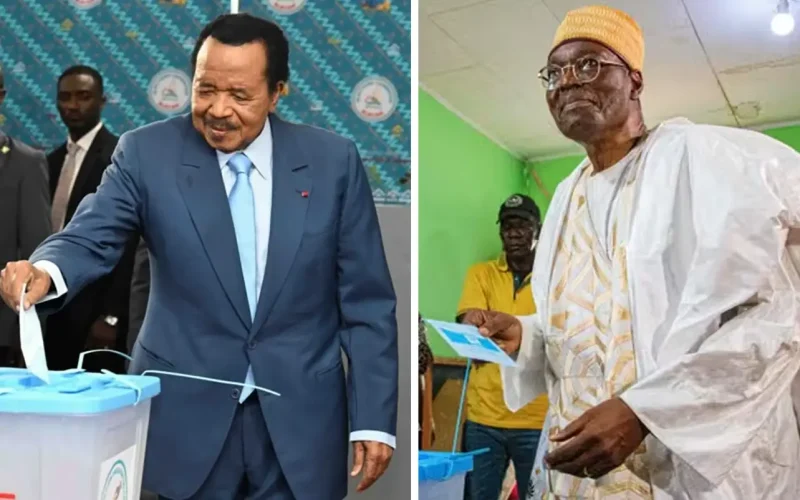
CAMEROON stands on a knife-edge this week, a nation gripped by a tense and historic political moment destined to shape its future for years to come. The longest week in Cameroonian politics has unfolded like a high-stakes thriller, with the air thick with anticipation and anxiety as the country waits for the Constitutional Council’s official announcement of presidential election results, scheduled for Thursday, October 23rd at 10:30 a.m. at the Yaoundé Convention Center.
After a nationwide vote on October 12th that has sparked fierce claims of victory from rival camps, uncertainty reigns supreme. In the capital’s streets, in the bustling markets of Douala, and in the remote villages of the Extreme North, Cameroonians hold their collective breath—caught between the weight of 43 years of history and the fragile promise of change.
The Defiant Challenger
At the heart of this fractious drama stands Issa Tchiroma Bakary, the 75-year-old candidate of the Cameroon National Salvation Front (FSNC). A former railway engineer turned political insider, Tchiroma spent two decades as one of Paul Biya’s most trusted lieutenants, serving in multiple cabinet positions including Minister of Communication, Transport, and Employment. But in June 2025, he made the audacious choice to break ranks, resign from government, and challenge the man he once served.
Since Sunday, October 13th—just hours after polls closed—Tchiroma has flooded the nation’s conscience with purportedly “official” polling station reports in his possession. Standing before the Cameroonian flag in his northern hometown of Garoua, he declared in a video that would reverberate across social media: “Our victory is clear, it must be respected.” Each declaration fans the flames of hope among his supporters, drawing large crowds that see in him the possibility of renewal. Yet his claims also deepen the fault lines in a populace weary of prolonged political limbo and skeptical after decades of disputed elections.
The government’s response was swift and severe. Grégoire Owona, deputy secretary-general of Biya’s ruling RDPC party, dismissed Tchiroma’s claims outright, insisting he neither won nor possessed legitimate polling results. More ominously, Minister of Territorial Administration Paul Atanga Nji accused Tchiroma of orchestrating “a cleverly planned diabolical plan with his occult networks at home and abroad aimed at setting Cameroon ablaze.” The minister had warned a week before the election that any unauthorized release of results would be deemed “high treason”—only the Constitutional Council, he insisted, has the authority to declare a winner.
Streets on Fire, Democracy on Trial
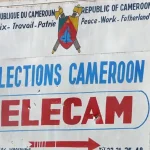
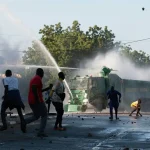
The tension exploded into the streets by October 15th. Protests erupted in several cities over allegations of electoral fraud and vote tampering. In Douala, Cameroon’s economic capital, demonstrators gathered at the Elecam headquarters, their chants echoing frustrations built over years of disputed polls. In Dschang, anger turned to flames as the offices of the ruling RDPC party were set ablaze—a vivid symbol of the combustible political atmosphere.
Behind closed doors, the National Vote Counting Commission worked painstakingly to verify and compile results. Cameroon’s electoral process is entirely manual—a laborious system where paper ballots must travel from individual polling stations to local voting commissions, then to departmental supervisory commissions, and finally to the national commission before reaching the Constitutional Council for validation. Each step takes time, each transfer point a potential site of suspicion in a nation where electoral integrity has long been questioned.
The World’s Oldest President
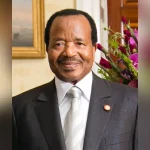
Looming over this entire drama is the figure who has defined Cameroon for more than four decades: Paul Biya. At 92 years old, he is not only Africa’s second-longest serving leader after Equatorial Guinea’s Teodoro Obiang, but the world’s oldest sitting president. Since ascending to power in 1982 following the resignation of Ahmadou Ahidjo—Cameroon’s first post-independence president—Biya has been the only leader most Cameroonians have ever known. In a country where the median age is strikingly young and 60% of the population is under 25, an entire generation has been born, grown up, and reached voting age under his unbroken rule.
Biya’s extraordinary longevity in office was cemented in 2008 when his RDPC party engineered a constitutional amendment abolishing the two-term presidential limit. Since then, he has cruised through elections—most recently in 2018, when he claimed over 70% of the vote in a contest marred by irregularities, low turnout, and violent protests led by opposition candidate Maurice Kamto. Kamto, who officially garnered 14% but claimed he had won, spent ten months in detention along with over 200 supporters. While he was eventually released, 41 of his followers remain imprisoned to this day, serving seven-year sentences for daring to protest the results.
Yet the once-unassailable president now appears vulnerable. His health has routinely been the subject of speculation, and he has spent extended periods in Europe, leaving day-to-day governance to key party officials and family members. His prolonged absences have fueled rumors and anxiety about succession. The constitutional provision is clear: should Biya die or step down while in office, power would transfer to the President of the Senate, Marcel Niat Njifenji, a longtime RDPC loyalist who would be required to organize new elections within 20 to 120 days but barred from running himself. Behind the scenes, a nervous succession battle has reportedly been brewing within the ruling party.
Even within his own family, cracks appeared. On September 18th, Biya’s daughter, Brenda Biya, published a stunning video on social media calling on voters not to elect her father and accusing her family of mistreating her. Though she subsequently deleted the video and issued an apology, the moment crystallized the generational divide and internal tensions surrounding his candidacy.
A Plea to the World
In a bold and evocative call on Monday, October 21st, Tchiroma directly appealed to Paul Biya himself. In his message, he implored the aging president to respect the people’s mandate, to step down with dignity rather than stain his historic tenure with overt electoral fraud. “Do not end such a long reign with blatant electoral fraud,” he urged, his words carrying both the weight of their shared history and the hopes of a generation demanding change.
But Tchiroma’s message transcended national borders. He issued a clarion call to Cameroon’s neighbors—particularly Nigeria and Chad—and to the international community: the African Union, European Union, United Nations, France, the United States, and other global partners. His plea insisted these actors refuse to remain silent watchers on the sidelines. Their voices, he argued, could play a crucial role in safeguarding peace and preventing the country from descending into turmoil. The implicit warning was clear: electoral fraud in Cameroon could ignite instability that ripples across Central Africa, a region already grappling with militant Islamist insurgencies, separatist conflicts, and fragile democratic institutions.
Cameroon’s strategic importance cannot be overstated. Along with Nigeria and Chad, it forms a critical frontline against Boko Haram and the Islamic State in West Africa, threats that have intensified in recent years. The country has experienced a 50% increase in fatalities linked to these groups, with over 800 deaths in the past year concentrated in the Extreme North Region. Meanwhile, in the Anglophone regions of the Northwest and Southwest, a brutal separatist conflict has raged since 2016, resulting in over 3,000 deaths, nearly 700,000 internally displaced people, and the disruption of schooling for 600,000 children. Human rights abuses by both government forces and separatist fighters have been widely documented.
These crises underscore the high stakes of the 2025 election. Any prolonged political instability or violent backlash to disputed results could exacerbate these security threats and deepen the alienation of already marginalized communities.
The Opposition’s Fragile Unity
The path to unseating Biya was always steep. Cameroon’s first-past-the-post electoral system—where the candidate with the most votes wins outright, no runoff required—inherently favors an incumbent with a powerful party machine and control over state institutions. A unified opposition was essential, but that unity proved elusive.
Maurice Kamto, arguably the most recognizable opposition figure after his dramatic 2018 run, was barred from participating by Elecam on July 26th. The electoral commission ruled that his Movement for the Renaissance of Cameroon (MRC), which had boycotted the 2020 legislative and municipal elections, was therefore ineligible to nominate a candidate. It was a controversial decision that eliminated Biya’s strongest challenger and seemed designed to fragment the opposition field.
In total, 83 people registered their candidacy, but only 13 made it onto the provisional ballot, including just one woman: Hermine Patricia Tomaïno Ndam Njoya, a 56-year-old former National Assembly deputy and current mayor of Foumban. Thirty-five rejected candidates appealed to the Constitutional Council, but ultimately, 11 opposition candidates competed on election day—a fractured field that worked in Biya’s favor.
Among those candidates were other former Biya allies who, like Tchiroma, sensed that change was inevitable and broke ranks. Bello Bouba Maigari, 78, a former close confidante for three decades who currently serves as Minister of State for Tourism and Leisure, remained in government even as he ran against his boss. The opposition also included Akere Muna, a 72-year-old international lawyer renowned for his work on anti-corruption and good governance, who had filed a petition seeking to disqualify Biya on grounds of advanced age, recurrent health absences, and presumed dependency on third parties. And there was Joshua Osih of the Social Democratic Front, who finished fourth in 2018 and warned ahead of this year’s vote: “The system makes it such that the elections cannot be free and fair, that we know.”
Despite the divisions, Tchiroma emerged as the focal point of opposition hopes. His campaign drew large crowds and backing from a coalition of opposition parties and civic groups. As a former insider with deep knowledge of the regime’s workings, he represented both continuity and rupture—someone who could speak credibly about governance while promising reform.
Democracy’s Test, Resilience’s Trial
As Thursday, October 23rd approaches, Cameroon is suspended in agonizing uncertainty. The manual vote-counting process has stretched nerves to breaking point. Every hour of delay feeds speculation—among Tchiroma’s supporters, that the regime is manufacturing results; among Biya’s loyalists, that the opposition is inciting chaos; among ordinary citizens, that their votes may not matter at all.
International observers have watched closely. The United States Embassy in Yaoundé, in a statement released in July, emphasized “the importance of free, fair, peaceful, and inclusive elections as a cornerstone of democratic governance and stability in Cameroon and Central Africa.” The embassy stressed that journalists, political parties, civil society organizations, and religious institutions must be allowed to operate without harassment, and that the fundamental freedoms of expression, assembly, and association guaranteed in the Cameroonian constitution must be protected.
Yet past experience has left many Cameroonians cynical. Biya and the RDPC have maintained their stranglehold over the country via control of all government institutions, including the electoral commission and judiciary. What independent observers have long viewed as a series of fraudulent elections led opposition parties to boycott the 2020 polls entirely. The 2018 election’s violent aftermath and mass arrests cast a long shadow over this year’s vote.
Now, as the Constitutional Council prepares to speak, the question is whether it will validate the voice of the people or the power of the incumbent. Will the announcement on Thursday morning herald a historic transfer of power—a moment when Africa’s oldest leader gracefully passes the torch to a new generation? Or will it be a bitter affirmation of the entrenched status quo, cementing Biya’s grip for another seven-year term that would take him to 99 years old?
A Nation’s Reckoning
This week embodies the weight of decades. It is a crossroads where the legacy of a leader who has dominated Cameroon’s political landscape for 43 years meets the fervent hopes of a people dreaming of renewal. For the youth who have never known another president, it is a chance to imagine their country differently. For the diaspora watching anxiously from abroad, it is a test of whether democracy can take root in soil long dominated by a single party. For neighboring nations and international partners, it is a question of whether stability can coexist with genuine change or whether the suppression of democratic aspirations will sow the seeds of future conflict.
The streets are tense but not yet ablaze. Calls for peace and respect for the electoral process have echoed from all political actors, even as protests and accusations fly. Civil society groups, religious leaders, and even some within the ruling party have urged restraint and respect for the rule of law. The mood is one of collective breath-holding, of a nation on the precipice.
As the clock ticks toward 10:30 a.m. on Thursday, October 23rd, Cameroon holds its breath. The Yaoundé Convention Center will become the stage for a moment that will reverberate for generations. Behind the polished words and official procedures lies a raw, human drama: millions of Cameroonians waiting to learn whether their voices have been heard, whether their hopes for change will be realized or dashed, whether their country will step forward into a new era or remain locked in the grip of the old.
The days ahead promise either a triumph of democracy or a test of resilience. They may bring jubilation or despair, vindication or bitter disappointment. But whichever path unfolds, this longest week will be etched in the collective memory of Cameroon as a profound moment of reckoning—the week when a nation confronted its past, wrestled with its present, and reached for its future.
Will it be business as usual under the world’s oldest president, or the dawn of something genuinely new?
Cameroon, and the world, is about to find out.