A defiant Nicolas Sarkozy proclaimed his innocence on Tuesday as he began serving a five-year prison sentence for conspiring to raise campaign funds from Libya, becoming the first former French president to be jailed since Nazi collaborator Marshal Philippe Petain after World War Two.
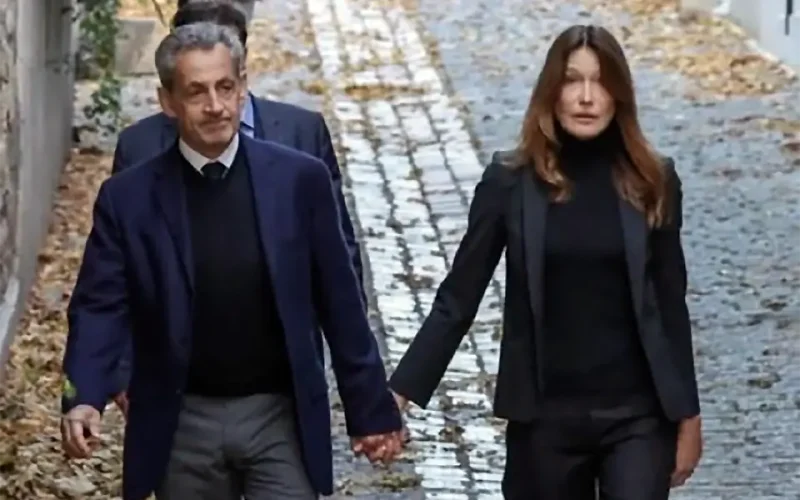
The 70-year-old former conservative leader, who governed France from 2007 to 2012, walked hand in hand with his wife, supermodel-turned-singer Carla Bruni, to a waiting car as supporters chanted “Nicolas, Nicolas” and sang the French national anthem outside his Paris home.
“I want to tell [French people], with the unshakable strength that is mine, that it is not a former president of the Republic who is being imprisoned this morning — it is an innocent man,” Sarkozy wrote in a lengthy message posted on X shortly before arriving at La Santé prison.
The dramatic scene marked a stunning downfall for a man who once commanded France’s nuclear arsenal and sat at the world’s most powerful negotiating tables.
Years of Legal Battles Culminate in Historic Sentence
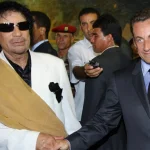
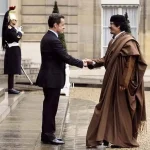
Sarkozy’s conviction last month capped years of legal battles over allegations that his 2007 presidential campaign accepted millions in cash from Libyan dictator Muammar Gaddafi. The Paris Criminal Court found him guilty of criminal association for allowing close associates to seek financial support from Gaddafi’s regime between 2005 and 2007.
While the court determined Sarkozy conspired with aides to orchestrate the scheme, he was acquitted of personally receiving or using the funds, as well as charges of misappropriation of public funds and passive corruption.
The irony of the case has not been lost on observers: Sarkozy later led France’s military intervention in Libya during the 2011 Arab Spring, ultimately contributing to Gaddafi’s overthrow and death.
Several of Sarkozy’s former allies were also convicted. Claude Guéant, his ex-campaign director, was found guilty of criminal association, passive corruption, passive influence peddling, forgery and aggravated money laundering. Former minister Brice Hortefeux was convicted of criminal association and faces charges of aiding illegal campaign financing.
Life Behind Bars at La Santé
Sarkozy will likely be housed in La Santé’s isolation unit, where inmates are kept in single cells measuring 9 to 12 square meters and separated during outdoor activities for security reasons. Following recent renovations, the cells now include private showers.
The former president will have access to a television for a monthly fee of 14 euros and a landline telephone. He told Le Figaro newspaper he would bring three books for his first week, including Alexandre Dumas’ “The Count of Monte Cristo” — the story of a man unjustly imprisoned who plots revenge against his betrayers.
Sarkozy’s lawyers have filed a request for early release pending his appeals trial, with expectations that the request will be reviewed within a month. They expressed hope he could be freed by Christmas.
Political Firestorm and Shifting Justice
The decision to imprison a former president has ignited fierce debate across France’s political spectrum. Sarkozy’s allies and far-right politicians have expressed outrage at the sentence.
“Nicolas Sarkozy is not a criminal,” said supporter Jacqueline Fraboulet, who joined the crowd cheering the former president Tuesday morning. “We actually feel like the justice system is taking the power, and that’s not good for France.”
Sarkozy’s children and brothers attended the gathering outside his home. The former president, looking sombre, waved at supporters before departing for La Santé.
The sentencing reflects France’s evolving approach to white-collar crime. In the 1990s and 2000s, many convicted politicians avoided prison altogether — a lenient tradition that appears to be ending.
President Emmanuel Macron, who has maintained warm relations with Sarkozy and Bruni, revealed Monday he had met with Sarkozy ahead of his incarceration. Justice Minister Gérald Darmanin said he would visit the former president in prison — statements that drew sharp criticism from left-wing politicians who accused them of breaching judicial independence.
From Presidential Palace to Prison Cell
The son of a Hungarian immigrant, Sarkozy burst onto the national stage promising pro-business reforms to reinvigorate France’s economy and restore the country’s global standing. His presidency, however, was quickly derailed by the 2008-2009 financial crisis.
Despite raising the retirement age from 60 to 62 and loosening the country’s 35-hour work week rules, voters gave him little credit for his reforms, denying him a second term in 2012.
Yet Sarkozy’s political influence has proved remarkably resilient as French society has shifted rightward in recent years, making his imprisonment all the more dramatic.
Sarkozy has consistently denied any wrongdoing throughout the legal proceedings, characterising the prosecution as politically motivated. In his message Tuesday morning, he claimed to be “a victim of revenge and hatred.”
As the heavy doors of La Santé prison closed behind him, Nicolas Sarkozy joined an ignominious club of world leaders whose pursuit of power ultimately led to their imprisonment — a cautionary tale written across continents and throughout history, now with a distinctly French chapter.