IN the grand theatre of international politics, few stories capture the imagination quite like the tale of two men separated by the Mediterranean Sea, yet bound together by ambition, money, and ultimately, justice delayed but not denied. This is the story of how a dead dictator’s reach extended from beyond the grave to topple one of France’s most powerful political figures.
The Unlikely Alliance
Picture the scene: it was 2005, and Nicolas Sarkozy was a man possessed by singular ambition. The then-Interior Minister prowled the corridors of French power like a restless lion, his eyes fixed firmly on the Élysée Palace. Across the Mediterranean, in the sprawling desert kingdom of Libya, another strongman held court – Muammar Gaddafi, the self-proclaimed “King of Kings of Africa,” draped in his flowing robes and golden ornaments, ruling with an iron fist wrapped in revolutionary rhetoric.
These two men – one a sharp-suited French politician with dreams of grandeur, the other an eccentric dictator with coffers overflowing from oil wealth – would forge an alliance that would echo through the decades like a curse from an ancient tomb.
Gaddafi, ever the shrewd operator despite his theatrical persona, saw opportunity in the ambitious Frenchman. Here was someone who could be useful, someone who might one day hold the keys to European power. And Sarkozy? He saw salvation for his presidential dreams in Libyan petrodollars.
The Secret Courtship
Between 2005 and 2007, as Sarkozy’s presidential campaign machinery hummed to life, a shadow dance began across continents. While the French public watched traditional campaign rallies and televised debates, a more sinister choreography was unfolding in the wings. Sarkozy’s inner circle – his most trusted lieutenants – became emissaries in this clandestine courtship.
Claude Guéant, Sarkozy’s campaign director and later his chief of staff, emerged as a key architect of this dangerous liaison. A man who had built his career in the shadows of power, Guéant understood that politics was often less about ideology and more about resources. Alongside him, Brice Hortefeux, another Sarkozy confidant, helped weave the web that would eventually ensnare them all.
The desert king was generous with his suitors. Millions of euros allegedly flowed from Tripoli to Paris, lubricating the wheels of Sarkozy’s presidential machine. It was a Faustian bargain written in oil money and sealed with handshakes in palatial halls far from the prying eyes of French voters.
The Crowned Puppet
May 2007 brought triumph to Nicolas Sarkozy as he ascended to the French presidency. But victory came with invisible chains. The man who now sat in the Élysée Palace was, in part, a creation of the Libyan strongman’s largesse. Gaddafi had invested in a French president, and like any shrewd investor, he expected returns.
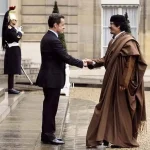
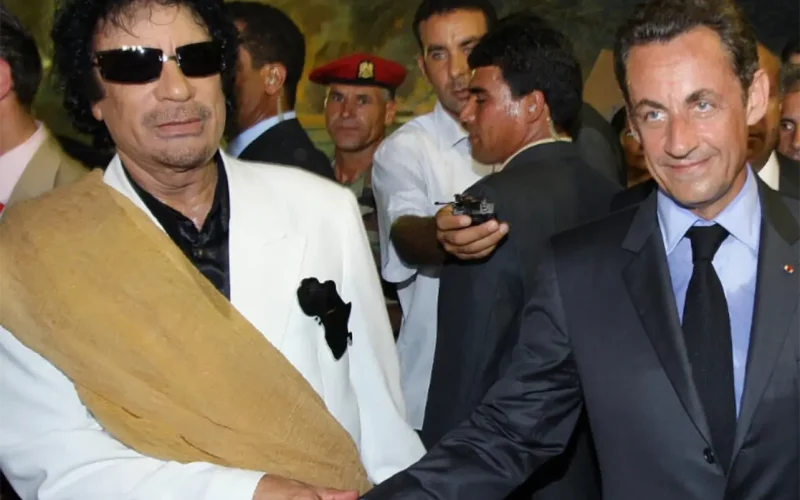
For a time, it seemed the arrangement would benefit both men. Sarkozy welcomed Gaddafi to Paris with pomp and ceremony, the dictator’s Bedouin tent pitched on the grounds of official residences. Photo opportunities showed two leaders shaking hands, smiling for cameras, while the true nature of their relationship remained buried beneath layers of diplomatic protocol.
But the Arab Spring was coming, and with it, the unravelling of everything.
The King’s Fall and the President’s Betrayal
2011 arrived like a sandstorm across North Africa. The Arab Spring swept through Tunisia, Egypt, and finally crashed against the walls of Gaddafi’s Libya. As his regime crumbled, the desert king found himself abandoned by the very man he had helped create. Sarkozy, now wearing the mantle of Western leadership, turned his back on his former benefactor with breathtaking cynicism.
France led the charge for international intervention in Libya. Sarkozy, the politician who had once courted Gaddafi’s money, now painted himself as a champion of Libyan freedom. French jets screamed across Mediterranean skies, their bombs falling on the kingdom that had funded Sarkozy’s rise to power.
In October 2011, Muammar Gaddafi met his end in the streets of Sirte, dragged from a drainage pipe and killed by the rebels whose money had been inadvertently helped empower through French intervention. But even in death, the desert king’s influence was far from finished.
The Ghost’s Revenge
They say the dead cannot harm the living, but Gaddafi’s ghost proved remarkably persistent. Evidence of the illicit funding survived the strongman’s death, hidden in bank records, testimony, and the guilty consciences of those who had participated in the scheme.
For years, the case built slowly, methodically. Investigators followed money trails across continents, pieced together meetings and phone calls, and gradually constructed a web of evidence that even a former French president could not escape.
Claude Guéant, once Sarkozy’s most trusted lieutenant, found himself ensnared in a legal nightmare. Charged with criminal association, passive corruption, passive influence peddling, forgery, and aggravated money laundering, he faced the full weight of French justice. Brice Hortefeux, too, could not outrun the consequences of their Libyan adventure.
The Judgment Day
Thursday’s verdict in a Paris criminal court was the desert king’s final victory. Judge Nathalie Gavarino’s words echoed through the courtroom like a pronouncement from beyond the grave: Nicolas Sarkozy was guilty of criminal association, guilty of allowing his associates to pursue Libyan funds, guilty of complicity in a scheme that had tainted his very presidency.
The man who had once walked the corridors of the Élysée Palace with the confidence of ultimate power now faced five years behind bars, his sentence a stark reminder that not even former presidents are above French law. The charges of misappropriation and passive corruption did not stick, but the core truth remained: Sarkozy had allowed himself to become entangled with a dictator’s money, and that entanglement had finally claimed him.
His co-conspirators fell around him like dominoes. Guéant faced the harshest judgment, convicted on multiple charges that painted him as the operation’s mastermind. Hortefeux, too, found himself caught in justice’s web, facing charges that could reshape the remainder of his life.
The Price of Faustian Bargains
As Nicolas Sarkozy faces five years in prison, the weight of his sentence crystallises the full scope of his fall from grace. One cannot help but reflect on the strange poetry of political justice. The man who betrayed his benefactor in life now finds himself betrayed by that same man in death.
Gaddafi’s money, once seen as the key to French political power, has become Sarkozy’s chains. The desert king’s investment has finally paid its intended dividend—not in political influence or favourable policies, but in the satisfaction of cosmic justice.
In the grand sweep of history, this story serves as a reminder that power built on corruption is ultimately power built on sand. The winds of justice may blow slowly, but they blow persistently, eventually uncovering even the most carefully buried secrets.
From his grave in the Libyan desert, Muammar Gaddafi has achieved what he could never accomplish in life: he has brought down a French president. It is perhaps the most elaborate and long-delayed revenge plot in modern political history, executed not by the living but by the persistent demands of truth and justice.
The desert king is dead, but his last gambit has finally reached checkmate.