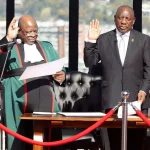
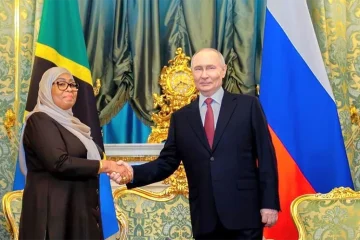
THE inauguration said everything. Not in a stadium where jubilant crowds would gather to celebrate a popularly elected leader, but in an army venue – sterile, controlled, militarised. President Samia Suluhu Hassan took her oath of office on Monday before a carefully curated audience; the 98% vote share she claimed was as hollow as the ceremony itself. This was not the celebration of democracy. This was its funeral.
What followed Tanzania’s election was not the peaceful transfer of power, but something far darker: a systematic crackdown that has transformed East Africa’s second-most populous nation into a pressure cooker of fear, grief, and simmering rage. The internet went dark for five days. Bodies piled up in morgues and homes. And when connectivity finally flickered back to life, the first message Tanzanians received from their government was not condolences or accountability, but warning: share images of the dead, and face prosecution.
The grand electoral theft began long before voting day. CHADEMA, Tanzania’s main opposition party, was barred from participating after refusing to sign a “code of conduct” – a document that opposition leaders described as a loyalty oath to a government already tightening its authoritarian grip. The party’s leader, Freeman Mbowe, had been arrested and charged with treason in April, his detention a clear signal of what dissent would cost. The electoral commission then disqualified the presidential candidate from the second-largest opposition party, systematically eliminating any credible challenge to Hassan’s rule.
By the time Tanzanians went to the polls, the outcome was predetermined. Hassan’s 98% victory – a figure that would embarrass even the most shameless autocrats – was less an election result than a coronation decree. In genuinely competitive democracies, such margins exist only in imagination. In Tanzania, they became an official record.
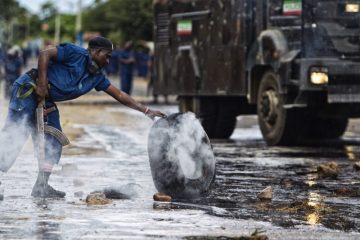
The people’s response was immediate and widespread. Protests erupted across the country as citizens rejected the charade. What happened next will haunt Tanzania for generations. According to CHADEMA, hundreds of people were killed as security forces moved to crush dissent. The government dismisses this as “hugely exaggerated,” but has refused to provide its own death toll or allow an independent investigation.
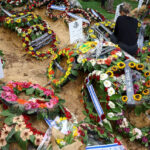
The evidence, however, speaks in images too gruesome to ignore and too dangerous to share. Photos and videos circulated on social media showing the bodies of victims, many bearing gunshot wounds. Among the dead, according to Viral Scout Management, were seven young soccer players aged 15 to 22, shot in their own homes. These were not rioters storming government buildings. These were teenagers with dreams of athletic glory, killed for the crime of being young in a country where youth had dared to demand democracy.
The casualties were not limited to the famous or documented. In homes across Dar es Salaam and beyond, families grieved losses they could not publicly acknowledge, could not photograph, could not share online without risking arrest under the government’s chilling new directive.
The five-day internet blackout was calculated cruelty. It served dual purposes: preventing protesters from organising, and, more insidiously, ensuring the world could not watch in real time as Tanzania’s government waged war on its own people. When internet access was restored Monday night, the police sent a mass text message that doubled as a threat: “Avoid sharing pictures or videos that cause panic or degrade a person’s dignity. Doing so is a criminal offence, and if identified, strict legal action will be taken.”
The message’s Orwellian logic is breathtaking. Images of citizens shot by security forces “cause panic” – as if panic, not murder, were the problem. Photographs of bodies “degrade dignity”, as if the bullets that created those bodies had not already accomplished that degradation. The warning makes clear that Tanzania’s government fears documentation more than it fears accountability.
Hassan’s choice of inauguration location was no accident. Popularly elected leaders begin their terms in stadiums, surrounded by masses of supporters whose votes legitimised their power. Hassan chose an army venue because her power rests not on popular mandate, but on the loyalty of security forces willing to kill to maintain it. The inauguration was staged for an audience of generals and commanders, the people who truly placed her in office and the people on whom her continued rule depends.
The contrast with Tanzania’s democratic past could not be starker. This is the nation that once peacefully transitioned from one-party rule to multiparty democracy, that prided itself on stability and gradual reform. Under Hassan, and before her, the late John Magufuli, that trajectory has reversed. Tanzania is not sliding toward authoritarianism; it has arrived.
As Tuesday dawned, Dar es Salaam attempted normalcy. Police and soldiers withdrew from some streets. The overnight curfew was lifted. But the fear remains, etched in the careful conversations of citizens who know their phones may be monitored, their social media watched, their words used against them.
Hassan’s government maintains the fiction of legitimacy. It claims security forces “acted responsibly to contain violence and destruction by protesters” – as if the violence of young men shot in their homes could be contained, as if the destruction of democratic norms were merely collateral damage. When UN Secretary-General António Guterres called for an investigation into allegations of excessive force, Tanzania’s response was silence masquerading as indignation.
The president has faced such calls before. Last year, amid reports of opposition figures being abducted, Hassan ordered an investigation. No findings were ever released. The disappeared remained gone. The pattern continues: promise inquiry, deliver impunity.
Tanzania’s descent should alarm the world, yet the international response has been muted. Western nations that champion democracy from podiums remain largely silent when one of Africa’s most populous nations openly abandons it. Economic interests – Tanzania’s natural gas reserves, its strategic location, its relative stability compared to neighbours – apparently outweigh concerns about hundreds of dead protesters.
The African Union, which suspended members like Mali and Guinea after military coups, has said nothing about Tanzania’s electoral sham. Perhaps because Hassan’s authoritarianism wears civilian clothes and follows the procedural motions of democracy, it escapes the continental body’s condemnation. The message to Africa’s autocrats is clear: stage elections, no matter how fraudulent, and you’ll avoid consequences reserved for those who seize power without such a theatrical cover.
What Comes Next
Tanzania now enters a dangerous phase. Hassan has five more years of guaranteed power, insulated from accountability by security forces and international indifference. The opposition, decimated by arrests and barred from formal political participation, faces a stark choice: accept permanent marginalisation or risk further crackdowns.
For ordinary Tanzanians, the future looks bleak. The social contract has been shattered. The government has demonstrated it will kill citizens to maintain control, will silence documentation of those killings, and will face no meaningful consequences for doing so. Young people who watched peers shot for protesting will carry that lesson forward: in Hassan’s Tanzania, dissent is not merely discouraged – it is lethal.
Yet authoritarianism is never as permanent as it appears. The very brutality required to maintain it reveals its weakness. A government that needs to bar opposition parties, rig elections by comical margins, shut down the internet, and threaten citizens over photographs is not a government confident in its legitimacy. It is a government afraid.
Tanzania’s tragedy is not yet complete. The bodies have been counted – or rather, not counted, not officially acknowledged, not properly mourned. The internet is back, but speech remains constrained. The inauguration in the army venue symbolised power derived from force rather than consent. But history teaches us that such power, however overwhelming in the moment, is ultimately brittle.
The question is not whether Tanzania will eventually return to democracy, but at what cost. How many more will die? How many more dreams will be stolen? How much longer will the world watch and do nothing?
For now, Hassan sits in power, shielded by soldiers and 98% vote shares that fool no one. But those images Tanzanians are forbidden to share – of young soccer players, of protesters, of hundreds whose names we may never know – those images exist. They cannot be permanently suppressed. They are evidence that will outlast any presidency.
Democracy in Tanzania has not died quietly. It has been murdered, loudly and violently, in full view of witnesses ordered to look away. The perpetrators are known. The methods are documented, despite the threats. And somewhere in Tanzania tonight, someone is keeping the record, waiting for the day when truth can be spoken without fear, when the dead can be mourned without warning, when elections mean something more than theatre staged at gunpoint in an army venue.
That day will come. Authoritarians always believe their power is permanent. They are always wrong.