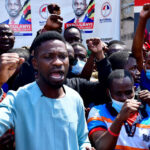
WHEN Ugandan security forces could not locate opposition leader Bobi Wine, they turned their fury on his wife, transforming her home into a theatre of state-sanctioned brutality that laid bare the complete erosion of legal constraints on Museveni’s coercive apparatus.
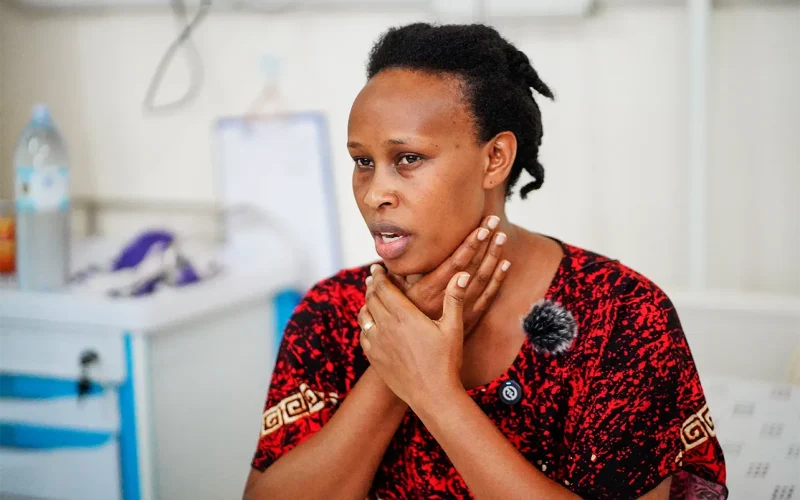
The raid on the Kyagulanyi residence follows a pattern that has become grimly familiar in authoritarian consolidation: when the target proves elusive, the state attacks the vulnerable. Barbra Kyagulanyi, found at home and unarmed, became the proxy for her husband’s defiance. According to her testimony from her hospital bed, soldiers strangled her, held her at gunpoint, and subjected her to physical torture – pulling her by the hair, smashing her head against furniture, splitting her mouth, and pinning her body beneath multiple assailants – all in a desperate attempt to extract information about her husband’s whereabouts and force her to surrender his phone password.
The calculated cruelty of this assault, the deliberate infliction of pain, the humiliation, the violation of domestic sanctuary, serves a purpose beyond intelligence gathering. It is designed to send an unmistakable message to all who would challenge Museveni’s grip on power: there are no safe spaces, no protected persons, no legal boundaries that will shield you from retribution.
Impunity as State Policy
What distinguishes the Ugandan security apparatus is not merely its willingness to violate the law, but the institutional confidence with which it does so. The brazenness of this operation – deploying “hundreds of soldiers” to raid the home of the country’s most prominent opposition figure – reflects a regime secure in the knowledge that accountability will never arrive.
This confidence is not misplaced. Army chief Muhoozi Kainerugaba, President Museveni’s son and heir apparent, has publicly vowed to hunt down and kill Bobi Wine. In a grotesque display of impunity, Kainerugaba boasted on social media of killing 30 “NUP terrorists” and arresting over 2,000 opposition supporters since the disputed election – framing systematic political repression as counter-terrorism and mass detention as crime prevention. That such pronouncements come from the military’s commanding officer, openly threatening the extrajudicial execution of a political rival, reveals a state apparatus that has abandoned even the pretence of legal constraint.
The Architecture of Repression
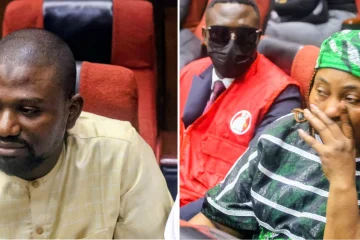
The violence against the Kyagulanyi family cannot be separated from the broader machinery of post-election repression. Bobi Wine’s lawyer, Muwanga Kivumbi – a deputy president of the National Unity Platform – was detained and threatened with criminal charges, accused of involvement in violence that killed seven people in his constituency. The pattern is transparent: opposition figures are either hunted into hiding, detained on fabricated charges, or subjected to violence that leaves them hospitalised or worse.
Those arrested face conditions designed to break both body and spirit. Reports indicate that detainees are subjected to torture and systematically denied medical treatment – a deliberate strategy of inflicting maximum suffering while evading the accountability that death in custody might provoke. The goal is not merely incarceration but degradation, transforming political resistance into a lived experience of physical agony.
The assault on Barbra Kyagulanyi occurred in the aftermath of an election that international observers and even U.S. senators have characterised as a hollow exercise staged to legitimise Museveni’s seventh term. The electoral process was marred by days-long internet shutdowns designed to prevent documentation of fraud and repression, systematic obstruction of opposition campaigning, and the deployment of security forces to intimidate voters and suppress dissent.
Bobi Wine’s denunciation of the result as “blatant theft” reflects a reality that extends beyond disputed vote tallies. When elections become rituals of authoritarian renewal rather than mechanisms of democratic choice – when the outcome is predetermined, and dissent is met with bullets rather than ballots – the entire political system transforms into an elaborate performance of legitimacy masking the mechanics of domination.
The International Dimension of Complicity
UN Secretary-General António Guterres has expressed concern about the situation in Uganda – a statement that captures the international community’s characteristic posture of observation without intervention. Concern without consequence is the diplomatic language of acquiescence. When the military chief of a sovereign nation publicly threatens assassination and boasts of killing opposition supporters, and the global response amounts to furrowed brows and carefully worded statements, impunity calcifies into precedent.
Bobi Wine’s lawyer has called on the United Nations and international community to demand verifiable guarantees of Wine’s safety. The specificity of this appeal, not merely for condemnation but for concrete protection, underscores the opposition’s recognition that Uganda’s internal legal and political institutions offer no recourse. When a political leader cannot return to his own home, when his wife is hospitalised from injuries inflicted by state forces, when his allies are detained and his supporters killed with impunity, the fiction of national sovereignty as a shield for human rights violations becomes untenable.
The Logic of Unconstrained Power
The raid on Barbra Kyagulanyi’s home represents the operational logic of a regime that has learned a crucial lesson: violence works when applied systematically and without apology. Museveni’s government has calculated – correctly, it seems – that the international community’s appetite for meaningful intervention is negligible, that regional bodies will prioritise stability over justice, and that domestic institutions have been sufficiently hollowed out to prevent internal accountability.
The true measure of impunity is not that law enforcement agencies violate the law, but that they do so openly, document their abuses publicly, and face no consequences. In Uganda, security forces operate with the understanding that brutality is not merely permitted but expected, that attacking unarmed women in their homes and torturing detainees are legitimate tools of political control.
Until this impunity is confronted with real costs, diplomatic isolation, targeted sanctions, international criminal accountability, and sustained pressure that makes repression more expensive than reform, the Museveni regime will continue to refine its machinery of domination. The traumatised Kyagulanyi family, the hospitalised opposition leader’s wife, the detained and tortured activists, and the thousands living in fear of midnight raids are not unfortunate byproducts of political competition. They are the intended outcomes of a system where law enforcement serves not to protect citizens but to eliminate threats to perpetual rule.