IN a case that has galvanised a South Dublin community and drawn political attention to Ireland’s deportation processes, hundreds of protesters gathered outside the Department of Justice this week to demand the reversal of a deportation order against the Oyekanmi family, who face removal to South Africa as early as this week.
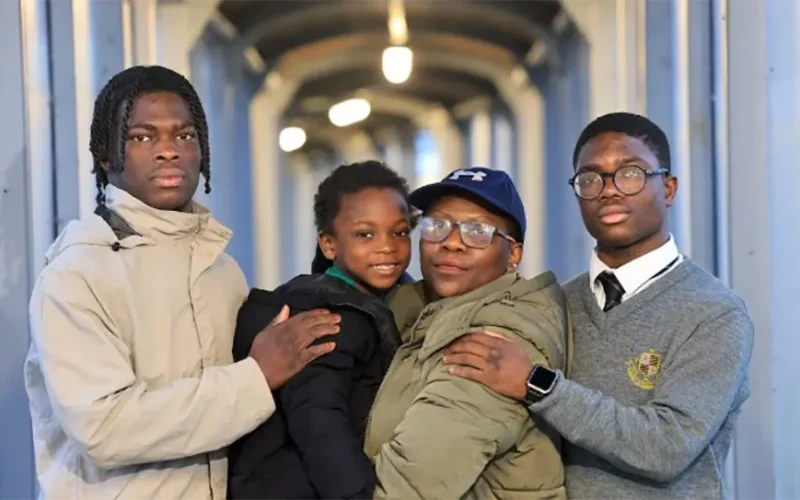
Titilayo Oluwakemi Oyekanmi and her three sons — Samuel (18), Joseph (14), and Genesis (5) — arrived in Ireland from South Africa in late 2023. Originally from Nigeria, Titilayo sought asylum in Ireland after what she describes as a violent attack by a gang and threats at gunpoint in South Africa. Both her initial asylum application and subsequent appeal were rejected, and the family received a deportation order in April 2025.
A Community Invested
What distinguishes this case from routine deportation proceedings is the extraordinary level of community integration the family has achieved in just over two years, and the unprecedented mobilisation of local residents, students, and teachers in their defence.
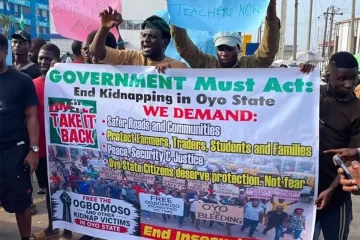
At least 300 people, including dozens of schoolchildren, attended Tuesday’s demonstration, delivering letters to the Department of Justice urging Minister Jim O’Callaghan to intervene. The protest reveals the human complications that can arise when immigration law intersects with community bonds.
Joseph Oyekanmi has been attending the prestigious Gonzaga College on a scholarship since September, where classmates describe him as an exceptional athlete, rugby player, and student. “He’s really smart and he really brings up a standard in our class,” said Luca Conan, one of Joseph’s classmates. “He’s very kind and caring and it’d be a shame to lose him.”
Samuel is scheduled to sit his Leaving Certificate examinations in June at Ballinteer Community School, while the youngest, Genesis, has also integrated into local schools. Their mother volunteers at a local church.
“They’ve really integrated with the community, they’ve given a huge amount back,” said Simon Matthews, whose son attends Gonzaga. “The kids are amazing.”
Legal Complexities and Humanitarian Appeals
The family’s legal situation presents layers of complexity. They came to Ireland from South Africa, which Irish authorities classify as a safe country, complicating their asylum claim. However, Titilayo is originally Nigerian, and she maintains that returning to South Africa would endanger her family’s lives.
Stephen Kirwan of KOD Lyons, the family’s solicitor, applied last year to have the deportation order revoked on humanitarian grounds. Nearly a year later, they have received no response and believe deportation is imminent. The family was transferred from an International Protection Accommodation Service centre in Sandyford to Castleknock last Friday in advance of their scheduled removal.
“The groundswell of support is something like I’ve never seen before,” Kirwan said Tuesday. “This particular case highlights very clearly, in my view, the fact that the deportation system is inhumane. We do have to have a rules-based system, but we have to have a rules-based system that’s based on fairness and equity.”
Kirwan emphasised that matters such as the family’s community integration were not considered in the original decision. “We’re simply saying we understand there’s a deportation order, but we also understand that there are exceptional circumstances,” he said.
Political Intervention Sought
The case has attracted political attention at the highest levels. Labour leader Ivana Bacik, who said she first contacted Minister O’Callaghan about the case late last year, raised the issue with Taoiseach Micheál Martin in the Dáil on Tuesday afternoon.
Martin said he would ask O’Callaghan to “review” the case — a response Bacik characterised as offering “a glimmer” of hope, though she warned time was running out.
“Of course, we all agree there must be a fair and effective migration and asylum system. Everybody agrees on that, but there must also be room within that system for humanity,” Bacik said.
The Department’s Position
The Department of Justice maintains it cannot comment on individual cases but outlined the framework governing such situations. According to a department statement, both the International Protection Office and the International Protection Appeals Tribunal are “fully independent” in deciding whether to grant international protection, examining each application “individually on its own merits, in line with national and international asylum law.”
People who have been refused international protection and exhausted appeals through IPAT are entitled to submit a request to review their permission to remain “where their circumstances have changed since their initial application,” the statement noted.
The department also emphasised that before a deportation order is made, individuals are offered assistance to return home voluntarily — the preferred option. In this case, the family was reportedly offered €10,000 and free flights home, which they declined.
“If a person’s application for international protection is refused and they are ordered to leave the State, they must do so,” the statement concluded. “Their case to remain in the State has been considered in detail and the appeals processes have been concluded.”
Tension Between Law and Compassion
The Oyekanmi case crystallises an enduring tension in immigration policy: the need to maintain consistent, rules-based systems versus the humanitarian imperative to consider individual circumstances and community ties.
Supporters argue that the family’s deep integration — evidenced by academic scholarships, sports club participation, church volunteering, and the network of friendships their children have formed — constitutes exactly the kind of “changed circumstances” that should warrant reconsideration.
Critics of the current system point to the nearly year-long wait for a response to the humanitarian review application, during which the family has lived under the shadow of imminent deportation, as evidence of systemic dysfunction.
From the department’s perspective, however, allowing community support to override legal determinations could undermine the integrity of the asylum system and create perverse incentives.
As the family awaits confirmation of their deportation date — possibly as soon as Thursday — the case poses fundamental questions about how Ireland balances compassion with consistency, and whether its current deportation framework adequately accounts for the human bonds formed during years-long asylum processes.
For Joseph’s classmates, gathered outside the Department of Justice on a Tuesday afternoon, the abstractions of immigration policy have given way to a simpler reality: the possible loss of a friend. “He always comes into school with a smile on his face,” said Jasper Gilmartin. “He’s an amazing athlete and it would be horrible to lose him.”
Whether that sentiment proves sufficient to alter the family’s fate remains to be seen.