THE chartered flight touched down at OR Tambo International Airport just after 4 am on Sunday morning, Irish time. On board were 63 people – 28 men, 26 women, and nine children – who had all, in the eyes of the Irish state, exhausted every legal avenue available to them. They were South African nationals, removed under deportation orders, and they arrived back in a country roiling with its own debates about who belongs, who is welcome, and on what terms.
It was the second charter removal flight from Ireland this year, and the eighth since such operations resumed in 2025. By any measure, it was a significant operation. But for many watching on both sides of the Atlantic, it was not the numbers that mattered. It was the faces – and in particular, the face of one family.
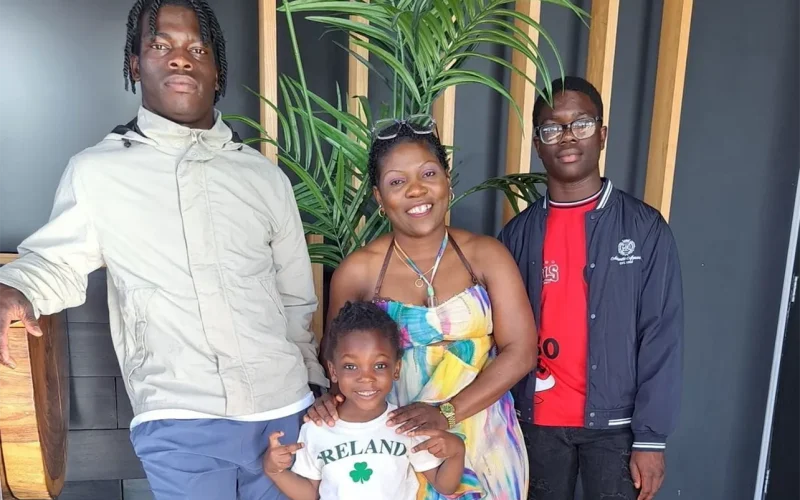
Among those on board, according to both RTÉ News and The Journal, was the Oyekanmi family: Titilayo Oluwakemi Oyekanmi, a Nigerian woman who had been living lawfully in South Africa, and her three sons – Samuel (18), Joseph (14), and Genesis, who is just five years old.
Their story had become, over the preceding weeks, one of the most contested human interest cases in recent Irish immigration history.
The family arrived in Ireland in October 2023, fleeing South Africa after Titilayo was attacked and threatened at gunpoint by a criminal gang. She feared for her children’s lives. They sought international protection. The International Protection Office refused them. They appealed. The International Protection Appeals Tribunal dismissed the appeal. A deportation order was issued in April 2025.
In Ireland, they had not merely waited. They had built a life. Joseph had earned a scholarship to Gonzaga College, one of Dublin’s most prestigious schools. Samuel was enrolled at Ballinteer Community School, preparing for his Leaving Certificate examinations – Ireland’s equivalent of the final school-leaving exams – scheduled for June. Both boys played sports in local clubs. Their mother volunteered at the parish centre in their south Dublin neighbourhood.
When the deportation order became imminent, hundreds of neighbours, schoolchildren, parents and teachers poured out into the streets outside the Department of Justice in protest. A petition gathered more than 5,000 signatures. Olympian David Gillick was among the public voices calling for the family to be allowed to stay. Glencullen-Sandyford Green Party Councillor Oisín O’Connor recalled seeing Joseph at rugby training with his team as recently as the Wednesday before the deportation – just days before the Saturday flight.
“Right up until this week, the family were still involved in community activities, going to sports training,” O’Connor told The Journal. “Titilayo volunteers in the local parish centre as well, and she would be very well known there. It’s just terrible.”
The family was granted a temporary reprieve, only for the hope to be extinguished on Friday. They were informed they had to leave Ireland the next day. Their solicitor released a statement calling the deportation “absolutely appalling.” Neighbours spoke of having had “no chance to say goodbye.”
On Saturday evening at 5.05 pm, the charter flight left Dublin Airport. By Sunday morning, the Oyekanmis were back in South Africa — the country they had fled, now designated by Irish authorities as a “safe country for returns.”
Not Just One Family
The Oyekanmis attracted the most public sympathy, but they were far from alone on that flight. Alongside them were dozens of others whose names did not become hashtags or petitions — people who had also, for various reasons, been denied the right to remain in Ireland.
According to An Garda Síochána, those removed included 28 adult men, 26 adult women, and nine juveniles. Ten of the individuals had been convicted of offences in Ireland, including crimes targeted under operations against sex offenders and drug trafficking, as well as road traffic offences. The returnees were accompanied on the flight by members of the Garda National Immigration Bureau, medical staff, an interpreter and a human rights observer.
Irish Minister for Justice Jim O’Callaghan made no apologies. In a statement, he said that deportation flights are now a “routine and essential” part of immigration enforcement, adding: “If a person does not have a legal permission to be in the State, or has been involved in criminality, they will be removed.”
O’Connor, however, saw it differently. He drew a sharp comparison to immigration enforcement in the United States. “They’re trying to fly pretty close to the ICE model,” he said. “They’re more than happy to show the deportations because they’re trying to appeal to people who are against all immigration.”
On the South African end, the arrival of 63 returnees – including nine children – has not been met with quiet acceptance. Social media has been ablaze with debate, and the controversy takes on a particular complexity given the Oyekanmis’ own origins.
The family is Nigerian by birth but had been lawfully resident in South Africa before fleeing to Ireland. Irish immigration law does not require deportees to return to their country of birth — they may be returned to a country legally obliged or willing to receive them. South Africa agreed to accept these returnees, many of whom had previously held residency there.
But a vocal chorus of South African voices online has raised a pointed concern: that some among the 63 may have been travelling on forged South African documents. This allegation — circulating widely on South African social media, amplified by users questioning the basis on which certain individuals claimed South African nationality – has added a charged dimension to what is already a fraught story.
For South Africans grappling with their own deep-running anxieties about illegal immigration, document fraud and identity crime, the arrival of 63 people deported from a European country on the basis of South African documentation touches raw nerves. Critics ask whether South Africa has fully verified the identities and document authenticity of all those being returned, and whether the country is being used as a dumping ground for individuals who may have no genuine connection to it.
These concerns remain unverified at the time of writing. South African authorities have not publicly responded to the claims about forged documents. The Department of Home Affairs, which would ordinarily play a role in receiving deported nationals and verifying their status, has yet to issue a statement on the specific flight.
What makes this story so difficult to resolve neatly is that almost every person involved – from the Irish Department of Justice to the Oyekanmis’ neighbours to South African commentators online – has a legitimate point, and those points are in deep tension with one another.
Ireland followed its legal process. The International Protection Office and the International Protection Appeals Tribunal are independent bodies, and both found that the Oyekanmi family did not qualify for international protection and could live safely in South Africa. The Department of Justice has made clear that those findings bind the state’s hand: refused applicants must leave.
And yet, a family that had integrated into Irish society – whose children attended school on scholarships, played rugby, trained with clubs, made friends – was removed without even the chance for those friends to say goodbye.
The children on that flight – nine in total, all part of family groups – had no say in any of this. They were passengers in decisions made by adults and institutions before some of them were old enough to understand what asylum means.
On the South African side, the story lands in a country where xenophobia and document fraud are political issues, where millions of undocumented migrants live in legal limbo, and where the state’s capacity to verify identity documents is frequently questioned. The suggestion that some of those deported may have used forged South African papers to access the Irish asylum system, if true, would represent a serious failure of document integrity at multiple levels, both in South Africa and in Ireland.