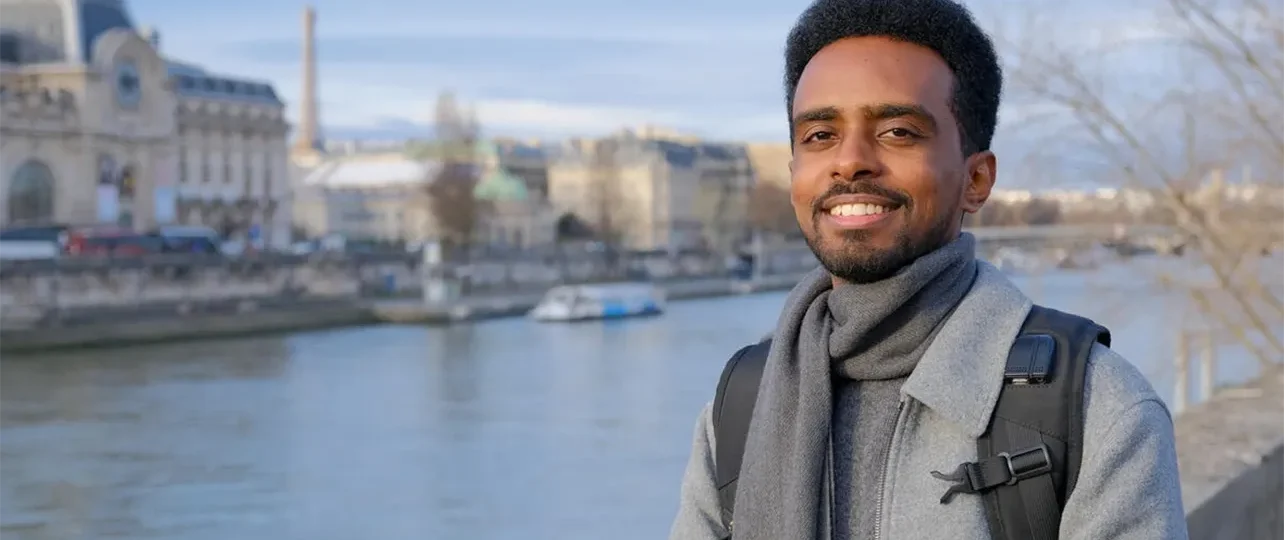

WHEN Faniel, a 29-year-old Eritrean refugee, received confirmation of his Sciences Po scholarship last year, the achievement was remarkable not because of his 90 percent engineering degree or his language qualifications, but because he had managed to clear a bureaucratic obstacle course that stops most refugees in their tracks before they even begin.
His case, coordinated across UNHCR offices in Yemen, Djibouti and France alongside the University Agency of the Francophonie, required exit facilitation from a conflict zone, a cross-border transfer to Aden, emergency travel documentation, an intermediate stop in Djibouti, and French governmental intervention on visa issuance. All of this to allow a fully qualified, already-accepted student to attend a university that had already chosen him.
The question his story raises is not one of individual triumph. It is structural: how many Faniel equivalents never made it past the documentation barrier?
The documentation wall
Protracted displacement — the condition defining most of the world’s 120 million forcibly displaced people — systematically strips refugees of the legal paperwork that nation-states require for virtually every formal transaction. Passports expire. Home governments become inaccessible, hostile, or simply nonexistent as functioning bureaucracies. Yemen, where Faniel was born to Eritrean parents who themselves fled by boat in 1989, is today the site of one of the world’s largest humanitarian crises — hardly a reliable issuer of internationally recognised travel documents for a stateless population.
Sciences Po, to its credit, did not treat documentation failure as Faniel’s personal problem. It contacted UNHCR France, triggering the multi-office coordination that ultimately got him to Paris. But that response was exceptional, not systematic. Most institutions receiving scholarship applications from refugees have no such protocol, and most applicants have no such advocate.
Complementary pathways: promising but narrow
Faniel travelled through UNIV’R, a complementary pathway for education that offers refugees a safe, legal route to French higher education outside of formal resettlement. The pathway is real, functional — and vanishingly rare in scope relative to need. Yemen alone hosts more than 63,000 refugees and asylum-seekers, many living in multigenerational displacement with, as UNHCR itself acknowledges, “limited economic opportunities and a shrinking protection space.”
Complementary pathways for education exist in a handful of countries. They remain chronically underfunded and under-institutionalised, dependent on NGO coordination, university goodwill, and government discretion rather than enforceable legal entitlement. For every refugee who navigates the system successfully, the architecture of that success — multiple UN offices, a responsive university, a sympathetic consular process — is rarely replicable at scale.
What the story doesn’t say
Faniel is now in Paris, studying International Development and Economy, walking past the Louvre and building his first snowman. The human detail is real, and it matters. But the same story that celebrates his arrival implicitly documents the failure of the system to make such arrivals routine.
His parents crossed the Red Sea in 1989. Thirty-six years later, their son required the intervention of three UNHCR country offices, a bilateral education agency, and French state authorities to legally board a flight for a degree program he had already been awarded.
That is not a success story about a pathway working. It is a case study in how extraordinarily narrow that pathway remains.