WHEN Noor Jahan Begum, 35, witnessed a passenger bus tumble over the edge of the Daulatdia ferry terminal and vanish into the murky waters of the Padma River on Wednesday afternoon, she was not watching a freak accident. She was watching Bangladesh’s deadliest daily reality unfold in a single, terrible moment.
“Some passengers got out of the bus, but their family members died, trapped inside,” she told AFP, her words bearing the particular anguish of someone who watched helplessly as screams faded beneath a brown river.
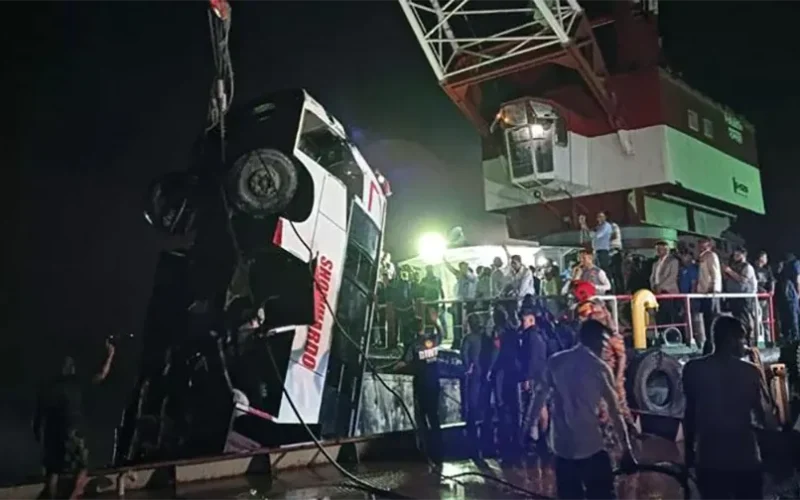
At least 24 people are now confirmed dead. Among them: five children. Eleven women. Six men. Two survivors who were pulled from the river, injured and fighting for life, later lost that fight at Rajbari Government Hospital. Officials fear more passengers may still be missing, even as the submerged wreck of the bus was located resting nearly nine metres — 30 feet — beneath the surface of the Padma.
“The bus was waiting to board a ferry when it fell into the river. Some passengers got out. But their family members died, trapped inside.”
Noor Jahan Begum, eyewitness
THE LAST JOURNEY
The bus, carrying roughly 40 passengers, was approaching a ferry at Daulatdia in Rajbari district — approximately 100 kilometres from the capital Dhaka — when it lost control. Footage verified by Al Jazeera shows the moment of the plunge: the vehicle toppling over an edge, bystanders shouting, onlookers throwing long scarves into the water in a desperate attempt to pull survivors to safety as people tried frantically to swim toward the terminal.
Four fire service units and 10 divers mounted a search and rescue operation supported by the army, police, coastguard and local authorities. The recovery of bodies from inside the sealed, sunken vehicle was painstaking work — divers descending again and again into the murk to bring the dead home to their families.
At Rajbari Government Hospital, footage showed relatives collapsing in grief. Mothers, husbands, children — people who had sent someone on what should have been an ordinary journey, now receiving back only the unbearable.
NOT AN ACCIDENT — A CRISIS
Bangladesh has a word for the kind of transport tragedy that struck the Padma crossing: durghatana — disaster. But road safety researchers argue that the word obscures rather than illuminates what is happening on the country’s roads and waterways.
“By terming these as accidents, the liability is being placed on fatalistic or natural mishaps,” BUET’s former Accident Research Institute director, Md Hadiuzzaman, told Prothom Alo after a cluster of deadly bus crashes in 2024. “But there were all the elements to lead to an accident.”
The elements are well documented. Poor and degraded road infrastructure. Vehicles operating without valid fitness certificates. Drivers without licences to operate heavy vehicles. Drivers working far beyond legally permitted hours, drowsy and impaired. Buses and trucks, representing only 6% of Bangladesh’s vehicle fleet, are yet involved in 38% of all road accidents.
The Daulatdia incident occurred at one of the busiest river crossing points in Bangladesh — a choke point where thousands of vehicles queue to board ferries across the Padma. The circumstances of exactly how the bus lost control remain under investigation, but the structural conditions that produce such disasters are not in dispute.
THE NUMBERS BEHIND THE GRIEF
Bangladesh’s Road Safety Foundation reported more than 200 deaths during the Eid holiday period that ended just this week. In one incident alone, a train collided with a bus, killing 12 people.
The World Health Organisation estimates that while Bangladesh’s official statistics record approximately 5,000 road traffic deaths annually, the actual toll is closer to 31,500 — meaning that more than 85 people are likely dying on Bangladesh’s roads and waterways every single day. In a country of 170 million people, road crashes amount to an estimated 5% of GDP in economic losses each year.
A 2025 analysis published in the Fortune Journal of Health Sciences, drawing on Bangladesh Road Transport Authority data, found that heavy vehicles — trucks and buses — accounted for 38% of all accidents despite comprising just 15% of road presence. The disproportionate lethality of bus travel is not incidental: it is baked into the system.
The Asian Transport Observatory notes that only 2% of Bangladesh’s roads carry a three-star or better safety rating for pedestrians, and just 5% for cyclists — figures that lag significantly behind regional averages. An investment of 0.2% of GDP annually, roughly US$768 million, could theoretically save 11,000 lives per year. It has not been made.
More than 85 people are estimated to die on Bangladesh’s roads every single day — a toll that remains largely invisible until disasters like Daulatdia bring it briefly into view.
CHILDREN ON THE PADMA
Five of the 24 confirmed dead were children. Their presence on that bus — presumably travelling with their mothers, 11 of whom also perished — speaks to the democratisation of transport risk in a country where the poor and working class have no insulated, air-conditioned alternatives. They travel by bus because that is how one travels in Bangladesh. They cross the Padma by ferry because the Padma must be crossed.
The Padma River is the principal distributary of the Ganges as it flows through Bangladesh toward the Bay of Bengal. It is wide, fast, and deep. In the monsoon season, it swells and becomes unpredictable. In any season, the country’s river crossings — hundreds of them, served by ageing ferries and congested terminals — represent some of the most dangerous transit points in Asia.
Bangladesh’s road and ferry accident toll is not primarily a story of dramatic plunges captured on mobile phones. It is a story of slow institutional failure: inadequate regulation, under-enforcement of existing laws, vehicles that should have been decommissioned still carrying families across provinces, ferry terminals without adequate safety barriers.
AN OLD STORY, TOLD AGAIN
Hundreds die each year in road and river accidents in Bangladesh, and each disaster produces a familiar cycle: official condolences, an inquiry committee, calls for reform, and then — until the next mass casualty event — near-silence.
Advocacy groups like the Bangladesh Jatri Kallayan Samiti have for years called for systemic change: an e-traffic enforcement system they estimate could reduce accidents by 80%, mandatory CCTV coverage, strict drivers’ hour regulations, and the swift prosecution of vehicle owners who operate unfit buses. These recommendations sit in reports and press releases while the death toll climbs.
“Blaming us won’t reduce the accidents,” Khandakar Enayet Ullah of the transport advocacy sector told Prothom Alo. “If BRTA and the law enforcement agencies take action against illegal vehicles and unlicensed drivers, we will extend our cooperation.”
Bangladesh is not alone in this struggle. Across the Global South, from sub-Saharan Africa to South and Southeast Asia, road safety is a quietly unfolding public health emergency — one that kills far more people annually than many of the conflicts and famines that command global attention. The WHO estimates that road traffic injuries are among the leading causes of death for people between the ages of five and 29 worldwide, with low- and middle-income countries bearing more than 90% of the burden.
AT RAJBARI HOSPITAL
By Thursday morning, the recovered bodies had been brought to Rajbari Government Hospital. Relatives had begun to arrive — the desperate, the already-knowing, the hoping-against-hope. The images emerging from the hospital show people bent double in grief, the specific posture of loss that needs no language.
Somewhere in those images are the families of five children, whose names have not yet been released to the international press — children who were on a bus that was waiting to board a ferry on a Wednesday afternoon, in a country where that journey, ordinary as breathing, can end at the bottom of a river.
The divers will continue searching. The inquiry will be announced. The recommendations will be written. And tomorrow, and the day after that, the buses will roll again toward the ferry terminals of the Padma.