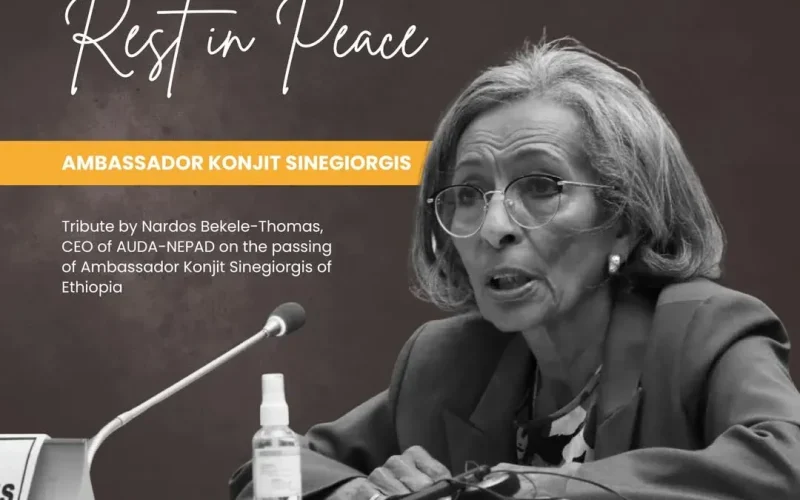
THERE are deaths that grieve a family. And there are deaths that grieve a continent.
The passing of Ambassador Konjit Sinegiorgis belongs to the second kind.
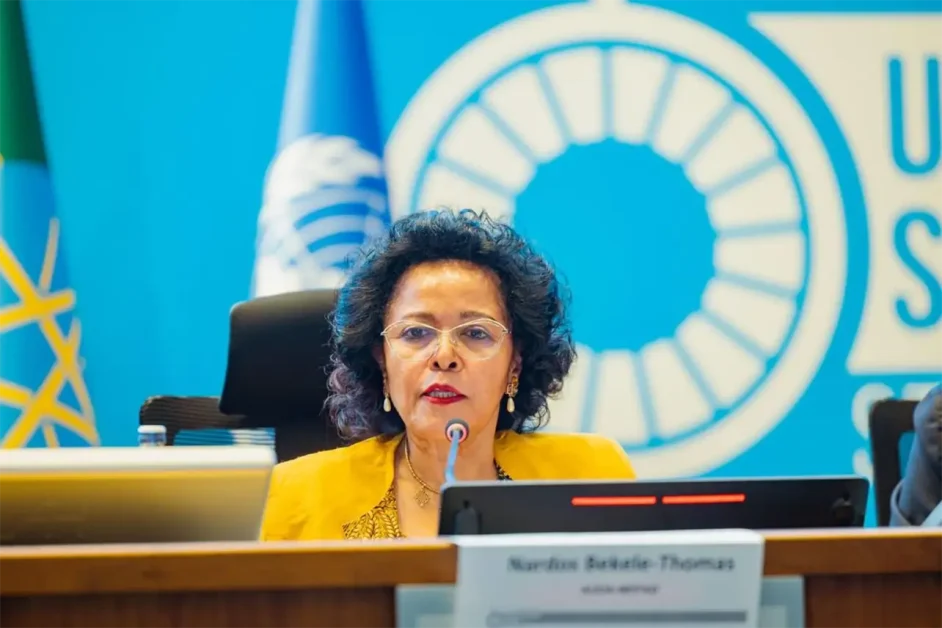
Nardos Bekele-Thomas, CEO of AUDA-NEPAD, spoke for the entire African Union family when she said simply: “I am deeply saddened by the loss of the long-serving Ambassador Konjit.” In that sentence – understated, sorrowful, personal – lies the measure of a woman whose career defied easy summary. You do not mourn a diplomat this way unless she was something more than a diplomat. You do not use the word long-serving unless you mean to honour a lifetime of quiet, disciplined, principled sacrifice.
Ambassador Konjit gave that lifetime to Ethiopia. She gave it to Africa. She gave it to the idea that diplomacy, practised with integrity, is among the noblest instruments of public service available to any nation.
A Beacon in an Age of Dimming Lights
Nardos Bekele-Thomas described her colleague as “a beacon of excellence and diplomacy” – and those words carry weight precisely because they are not rhetorical. Ambassador Konjit Sinegiorgis operated across the full arc of Ethiopia’s modern history, serving under successive political dispensations with a consistency that most politicians cannot claim and most institutions cannot sustain. She understood the vital distinction between the government of the day and the state in perpetuity. Governments rise and fall. Regimes remake themselves in each generation. But the state endures – and it is the state, not its temporary custodians, that professional diplomats serve.
She served it faithfully.
“Her dedication to fostering peace, justice, and fairness,” said Bekele-Thomas, “has left an indelible mark on Ethiopia and the world.” These are not the words of ceremonial condolence. They are a precise description of what principled diplomacy looks like from the inside – from the vantage point of those who worked alongside her, who watched her navigate the hardest rooms with grace and without compromise.
The AUC Chairperson, H.E. Mahmoud Ali Youssouf, said she “embodied the highest ideals of African diplomacy, marked by integrity, excellence, and an unyielding commitment to our shared future.” As one of Ethiopia’s earliest female ambassadors, she helped open doors that had never been opened before – and she walked through them without fanfare, because the work itself was always the point.
Humble. Humane. Consequential.
What strikes those who knew her most deeply was not the scale of her portfolio but the character of her presence. Nardos Bekele-Thomas chose her words carefully: “As a humble and humane leader, she embodied compassion and objectivity, inspiring countless individuals.”
Humility and humanity are not qualities we typically celebrate in diplomacy. We celebrate leverage. We celebrate access. We celebrate the art of manoeuvre. But Ambassador Konjit reminded those around her that the most consequential diplomatic work is not performed in the spotlight. It is performed quietly, in the margins between crises, in the spaces where a calm voice and a principled position prevent a conflict that will never be recorded in any history book because it never happened.
That is the invisible legacy of great diplomats. Their greatest victories leave no visible scar, because the wound never opened.
Women, Youth, and the Future She Tended
Her influence, however, was not limited to statecraft. Bekele-Thomas was unequivocal: “Her legacy as a champion of women’s empowerment and youth development will continue to shape the future.”
Ambassador Konjit mentored generations of Ethiopian diplomats — shaping not merely careers but values. She modelled, through her own life, what it meant for an African woman to occupy the highest corridors of continental power with authority, substance, and grace. The AUC Chairperson captured this precisely when he said her legacy “will continue to inspire generations of African diplomats, particularly women, to serve with courage, distinction, and purpose.”
This is the inheritance she leaves to those who will come after her. Not doctrine. Not a manifesto. A standard.
A Warning Wrapped in a Tribute
Her passing, however, is more than a moment of mourning. It is a reckoning.
We live in an era of diplomatic decline — an age in which multilateralism is under strain, principled mediation has retreated, and transactional deal-making has colonised the space that serious statecraft once occupied. Foreign ministries have been hollowed out. Mediators are sidelined. In far too many places, force has ceased to be the last resort and become the default instrument.
When diplomacy loses stature, war gains ground.
The African Union and Africa’s institutions must confront this honestly. The erosion of committed, principled diplomats — those capable of serving as serious negotiators rather than messengers for external interests — is increasingly at the heart of Africa’s failure to avert, manage, and resolve its conflicts. The continent cannot afford to normalise the short-term arrangements, lacking in legitimacy and political vision, that are increasingly dressed up as peace.
Ambassador Konjit represented the opposite of this decline.
“Ambassador Konjit’s remarkable life and service,” wrote Bekele-Thomas, “remind us that true greatness lies in kindness, empathy, and selfless effort.”
In a world that rewards loudness, she chose discipline. In a world that rewards self-interest, she chose service. In a world that rewards transactionalism, she chose principle.
A Standard, Not Just a Memory
She is gone. But she has not left us with nothing.
She has left us with a standard — of patriotism, of Pan-Africanism, of professionalism, of principled service. She has left us with the example of a woman who served across political eras without losing her moral compass, who mentored the next generation without demanding credit, and who advanced Africa’s voice in the world without ever diminishing her own integrity.
Nardos Bekele-Thomas closed her tribute with words that deserve to be heard beyond the formal condolence note: “May her soul rest in eternal peace, and may her memory be a blessing to all whose lives she touched.”
That memory is a blessing. But it is also a demand.
It demands that Africa produce diplomats worthy of her tradition. It demands that the continent resist the reduction of statecraft to manoeuvre and self-interest. It demands that we ask — seriously, strategically — what kind of diplomats Ethiopia needs today, and what kind of diplomatic culture Africa must rebuild in an age of fragmentation and crisis.
Ambassador Konjit Sinegiorgis answered that question with her life.
Now the question falls to the rest of us.