IT was only his second day as a medical intern when the world he had spent a lifetime building collapsed around him. On 15 April 2023, Gbreel arrived for his shift at a hospital in Nyala, the capital of South Darfur State in Sudan, and noticed an unusual number of soldiers on the city streets. He dismissed the thought and walked to his ward. Within five minutes, the building shook. A bomb had struck part of the hospital.
Gbreel switched on a television. What he saw confirmed what the sounds had already told him: Sudan was at war. Fighting had broken out in Khartoum between the Sudanese Armed Forces and the paramilitary Rapid Support Forces — a conflict that would rapidly consume the entire country and displace millions of people, including him.
“I had no idea that within minutes of starting work, everything would change,” he recalled. “We turned on the TV and saw what was happening. And I understood immediately — there was no future for me there anymore.”
“There was no future for me there. But the dream — that I kept.”
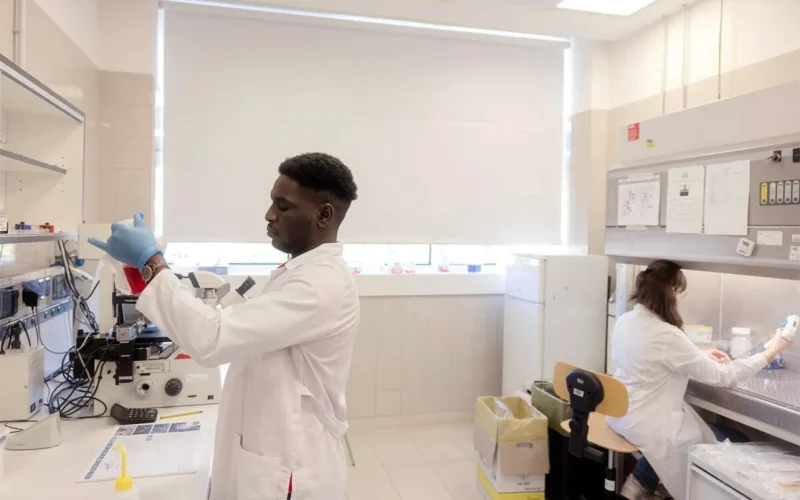
What followed was a three-year journey of survival, displacement, and extraordinary determination that would eventually take Gbreel from a Ugandan refugee settlement to a university classroom in southern Italy, where he is today pursuing a Master’s degree in Clinical and Experimental Biology.
A CHILDHOOD FORGED BY CONFLICT
Gbreel grew up in South Darfur, a region that had known little peace in his lifetime. Violence, armed conflict, and insecurity were constants from childhood. Yet at some point during those turbulent years, he had found an unlikely refuge — in books, in medicine, in the idea that knowledge could offer a way out. He resolved to become a doctor.
He managed to reach Khartoum, the capital, to study. The city felt almost surreal after the war-scarred landscapes of Darfur. “When I arrived there, I asked myself: Is this really Sudan?” he said. “Two years without hearing a single gunshot. I wanted to bring my whole family there once I finished school. I had no idea a place like that existed in our country — somewhere you could live a normal life without fearing you would be attacked or lose someone you loved.”
He completed his medical studies, and in April 2023, he began his clinical internship — the threshold between student and doctor. He had crossed it for just two days when the bombs ended that chapter of his life.
THE LONG ROAD TO SAFETY
Gbreel’s immediate family was unharmed in the initial outbreak of violence. Together — his mother, his two brothers, their wives and children — they fled Nyala, moving through several locations inside Sudan as they searched for safety. It became clear there was none to be found. The war followed them.
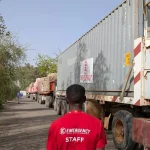
They made the decision to leave Sudan altogether. Crossing into South Sudan, the family eventually made their way to Uganda, arriving at the Kiryandongo refugee settlement, where they were formally received as refugees and given a plot of land and materials to build a home.
“The journey was extremely hard,” Gbreel said. “But we were together, and we were moving towards safety. That made it easier. The turning point was when we crossed into Uganda. For the first time, someone welcomed us — with a smile, with understanding of what we had been through. The support was modest, but it felt enormous.”
“Someone welcomed us with a smile. The help was modest. But it felt enormous.”
For Gbreel, Kiryandongo was a place of recovery. But it was never the end of the road. He had not abandoned medicine. Even in a refugee settlement, with no guarantee of a future and a family that depended on him, he kept the dream alive — researching pathways, applying to programmes, looking for any opening that would allow him to continue.
A DOOR OPENED BY OTHERS
The door, when it finally opened, came in the form of UNICORE — the University Corridors for Refugees programme run by UNHCR, the United Nations Refugee Agency. Designed to provide displaced students with access to higher education in Italy, UNICORE offers not merely an academic place, but a legal pathway: a visa, a scholarship structure, and institutional support at the receiving university.
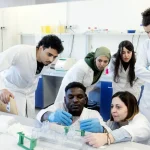
Gbreel submitted his application. He was accepted. The University of Foggia, in the Puglia region of southern Italy, admitted him to its Master’s programme in Clinical and Experimental Biology. In 2025, he arrived in Italy. He is expected to complete his degree in 2027.
The symmetry of his journey is not lost on him — a man from southern Sudan, now studying in southern Italy, carrying within him the weight of everything that happened in between. But the direction of travel is unmistakably forward.
MORE THAN ONE STORY
Gbreel’s story matters beyond its individual arc. It arrives at a moment when the Sudan conflict has become one of the worst humanitarian crises on the planet. By the end of 2024, more than 11 million people had been forcibly displaced inside Sudan — the largest number of internally displaced people of any country in the world. Over 2.7 million Sudanese had fled across borders into neighbouring countries.
Against that scale of suffering, stories of individual triumph can feel thin. But they also carry a particular kind of power: they refuse the dehumanisation that accompanies statistics. They insist that behind every number is a person with a name, a calling, a future.
Gbreel’s future is in medicine. He has said he intends to serve people — not just any people, but the vulnerable, the displaced, those who have experienced what he has experienced. The doctor he is becoming was shaped by the war he survived. There is, in that, something the conflict did not destroy.
“I want to use what I have learned — all of it — to help people who have been through what I’ve been through.”
UNICORE, the programme that opened the door for him, represents a form of institutional kindness: a system deliberately designed to give talent a second chance, to recognise that displacement does not erase ability. For Gbreel, it was the stranger who smiled at the Ugandan border. It was the admissions committee in Foggia. It was every person along the way who looked at a refugee and chose to help rather than look away.
He is studying. He is building. He is still becoming the doctor he decided to be as a child in a conflict zone — long before the world gave him any reason to believe it was possible.