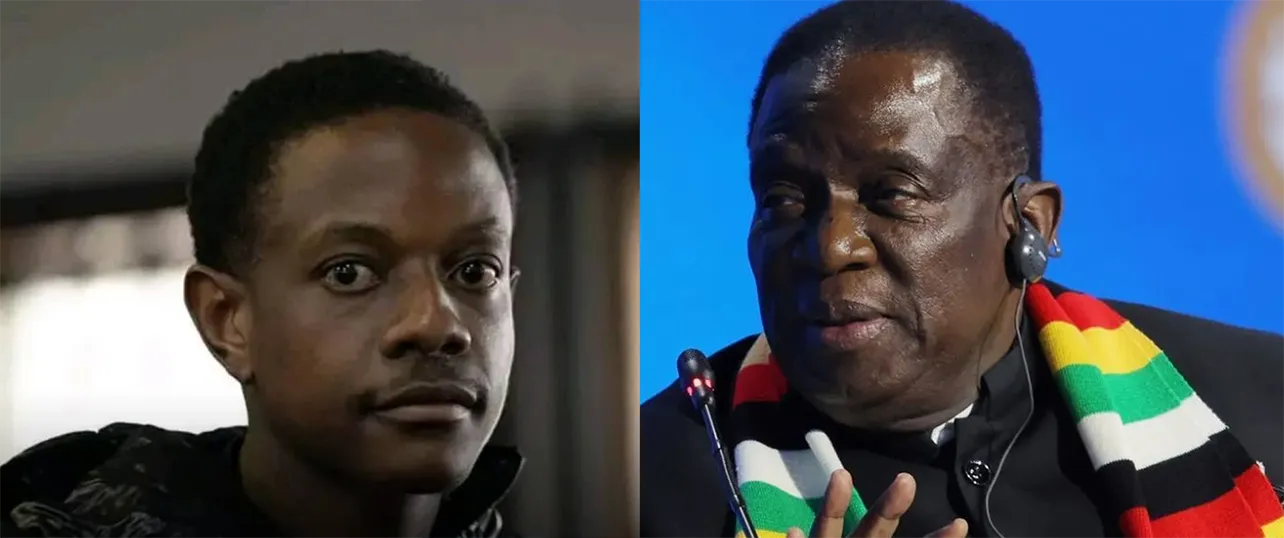

THE debate about whether the son of Zimbabwe’s late President Robert Mugabe received preferential justice in a South African court was already burning on Thursday afternoon. Then Bellarmine Mugabe himself lit the match that turned it into an inferno.
In a post on X, the platform formerly known as Twitter, Mugabe – who goes by the handle @ChatuBellamine – revealed that the R600 000 fine he paid to walk free from the Johannesburg Magistrates’ Court was not paid from his own pocket. It was paid by Zimbabwe’s current head of state, President Emmerson Dambudzo Mnangagwa, the man who succeeded his father and who has spent years attempting to put the ghost of Mugabe-era Zimbabwe behind him.
| “Today, I apologize to President ED and all law-abiding Zimbabweans for tarnishing my father’s name and the country’s reputation. I was fined R600,000, which President ED has already paid on my behalf, he warned me not to repeat such behavior. I will return back to Zimbabwe today.”— Chatunga Bellarmine Mugabe (@ChatuBellamine), X (formerly Twitter), Thursday 1 May 2026 |
In nine sentences, Mugabe confirmed what many critics had already suspected in spirit if not in fact: that his freedom from prison was underwritten not by personal wealth, but by the direct intervention of a sitting African head of state. The post — which combined an apology, an acknowledgement, and a declaration of departure — immediately went viral across southern African social media platforms and drew commentary from politicians, legal scholars, and civil society organisations in both countries.
| “A sitting president paid a criminal fine so that the son of his predecessor could avoid jail in a foreign country. This is no longer just a justice story. It is a diplomatic one.” |
THE REVELATION: WHAT MNANGAGWA’S INTERVENTION MEANS
The political implications of Mnangagwa’s payment cascade across several domains simultaneously. In Zimbabwe, it raises immediate questions about the use of presidential resources or influence to settle a private criminal fine in a neighbouring state — and about the nature of the relationship between the new Zimbabwean establishment and the family of the man it displaced. Mnangagwa came to power in November 2017 in a military-assisted transition that ousted Robert Mugabe. That he would now pay the legal bills of Mugabe’s son — and reportedly warn him not to repeat his behaviour — suggests a relationship far more intimate and protective than either camp has previously disclosed.
In South Africa, the revelation does something even more destabilising to the debate already underway: it retroactively confirms that Bellarmine Mugabe’s escape from imprisonment was never really about whether he had the personal means to pay. It was about whether a head of state would intervene on his behalf. The fine option that South African law provides — and which critics had already argued favours the wealthy over the poor — was in this case not even accessed through private wealth. It was accessed through sovereign patronage.
This distinction matters enormously. When a wealthy individual pays a fine to avoid prison, one can argue that the law, however inequitable in its architecture, was followed. When a sitting president of a foreign state pays that fine on behalf of a criminal defendant in another country’s court, the question becomes whether the independence and integrity of the judicial outcome were compromised in a manner that goes beyond the merely financial.
THE APOLOGY: READING BETWEEN THE LINES
Mugabe’s post is remarkable not only for what it reveals but for what it performs. The apology — directed at “President ED and all law-abiding Zimbabweans” — is structured in a way that positions Mnangagwa as a stern but benevolent authority figure: a man who paid the bill, delivered the warning, and sent the errant young man home. It is the language of a patron-client relationship dressed in the syntax of contrition.
The apology to Zimbabwe’s law-abiding citizens for “tarnishing my father’s name and the country’s reputation” is also politically loaded. It frames the offence not as a crime against a South African victim — the man who was shot — but as an embarrassment to Zimbabwe’s international standing. The victim of the shooting, who received a substantial financial payment as part of the case proceedings, is entirely absent from Mugabe’s public statement of remorse.
Legal analysts noted on Thursday that the post, while voluntary and made on a private platform, could raise questions in any future proceedings about the nature of the settlement and the degree to which the outcome was shaped by forces external to the South African judicial process. “A head of state announcing publicly that he paid to secure the departure of a convicted individual is an extraordinary statement,” one senior advocate told The African Mirror. “It will not go unexamined.”
| “The apology is to Zimbabwe. The silence is deafening for the man who was shot.” |
HOW IT BEGAN: SHOTS IN THE NIGHT
The events that brought Bellarmine Mugabe and his cousin and co-accused, Tobias Matonhodze, before a South African court began with a violent confrontation whose precise circumstances remain contested. A firearm was produced and pointed. A shot was fired. A man was wounded. Police arrived, and both men were arrested.
Court proceedings subsequently revealed that the victim received a substantial financial payment in the wake of the incident — a development that shifted the victim’s posture toward both the investigation and the prosecution. Mugabe faced charges of pointing a firearm and violating immigration laws. Matonhodze faced the graver charges: attempted murder, defeating the ends of justice, and unlawful possession of a firearm and ammunition. Both men entered guilty pleas.
THE SENTENCES: A STUDY IN CONTRASTS
| BELLARMINE MUGABE Pointing of a firearm: R400 000 or 24 months Immigration violation: R200 000 or 18 months PAID BY MNANGAGWA | DEPORTED | TOBIAS MATONHODZE Attempted murder: 12 months Defeating ends of justice: 12 months Unlawful firearm possession: 3 years Unlawful ammunition possession: 12 months EFFECTIVE: 3 YEARS | IMPRISONED |
THE EQUALITY QUESTION — NOW MORE EXPLOSIVE THAN EVER
Even before Mugabe’s post landed on Thursday afternoon, the split sentences had ignited South Africa’s perennial debate about equality before the law. Section 9 of the Constitution guarantees it. The reality of a justice system in which the fine option is available only to those who can pay has long troubled legal scholars and social justice advocates alike.
Mugabe’s revelation that the fine was paid by a sitting head of state does not merely deepen that debate — it detonates it entirely. The argument that the law was applied equally but produced unequal outcomes because of financial inequality now has to contend with a new and more troubling fact: that the financial resource deployed to purchase Mugabe’s freedom was not even his own. It was a presidential gift from a neighbouring country’s head of state.
For critics of South Africa’s justice system, this is not a nuance. It is the heart of the matter. The poor go to prison. The connected call a president. The Constitution says all are equal before the law. The events of Thursday in a Johannesburg courtroom — and in the X post that followed — say something different.
| “The poor go to prison. The connected call a president. And the Constitution watches in silence.” |
THE IMMIGRATION DIMENSION: A STATE THAT LOOKED AWAY
The R200 000 immigration fine is a secondary but revealing element of this story. Mugabe had been residing in South Africa unlawfully for an extended period — a sustained and documented violation of the republic’s immigration laws. Tens of thousands of undocumented migrants from the same region are deported annually without due process, without fine options, and without press conferences. The son of a former president accumulated violations over time, paid a fine underwritten by a sitting head of state, and departed on a commercial flight.
MATONHODZE: THREE YEARS, NO PATRON
As the post-sentencing narrative pivoted rapidly toward the Mnangagwa revelation, Tobias Matonhodze began his journey into the South African prison system. He had no president to call. He had no fine option. He had three years. His charges were more serious — attempted murder speaks to intent that mere firearm-pointing does not — but the structural reality of his situation is simple: he lacked the connections that transformed a custodial sentence into a deportation.
He is the man the headline forgot. He will not forget the next three years.
ANALYSIS: WHEN PRIVILEGE WEARS A PRESIDENTIAL SEAL
What began as a case study in how South Africa’s fine option architecture produces unequal outcomes has become something more serious: a question about whether the judicial process itself was insulated from the intervention of a foreign head of state, or whether presidential patronage — deployed across an international border — can in practice determine who goes free and who goes to prison.
Mnangagwa has not commented publicly. The South African Department of Justice has not indicated whether it will examine the matter further. The Department of Home Affairs has confirmed only that the deportation proceeded as normal. None of these silences will satisfy the South African public or the constitutional scholars who will spend the coming days parsing the meaning of Thursday’s extraordinary sequence of events.
A young man pointed a gun. A man was shot. Money changed hands with the victim. A fine was imposed. A president paid it. And a cousin who had none of these resources began a three-year sentence. South Africa’s Constitution calls for equality before the law. South Africans are calling it something else entirely.