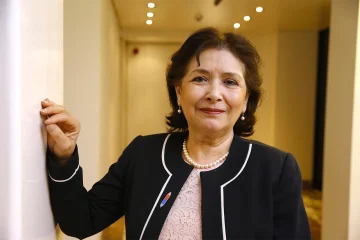
FOR eleven years, Diezani Alison-Madueke lived as a woman accused – her name a byword in two countries for the worst excesses of oil-fed power, her image fixed in the global imagination somewhere between “Oil Queen” and prime exhibit in the case against Nigeria’s plundered petroleum patrimony. This week, a London jury took that image apart, verdict by verdict, count by count, until nothing of the prosecution’s case remained standing.
Six charges. Six not-guilty verdicts. Forty-six hours of deliberation to undo eleven years of accusation.
| 11 YEARS OF INVESTIGATION | 46+ HOURS OF DELIBERATION | 6 CHARGES, ALL DISMISSED |
It is one of the most consequential corruption-trial collapses involving an African public official in recent memory – not because it ends the story of Nigeria’s oil-era reckoning, but because of what it exposes about the gulf between allegation and proof, between political narrative and evidentiary fact, when the world’s most resourced anti-corruption machinery goes looking for something it ultimately could not find.
Sitting at Southwark Crown Court, the jury cleared the 65-year-old former Minister of Petroleum Resources of five counts of accepting bribes and one count of conspiracy to commit bribery. Her brother, Doye Agama, a clergyman accused of conspiring with her over payments allegedly channelled to his church, walked free alongside her. So did oil executive Olatimbo Ayinde, acquitted of bribing the former Nigerian National Petroleum Corporation boss Emmanuel Ibe Kachikwu and of bribing Alison-Madueke herself.
The prosecution’s case, brought by the UK’s National Crime Agency, had alleged she was given what amounted to a life of luxury in London – funded, prosecutors said, by oil and gas figures angling for access to Nigeria’s lucrative contracts. Yet British prosecutors never actually alleged that Alison-Madueke steered contracts to anyone undeserving of them. The Crown’s case rested on a narrower and, it turned out, unsustainable claim: that it was merely “improper” for a minister of her rank to accept the benefits in question – not that those benefits bought outcomes. The jury was not persuaded. On all six counts, twice over for some defendants, it said no.
It is a verdict that lands with particular force, given who brought the case and how long they took to bring it. The first scrutiny of Alison-Madueke’s conduct reaches back to her arrest in London in 2015. The NCA did not authorise charges until 2023. The trial itself, beginning in January 2026, ran for roughly five months before a jury that needed the better part of two full working weeks to reach its conclusion – a deliberation long enough, and a case complex enough, that it nearly collapsed entirely before verdicts were even reached, after defence arguments about disclosure failures and missing documents threatened to derail proceedings.
HER WORDS
Outside the glare of Southwark’s cameras, in a video statement that has now travelled across the continent, Alison-Madueke did not speak as a defendant relieved of a guilty verdict. She spoke as a believer rendering an account to her God.
“I’m just thankful to God. It’s been a very, very arduous and long, almost 11 years. It’s been traumatic for, not just for me, but for my family, for friends, for all those who have stayed and supported, for my 93-year-old mother in Port Harcourt, for my son, and for all those who love us, friends and family.”
She did not flinch from naming the cost.
“Look, we’re surrounded by friends here. So it has been a hard journey, but I tell you this, God will always do as God wills, and God will be God. God is not a man that he should lie.”
There was no triumphalism in it, no settling of scores with her accusers — only the language of vindication delivered, in her telling, on a timetable not her own.
“So when he promises you something, he will see it through. It has been almost 11 years I’ve been here. I did my job to the best of my ability, but like I said, God is not a man that he should lie. God is God, and we thank him.”
She returned to the same themes, almost verbatim, in a separate reflection on the toll the case had exacted — on a mother in her nineties, on a son who grew into adulthood under the cloud of his mother’s prosecution, on friendships tested by a decade of suspicion.
“I did my job to the best of my ability. I am just thankful to God. It’s been a very, very arduous and long, almost 11-year journey. It has been traumatic, not just for me, but for my family, my friends, and all those who have stayed and supported me. For my 93-year-old mother in Port Harcourt, for my son, and for all those who love us, it has been a hard journey. But I tell you this: God will always do as God wills, and God will be God.”
Her legal team struck a sharper, more adversarial note than their client did. A statement issued on her behalf described eleven years in which she had “unnecessarily endured the ordeal of being separated from her family,” and declared that she was “finally allowed to resume her private and public life with her reputation restored and enhanced.” Through her spokesperson, she went further still:
“For 11 long, gruelling years this case has hung over my head and has tormented me and my family. But today, the past decade of relentless and unjust vilification, condemnation and scrutiny has finally come to an end.”
THE WOMAN BEHIND THE TITLE
It is worth pausing on who, precisely, has just been acquitted. Diezani Alison-Madueke was no minor functionary swept up in an oil-sector dragnet. She was the first woman to hold Nigeria’s petroleum portfolio, serving from 2010 to 2015 under President Goodluck Jonathan in a ministry that, more than any other in Abuja, has long been regarded as the master switch of the Nigerian state’s fortunes. She went on to chair the Organization of the Petroleum Exporting Countries in 2014 and 2015 – the first woman in OPEC’s history to do so, a distinction that placed her, however briefly, among the handful of people on earth with genuine influence over the global price of crude.
It was a vertiginous height from which to fall, and fall she did, publicly and repeatedly, across a decade in which “Diezani” became shorthand in Nigerian political discourse for a particular species of oil-era excess. The US Department of Justice weighed in as early as 2017, alleging she had used her ministerial influence to steer valuable contracts toward executives who paid her for the privilege – allegations that fed civil forfeiture actions in the United States naming Nigerian businessmen Kolawole Akanni Aluko and Olajide Omokore as the alleged conduits of bribes laundered into luxury property. Successive scandals at the state oil company, the Nigerian National Petroleum Corporation, swirled around her tenure. By the time Jonathan’s government fell in 2015, she had already relocated to London, where she has lived ever since, and from where she fought, point by point, the case the Crown only now has lost.
Throughout, she maintained a defence that ran directly counter to the popular caricature: that she was “Madame Due Process,” a minister who held no real personal sway over how contracts were awarded, and that whatever spending the prosecution pointed to was either reimbursed by the Nigerian state for official business or covered from her own pocket. Former President Jonathan himself gave evidence in her defence, confirming he had personally approved her use of private jets on foreign trips – testimony that went directly to undercutting the prosecution’s “life of luxury” framing.