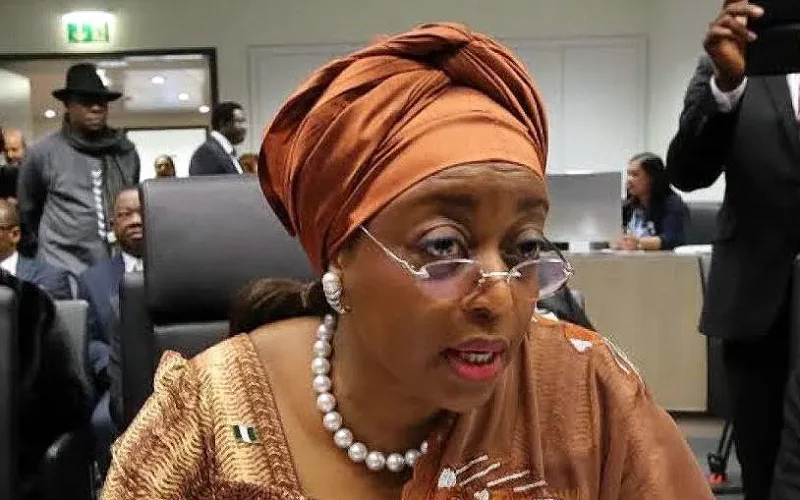
THERE was a time when Diezani Alison-Madueke’s voice moved oil markets. When she walked into an OPEC ministerial meeting, a woman in a sea of Arab princes and Gulf potentates, the world paid attention. Nigeria, a country that has produced so few female titans in its political economy, had in her something remarkable: a woman of exceptional ability, commanding presence, and enormous power, presiding over the engine room of the nation’s wealth.
That was then. On Monday, the 65-year-old former Petroleum Minister stood in the dock at Southwark Crown Court in London, charged with five counts of accepting bribes and one count of conspiracy to commit bribery. It was, by any measure, the most important day of her life in the decade since her world collapsed.
For the first time since her name became synonymous with Nigeria’s culture of elite impunity – since the mansions, the allegations, the 2015 EFCC dragnet, the British and American investigations, the years of living in legal exile – Diezani Alison-Madueke spoke directly, unfiltered, and on oath.
“I can state categorically that at no point did I ask for, take, or receive a bribe of any sort… and did not abuse my office.”
Diezani Alison-Madueke, Southwark Crown Court
THE WEIGHT OF THE CHARGES
The prosecution’s case is built on the language of excess. Prosecutors allege that Nigerian businessmen funded a lifestyle that reads less like official hospitality and more like the private treasury of a feudal lord: more than £2 million at Harrods; £4.6 million in property renovations across London and Buckinghamshire; a £2.8 million Marylebone townhouse; apartments overlooking Regent’s Park; Christmas stays in Gerrards Cross; rent-free tenancies in St John’s Wood.
The name that threads through these allegations is Kolawole Aluko, the Nigerian oil baron who himself fled Nigeria under clouds of asset-forfeiture proceedings. The prosecution’s portrait is one of a transactional relationship, where access to Nigeria’s oil wealth was the currency and luxury London living was the return.
The numbers are staggering in their specificity. In a country where millions survive on less than £2 a day, the court heard of a £100,000 cash delivery, allegedly made through a chauffeur, that Alison-Madueke says she knew nothing about. It is a detail that prosecutors clearly believe speaks for itself.
HER COUNTER-NARRATIVE
Yet Alison-Madueke’s defence is not a simple denial. It is a structural argument, and it is more sophisticated than her critics may have anticipated.
She told the court that the Nigerian National Petroleum Company, the NNPC, was hamstrung by financial inefficiencies so severe that official travel and logistics could not be managed through normal institutional channels. A London-based logistics service company, she explained, was established precisely to bridge that gap — to ensure that a minister representing Africa’s largest oil producer could function on the international stage without bureaucratic paralysis.
“They paid for all my hotels, chauffeurs… to allow me to perform the job that I did,” she said. The implication is clear: what the prosecution frames as bribery, she frames as operational necessity, ultimately reimbursed by the state.
For every year she spent in a luxury London apartment, her country lost billions to oil theft, pipeline vandalism, and the very corruption she is now charged with enabling.
Whether that argument lands with the jury is another matter. The distinction between a businessman paying a minister’s bills and the state later reimbursing them is fine to the point of invisibility in a system with no paper trail, no transparent procurement, and no independent oversight. Nigeria’s institutional dysfunction, she is effectively arguing, made corruption structurally indistinguishable from governance.
THE ARC OF AN EXTRAORDINARY LIFE
The tragedy of Diezani Alison-Madueke, if that is what this is, is inseparable from the arc of her rise. She broke through the glass ceiling of Shell Nigeria, becoming the first female senior executive in its history. She railed from the witness box against the company’s handling of the Niger Delta oil spills that have poisoned communities for generations, and defended her father, a former Shell employee who sued the company.
She spoke of the death threats, the kidnapping of family members, the relentless reality of being a powerful woman in what she herself described as “a very patriarchal society.” In 2015, she made history as the first woman to preside over OPEC. For a continent that has produced so few female leaders of global consequence, that achievement still resonates.
And yet, for every year she spent in a luxury London apartment, her country lost billions to oil theft, pipeline vandalism, and the very corruption she is now charged with enabling. Under her watch as petroleum minister from 2010 to 2015, Nigeria was haemorrhaging crude. The paradox of a reformist rhetoric married to a lifestyle of extraordinary luxury is precisely what the prosecution wants the jury to hold in mind.
A DECADE OF EVASION ENDS
The charges against Alison-Madueke have been a decade in the making. She was arrested in London in October 2015, shortly after Nigeria’s new government under President Muhammadu Buhari launched its anti-corruption offensive. She was released on bail and has remained in the United Kingdom since, a liminal figure — neither convicted nor cleared, her passport effectively her prison.
The British and American authorities have circled her for years. In the United States, she featured in an asset forfeiture case tied to Aluko and another oil magnate, Jide Omokore, with luxury properties in New York and Los Angeles connected to Nigerian oil contracts worth hundreds of millions of dollars. None of that has produced a conviction. Until now, no court anywhere in the world had ever heard Diezani Alison-Madueke’s own voice in her own defence.
Monday changed that. And in changing it, it also changed the nature of the case. This is no longer a story told only by prosecutors, investigators, and the fugitive memory of a government she served. It is now a contested narrative, with a human being at its centre asserting, under oath and under the formidable pressure of cross-examination, that she is innocent.
This is no longer a story told only by prosecutors. It is now a contested narrative, with a human being at its centre asserting, under oath, that she is innocent.
WHAT IS AT STAKE
The stakes of this trial extend far beyond Alison-Madueke herself. For Nigeria, it is a test of whether accountability can follow power across borders and across decades. For Britain, it is a test of whether its courts can process the systemic corruption that its financial sector and luxury real estate market have, for too long, passively facilitated. For Africa, it is a study in the impossible position of powerful women who must navigate institutions built by men who set the rules of the corruption game long before they arrived.
Alison-Madueke’s co-accused, oil industry executive Olatimbo Ayinde, 54, also denies one count of bribery and one count of bribing a foreign public official. The trial continues.
What Diezani Alison-Madueke said on Monday was that she has nothing to hide. What the prosecution says is that the evidence tells a different story. The jury, when it finally deliberates, will not just be judging a woman. It will be judging an entire system of power — and deciding whether the woman at its summit was its architect, its beneficiary, or merely, as she insists, its reluctant instrument.